
Solid Carbide Flat Drill 9610 AQDEXZ | 180° Flat-Bottom Edge — No Walking on Slanted / Cross Holes
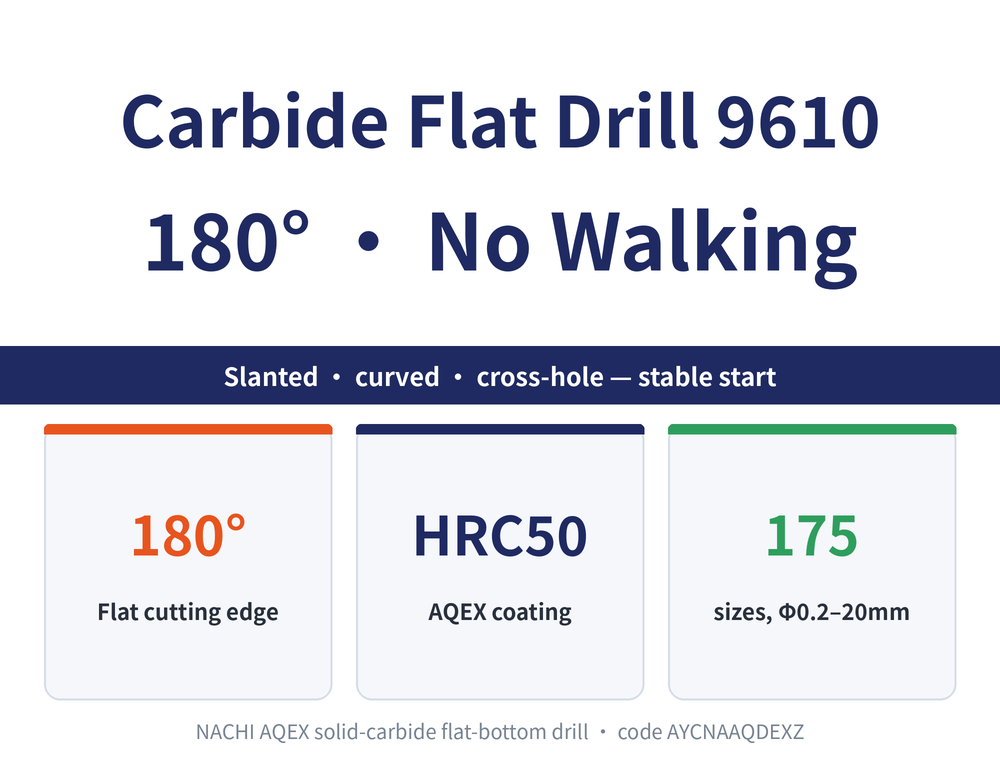
Drilling into a slanted, curved or cross hole, a conventional 140° pointed drill tends to walk and drift the moment it touches down — the hole moves off position, the edge takes a one-sided load and can even chip. The Solid Carbide Flat Drill 9610 AQDEXZ (NACHI AQEX flat-bottom drill) uses a 180° flat cutting edge so the whole face engages at once and the drill locates the moment it starts — solving this old problem at the root. With the AQEX high-heat coating, it machines up to HRC50 across carbon/alloy steel, stainless and cast iron; Φ0.2–20mm, depth ratio 3–5D, in 175 sizes.
Why use a flat edge on slanted / cross holes?
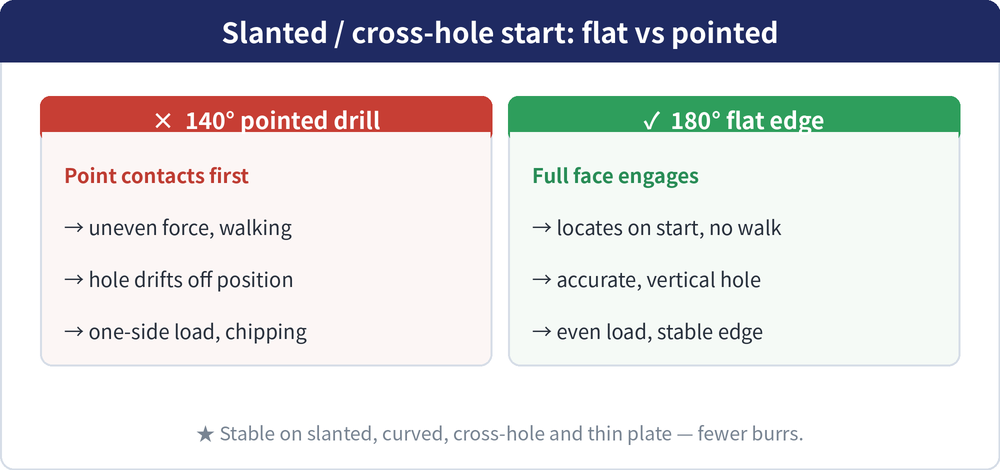
It comes down to the first cut. A pointed drill touches with a single point and slides toward the low side on a slope; a flat edge engages the entire face at once, so it stands firm from the start.
Benefits at a glance
- 180° flat edge: starts without walking or drifting on slanted, curved and cross holes — high position accuracy and a flat hole bottom.
- AQEX coating + carbide: wear-, heat- and stick-resistant, machining up to HRC50; stays lubricated even without through-coolant.
- One tool, many jobs: flat drilling, counterboring and spot-facing; the 20° helix balances rigidity with flat-edge strength for fewer burrs on thin plate.
Specifications
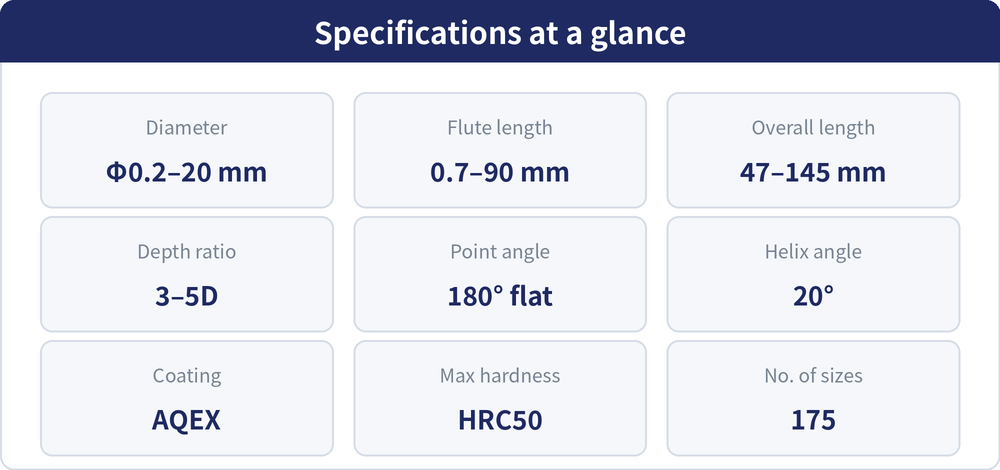
| Item | Specification |
|---|---|
| Brand | NACHI · AQEX series |
| Product code | AYCNAAQDEXZ (9610 AQDEXZ) |
| Tool material | Solid carbide (tungsten carbide) |
| Point angle | 180° (flat cutting edge) |
| Helix angle | 20° |
| Coating | AQEX (high heat & hardness) |
| Diameter / shank tolerance | h7 / h6 |
| Diameter range | Φ0.2 – 20 mm |
| Flute / overall length | 0.7 – 90 mm / 47 – 145 mm |
| Depth ratio | 3 – 5D |
| No. of sizes | 175 total |
| Max workpiece hardness | HRC50 |
Manufacturer spec drawing & dimensions
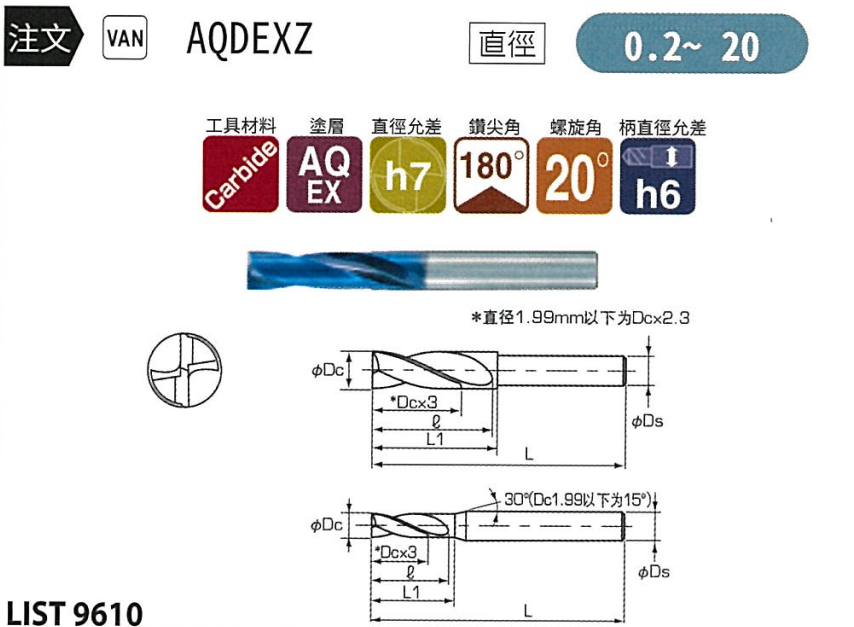
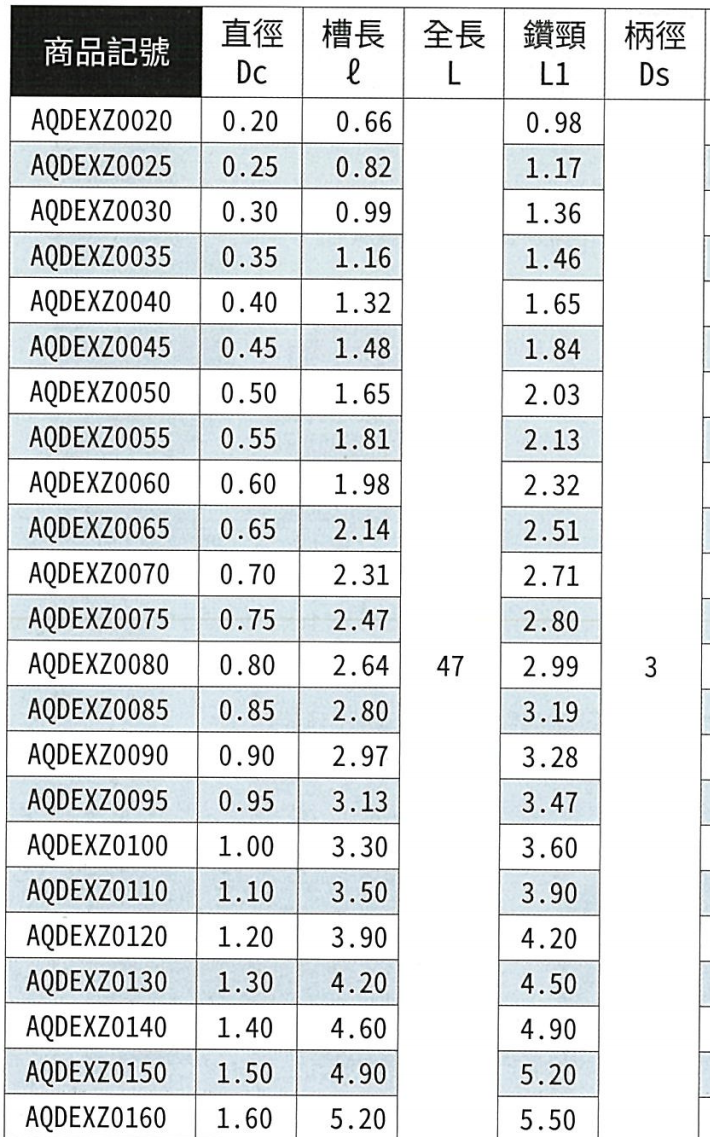
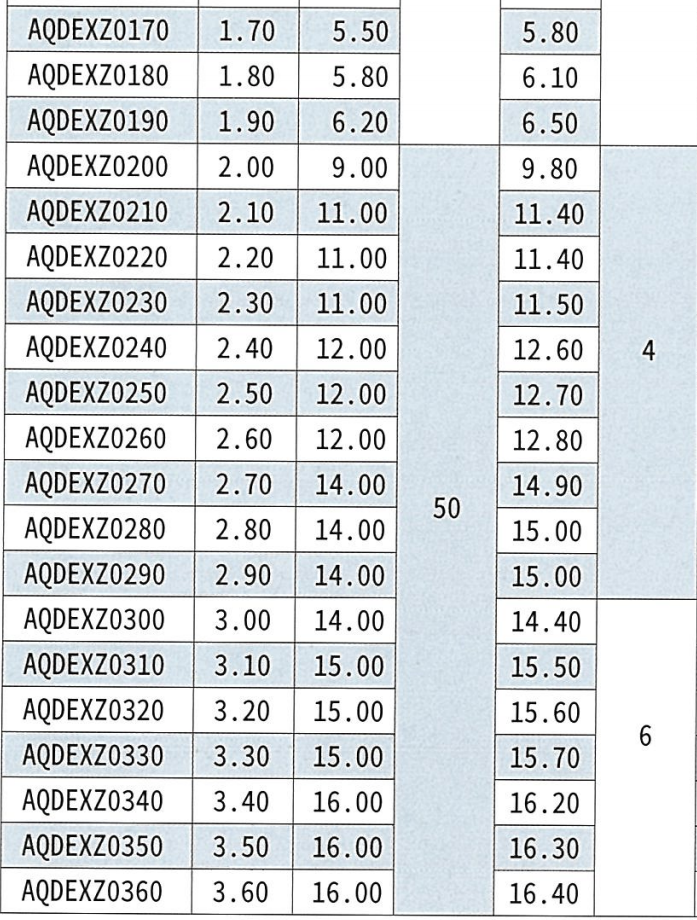
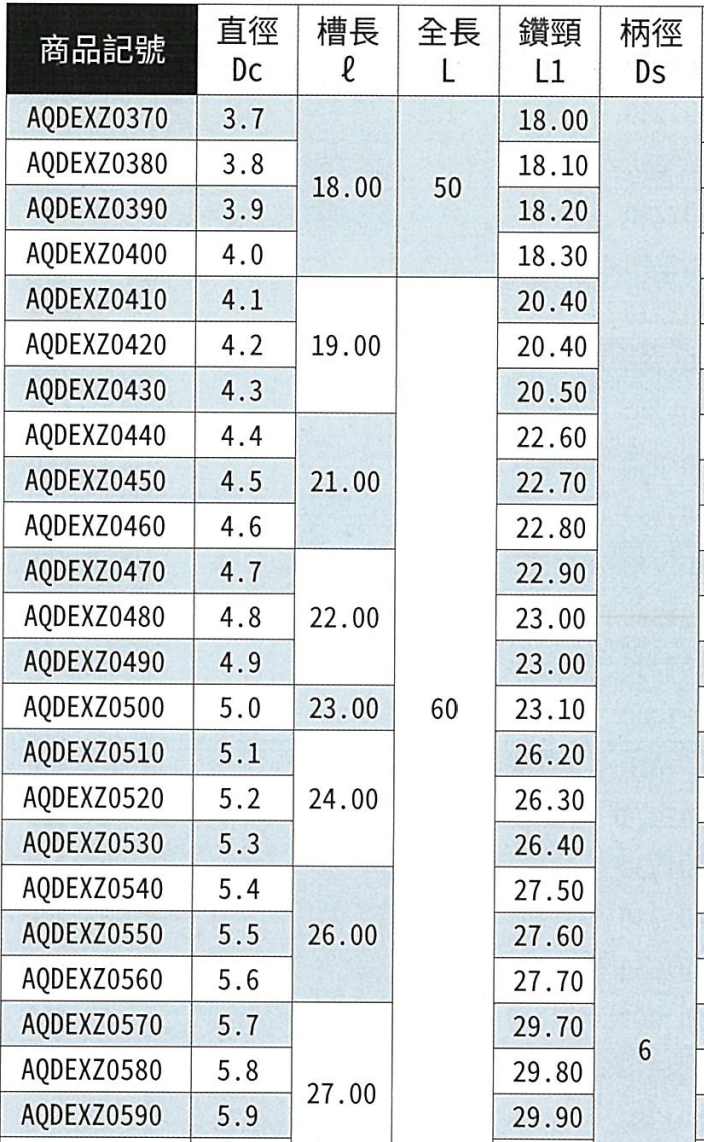
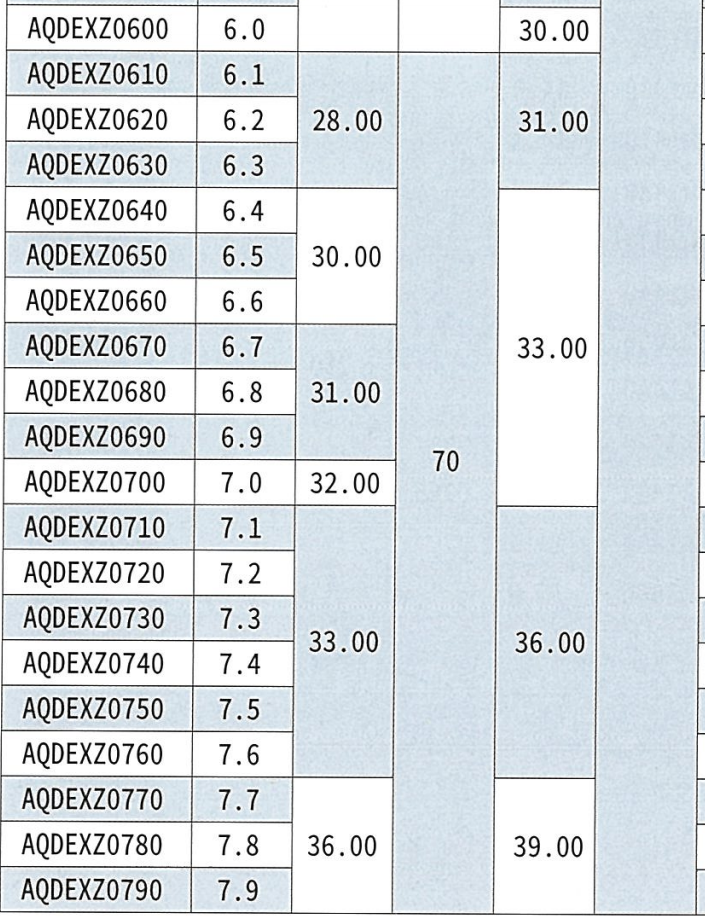
Detailed size tables (manufacturer)
The tables below list the manufacturer dimensions per size (product code / diameter Dc / flute length / overall length L / drill neck L1 / shank Ds). 175 sizes are available to order — please choose from the "Specification" selector above or request a quote for sizing help.
Features (your pain point, and how this drill solves it)
| Common pain point | How this drill solves it |
|---|---|
| Walking, drift and breakage when starting on slanted / curved / cross holes | The 180° flat cutting edge loads the whole face at once — locates on start, no walking |
| Stainless work-hardening, sticking and rough hole walls | Carbide + AQEX coating resists sticking and heat for clean walls (up to HRC50) |
| Needing a separate tool for flat / counterbored holes | One tool flat-drills, counterbores and spot-faces — fewer tool changes |
| Burrs and distortion when drilling thin plate | The 20° helix balances rigidity and flat-edge strength to cut burrs and distortion |
| No through-coolant, insufficient lubrication | The AQEX coating keeps lubricity even without internal coolant for stable drilling |
Manufacturer highlights: completes slanted seats and tap pilot-hole bottoms with a single drill; a double margin design gives stable cutting and higher hole accuracy; a versatile flat-bottom drill; the AQUA EX coating offers excellent heat and wear resistance for long life.
Workpiece materials & selection
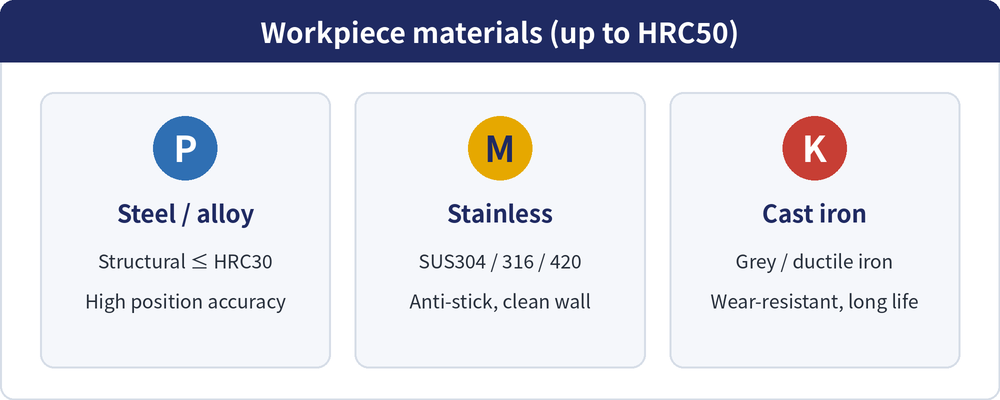
| ISO group | Representative material | Performance |
|---|---|---|
| P Steel | Structural & alloy steel (below HRC30) | High position accuracy; good location on slanted / cross holes |
| M Stainless | SUS304 / 316 / 420 | Good anti-stick and clean walls; handles work-hardening |
| K Cast iron | Grey iron, ductile iron | Wear-resistant against powdery chips for long tool life |
Manufacturer material applicability chart
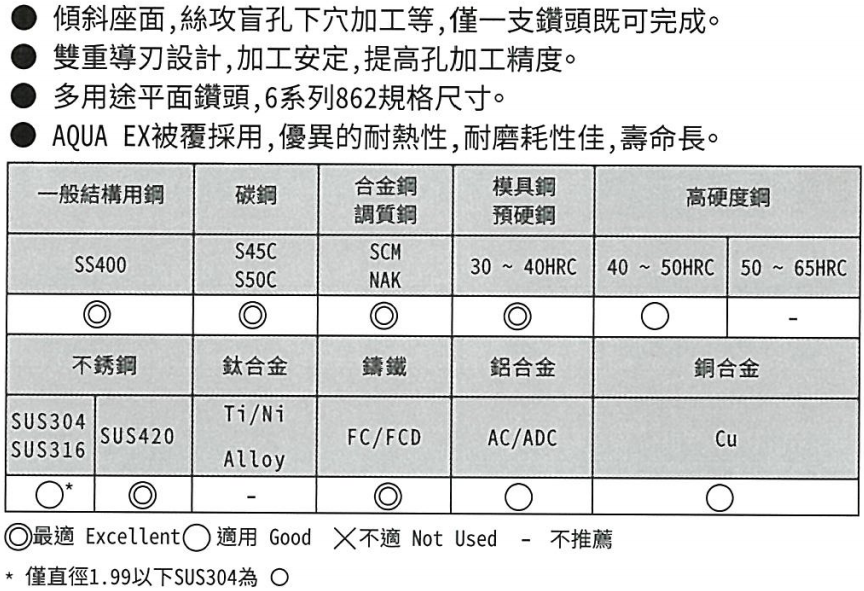
| Material | Representative grade | Suitability |
|---|---|---|
| Structural steel | SS400 | ◎ Excellent |
| Carbon steel | S45C / S50C | ◎ Excellent |
| Alloy / pre-tempered steel | SCM / NAK | ◎ Excellent |
| Mold / pre-hardened steel | 30–40 HRC | ◎ Excellent |
| Hardened steel | 40–50 HRC | ○ Good |
| Hardened steel | 50–65 HRC | – Not recommended |
| Stainless | SUS304 / 316 | ○ Good (good below Φ1.99) |
| Stainless | SUS420 | ◎ Excellent |
| Titanium | Ti / Ni Alloy | ✕ Not used |
| Cast iron | FC / FCD | ◎ Excellent |
| Aluminum | AC / ADC | ○ Good |
| Copper | Cu | ○ Good |
※ For material grouping and tool-selection logic, see “ISO Workpiece Material Classification”.
Applications
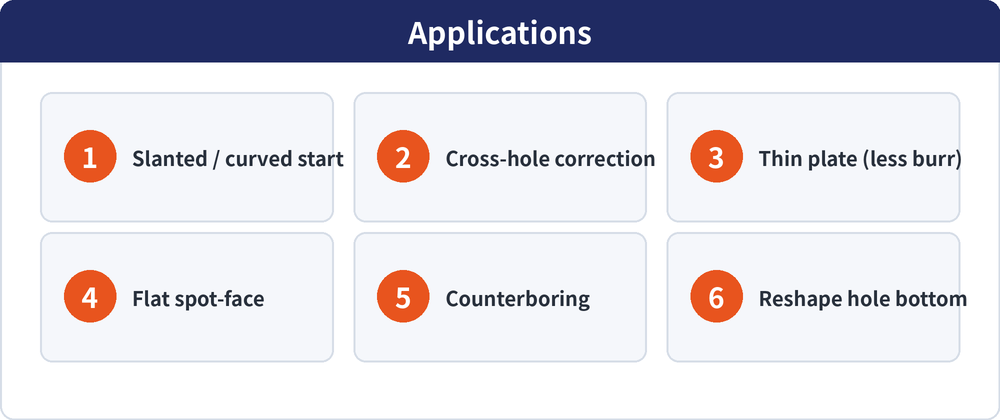
- Slanted and curved surface drilling
- Cross-hole machining and hole-position correction
- Thin-plate drilling (fewer exit burrs)
- Flat drilling, counterboring and spot-facing
- Slanted seats and tap pilot-hole bottoms in a single tool
- Operations that need to reshape the hole bottom
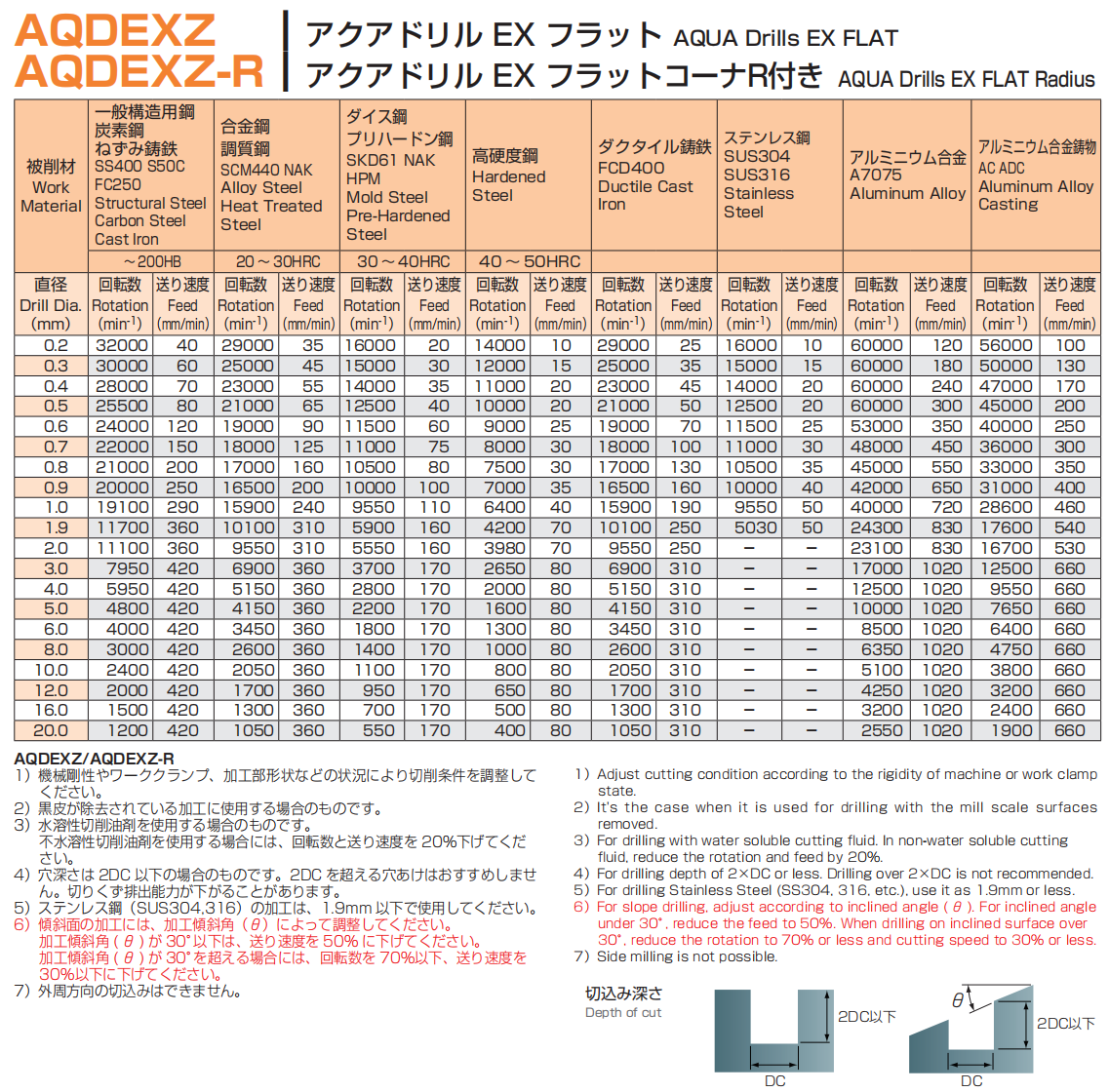
Recommended cutting conditions (manufacturer)
The chart below is NACHI’s recommended cutting conditions for AQDEXZ / AQDEXZ-R, listing spindle speed (min-1) and feed (mm/min) by workpiece material (structural / carbon steel & grey cast iron, alloy / heat-treated steel, mold / pre-hardened steel, hardened steel, ductile cast iron) and drill diameter. These are manufacturer reference values — adjust for machine rigidity, clamping, coolant and hole depth; for the calculation logic see “End Mill Cutting-Conditions Calculation Guide”.
Q: How is a flat drill (flat-bottom drill) different from a regular twist drill?
A: A regular twist drill is a ~140° pointed drill where the tip touches first; a flat drill has a 180° flat edge that engages the whole face at once. The flat drill produces a flat-bottom hole and is far less likely to walk on slanted, curved and cross holes, giving higher position accuracy.
Q: Why use a flat drill on a slanted surface or cross hole?
A: On a slope, curve or existing hole, a pointed drill is loaded unevenly and walks, drifts or even chips. The 180° flat edge loads the edge evenly and locates on start, which is exactly why it suits slanted starts and cross-hole correction.
Q: How hard a material can the 9610 AQDEXZ machine?
A: Up to HRC50, covering carbon/alloy steel (structural steel below HRC30), stainless SUS304/316/420 and cast iron. The carbide substrate plus AQEX coating balances wear resistance, heat resistance and anti-stick performance.
Q: Can a flat drill make counterbores or spot-faces?
A: Yes. Beyond drilling, the 180° flat edge can also counterbore and spot-face — one tool for several jobs, with fewer tool changes.
Q: What sizes are available?
A: Diameter Φ0.2–20mm, flute 0.7–90mm, overall length 47–145mm, depth ratio 3–5D, in 175 sizes total. See the manufacturer size tables above, then choose from the size menu or request a quote for sizing help.
Related technical articles
To understand the principle and selection of flat drills, read more:
- Flat Drill vs Twist Drill vs End Mill: Differences & Selection — how the three tools differ and which holes each suits.
- Complete Flat Drill Guide: Structure, Angle & Selection — the principle of the 180° flat edge and key selection points.
- Flat Drill Applications: Slanted, Cross and Counterbored Holes — common machining scenarios and practical methods.
Questions on sizing or pricing? Send an enquiry from the page, or contact us via the service phone / official LINE in the footer — we will help you pick the right size for your hole diameter, material and depth ratio.