Flat Drill Applications: Pilot, Deep Holes, Inclined Surfaces & Tap Drilling
Flat drills integrate pilot, counterbore and deep-hole machining into a single process, greatly simplifying the workflow and raising efficiency. Taking AQUA EX as an example, a rigid body and special edge geometry allow drilling directly on inclined surfaces without pre-machining, reducing hole oversize and tool wear; measured roundness and tool life clearly beat conventional tools, suiting high-precision, high-efficiency CNC work. For principles and selection, see Flat Drill Machining Guide.
Multi-Purpose Applications
One flat drill integrates several operations, cutting tool changes and raising overall efficiency.
| Application | Note |
|---|---|
| Pilot hole | No separate pilot needed; positions and engages directly |
| Counterbore | Flat-bottom counterbore in one pass |
| Deep hole | Integrates pilot and deep hole in one process |
| Inclined-surface drilling | Engages directly on inclines without slipping |
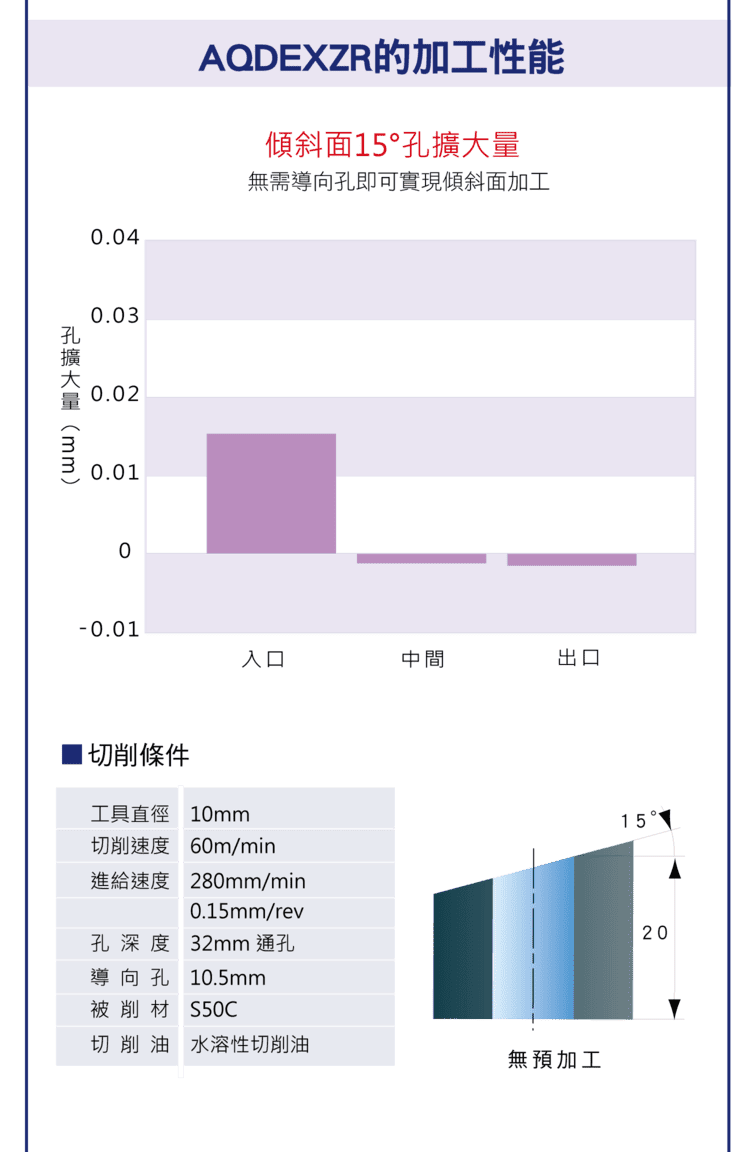
Pilot, Deep-Hole and Tap-Drill Integration
Flat drills remove conventional pre-machining steps and add benefits for tap-drill holes.
| Item | Conventional | Flat drill |
|---|---|---|
| Pilot + deep hole | Pilot first, then deep-hole drilling | Direct pilot + drilling, no extra pre-machining |
| Tap-drill hole (with tap) | Deeper hole, shorter effective thread | Lower hole depth, longer effective thread |
| Effect | More steps, higher time cost | Simpler flow, better thread strength and efficiency |
For the overall drill-and-tap workflow, see Drill and Tap Process Guide.
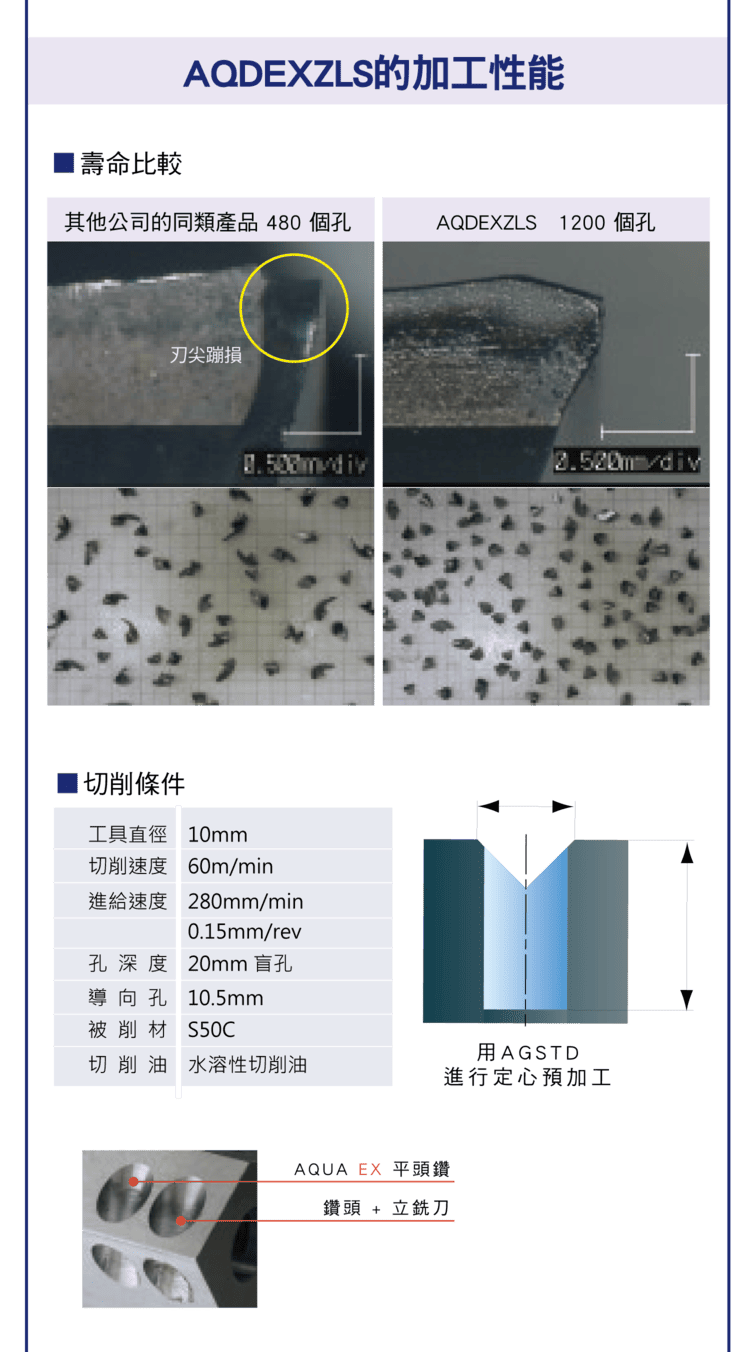
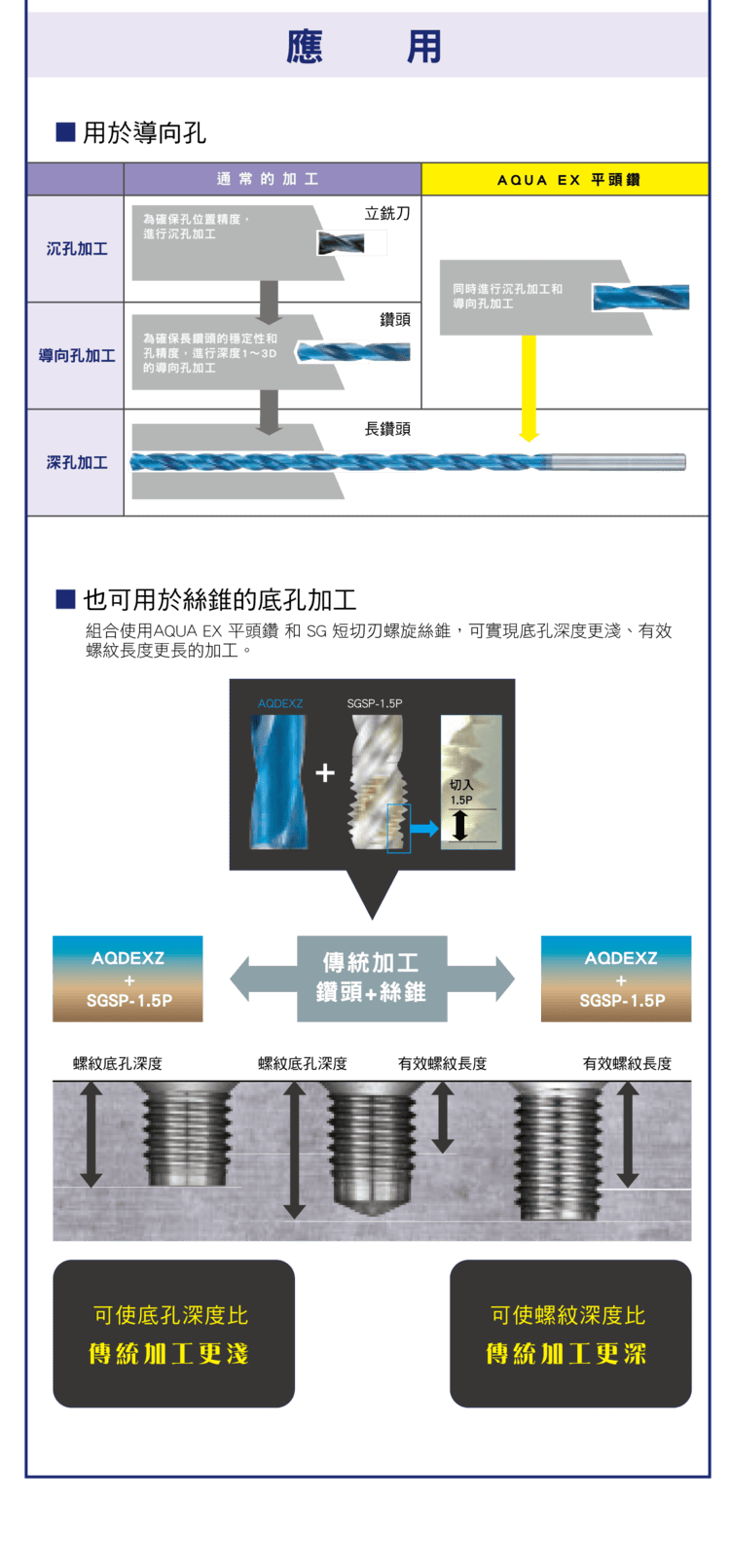
Inclined-Surface Capability & Hole Accuracy
| Aspect | Conventional | Flat drill (AQUA EX example) |
|---|---|---|
| Inclined-surface drilling | Needs pilot; prone to deflection and vibration | Direct on inclines, no pre-machining, better accuracy |
| Hole oversize | Noticeable enlargement | Minimal oversize |
| Diameter consistency | Entry/middle/exit differ | Stable, consistent entry/middle/exit |
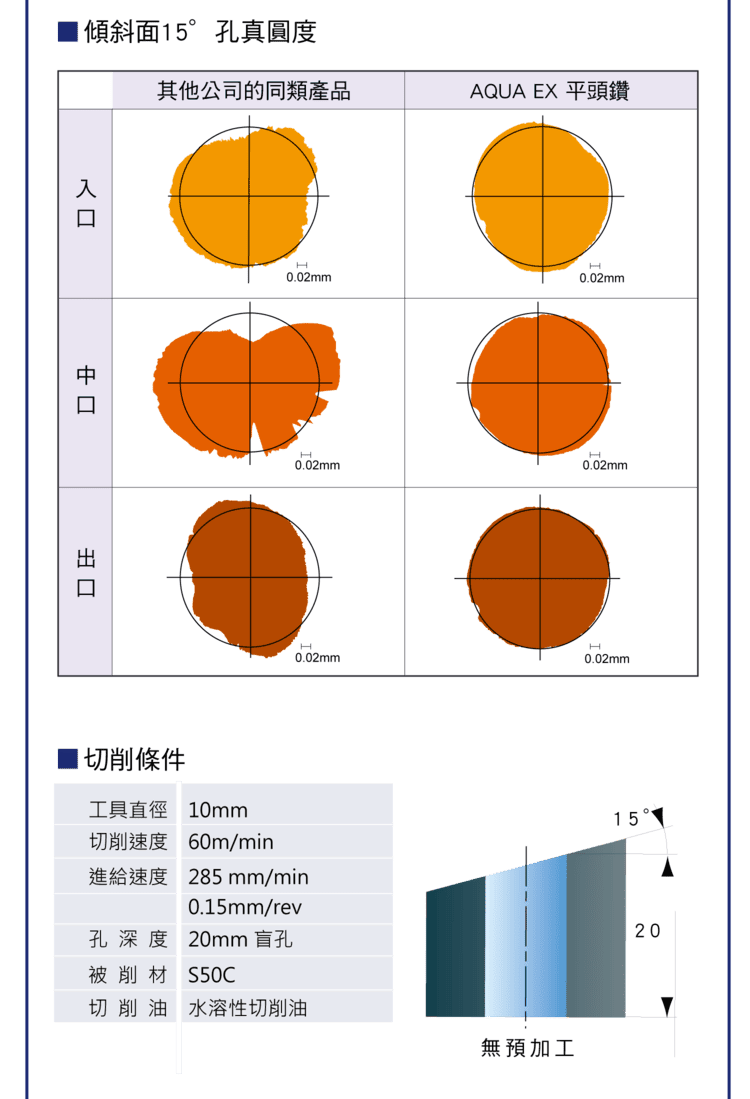
Tool Life & Recommended Cutting Conditions
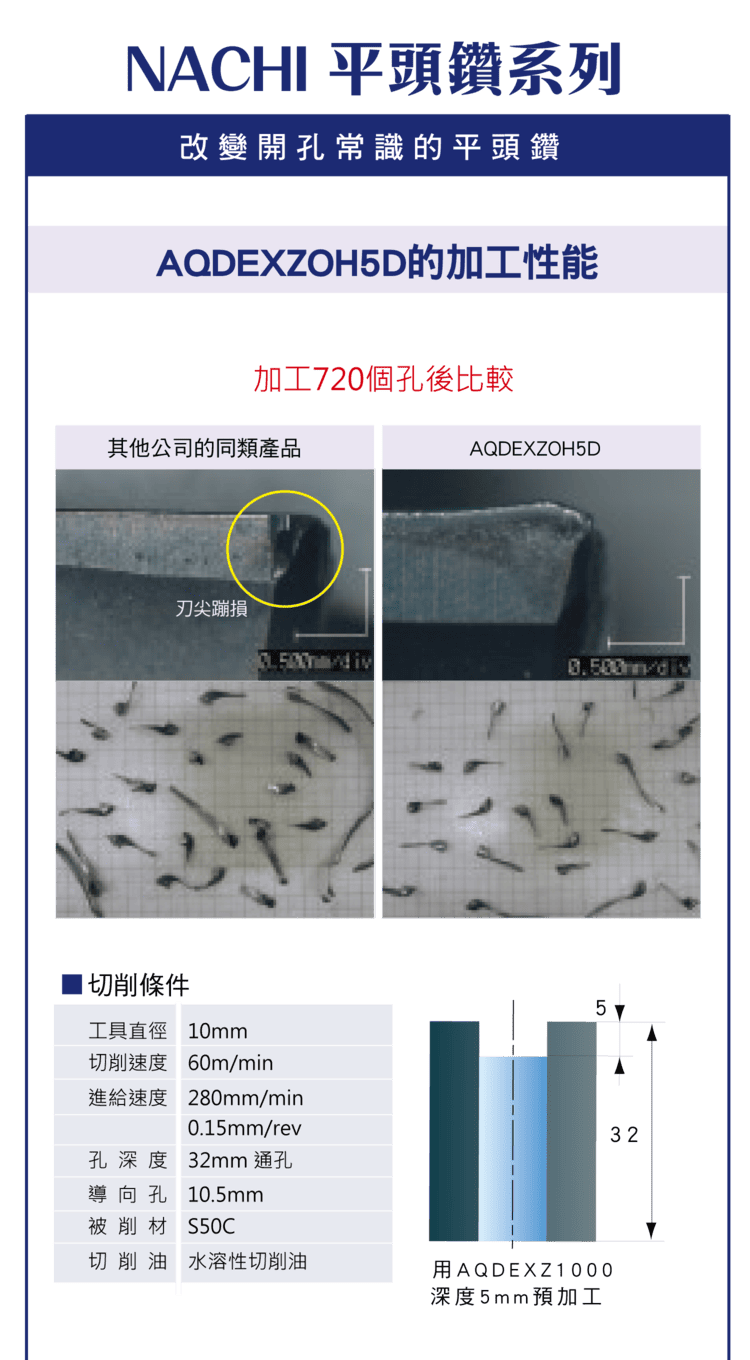
Maker tests show longer life thanks to wear-resistant coating and optimized edge geometry.
| Item | General tool | Flat drill (AQUA EX example) |
|---|---|---|
| Tool life | ~480 holes | ~1200 holes (about 2× or more) |
Example maker conditions; set actual parameters by machine, diameter and material.
| Item | Example |
|---|---|
| Tool diameter | ~10 mm |
| Cutting speed vc | ~60 m/min |
| Feed rate vf | ~280 mm/min |
| Feed per rev fn | ~0.15 mm/rev |
| Material | S50C |
| Depth | ~20–32 mm |
For parameter calculation, see Drilling Parameters Guide.
Quality, Stability & Selection Advice
Flat drills keep high roundness with minimal dimensional deviation even on inclined surfaces, with smooth chip evacuation, stable cutting force and low vibration—reducing rework.
| When to use | Recommended setup |
|---|---|
| High-precision holes | CNC machining center |
| Inclined-surface machining | High-rigidity equipment |
| Multi-process integration | Stable clamping and ample cooling |
For how the three hole-making tools differ, see Flat Drill vs Twist Drill vs End Mill.
※ The hole-count life (480/1200), oversize and cutting conditions are example maker data; actual results depend on machine, clamping, material and cooling.
FAQ
Can a flat drill skip the pilot hole?
Yes. Its stable edge allows direct pilot + drilling, and it engages inclined surfaces without pre-machining—simplifying the flow and cutting tool changes and time.
What's the benefit for tap-drill holes?
A flat drill leaves a near-flat bottom, lowering hole depth and increasing effective thread length—so thread strength and tapping efficiency both improve.
Why is hole accuracy more stable?
Stable engagement and minimal oversize give consistent entry, middle and exit diameters; even on inclined surfaces it keeps high roundness with minimal deviation.
Is tool life really longer?
Per maker test examples, a general tool lasts ~480 holes and a flat drill ~1200 holes—about 2× or more—mainly from wear-resistant coating and optimized edge geometry; actual life depends on conditions.
For the full reading guide on this topic, see Hole Accuracy: A Complete Reading Guide.
This article is part of Drill Bits: The Complete Guide - Start From Depth-to-Diameter, Then Pick the Drill and Set the Conditions; that guide shows how the whole topic fits together.