Barrel Finishing or Brushing: Choosing the Route for Bulk Deburring and Surface Finish
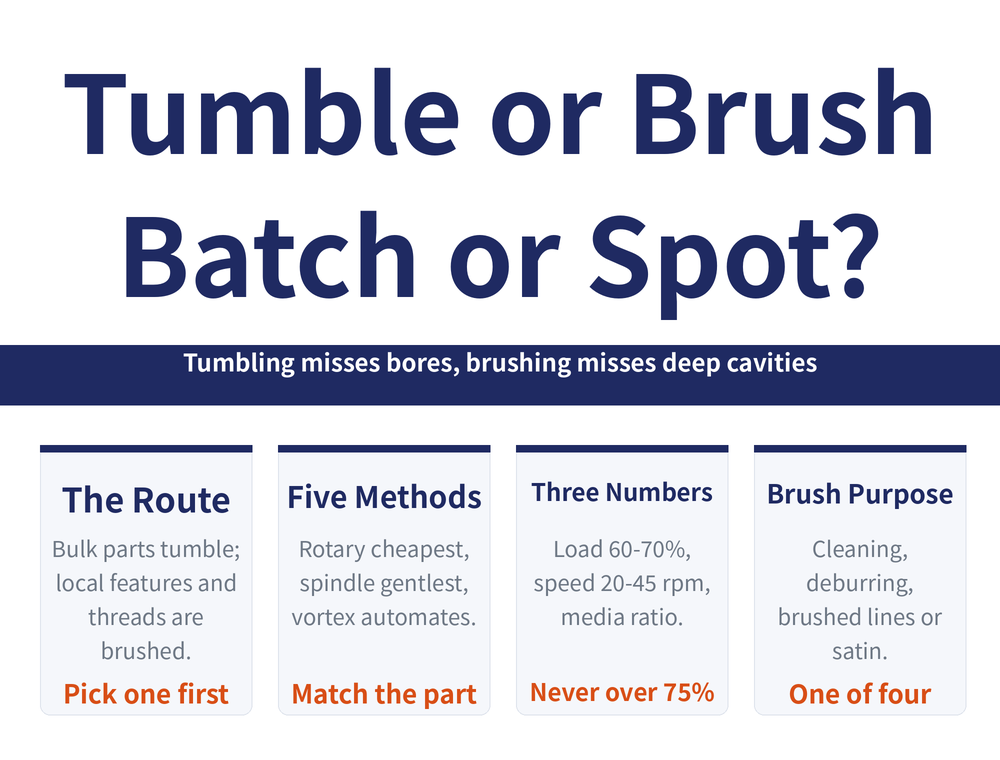
A batch of small parts needs deburring — do you tumble the whole lot, or brush them one at a time? Barrel finishing handles the batch but never reaches a bore; brushing can target a spot but cannot get into a deep cavity. This guide lays out the five tumbling methods, media, load factor and speed, plus the four purposes of brushing with wire types and wheel forms, so you pick the route before you pick the consumable.
1. Pick the route: tumble the batch or brush the spot
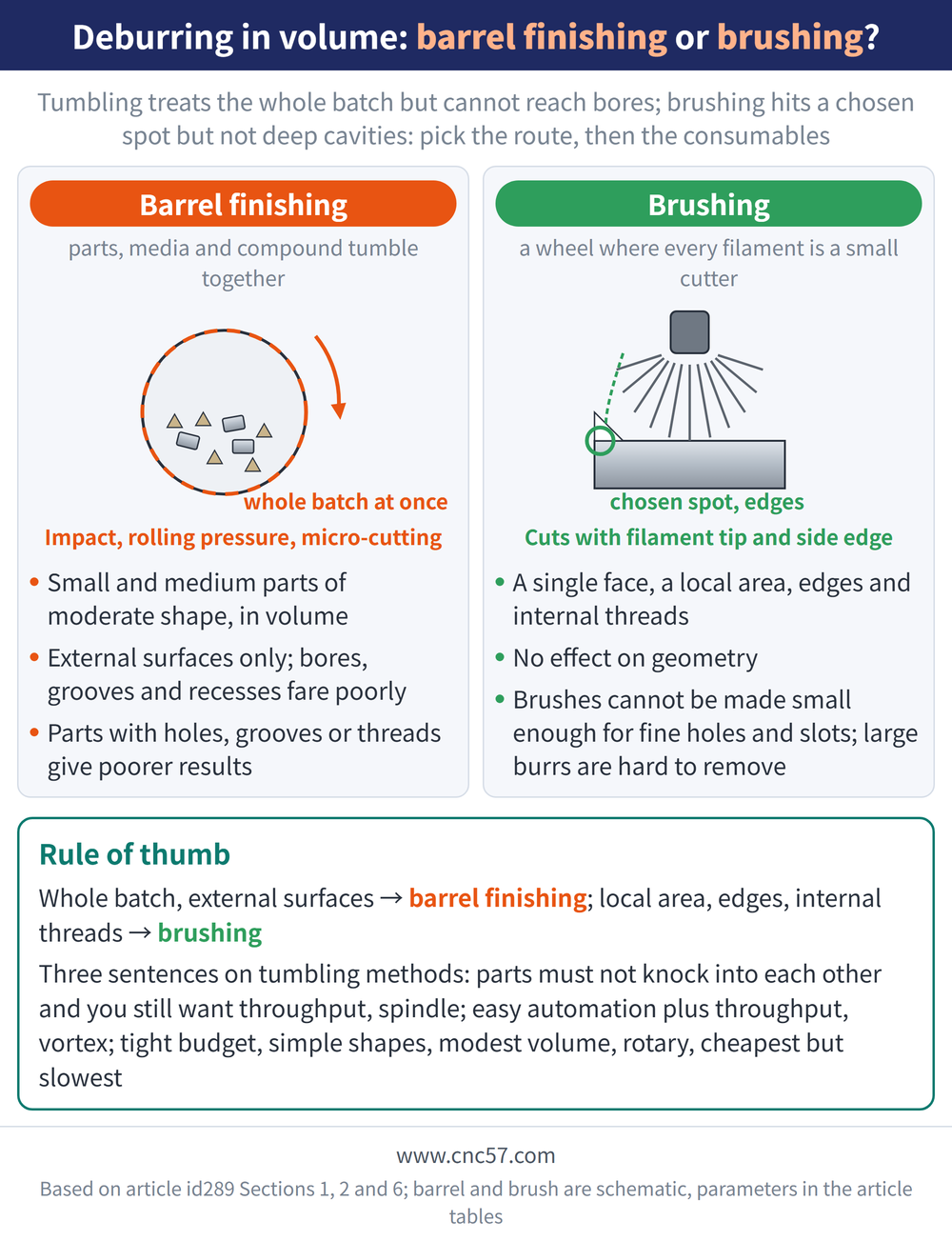
Barrel finishing puts parts, media and compound into a barrel together; the loose media works by impact, rolling pressure and micro-cutting to bring roughness down and take burrs off. Brushing uses a wheel of metal wire, animal bristle or synthetic fibre and cuts with the tip and side edge of each filament — every filament is a small cutting tool.
| Aspect | Barrel finishing | Brushing |
|---|---|---|
| Best suited to | Small and medium parts of moderate shape, in volume | A single face, a local area, edges and internal threads |
| What it cannot reach | External surfaces only; bores, grooves and recesses fare poorly | Brushes cannot be made small enough for fine holes and narrow slots |
| Effect on size | Can partly replace pre-plating grinding and buffing | No effect on geometry; size change only 0.5~1μm |
| Other limit | Parts with holes, grooves or threads give poorer results | Burrs larger than 300μm are hard to remove |
2. Choosing among five tumbling methods
| Method | Rate | Part damage | Automation | Applications |
|---|---|---|---|---|
| Rotary | Low | High | Average | Small irregular parts, lowest cost |
| Vibratory | Average | Low | Easy | Small and medium irregular parts |
| Centrifugal | High | Better | Harder | Small and medium irregular parts |
| Vortex | High | Better | Easy | Small and medium irregular parts, not thin plates |
| Spindle | High | None | Fairly easy | Small and medium parts, shafts, discs and irregular parts |
Three sentences to decide: parts must not knock into each other and you still want throughput, use spindle. You want easy automation plus throughput, use vortex. Budget is tight, shapes are simple, volume is modest, rotary is cheapest but also slowest. On surface brightness only rotary is rated poor; the other four are all rated good.
3. Choosing tumbling media
| Media class | Character and use |
|---|---|
| Natural | Emery is the common one; granite, marble and river sand break down and clog, rarely used |
| Sintered | Corundum and silicon carbide, stronger cutting than natural media, better finish |
| Preformed | Ceramic-fired or resin-bonded, made as balls, cubes, triangles, cones or cylinders |
| Steel | Hardened steel balls, nail heads, section steel pieces; strong and hard to fracture |
| Organic | Corn cob, walnut shell, peach stone, sawdust; mainly for the final dry polish and dry-off |
Three things drive the choice: media shape must suit the part so bores and grooves get worked too; metal parts take hard media while soft parts such as plastics take organic media mixed with hard media; a high finish requirement means rounder, smaller media, but not so small that it lodges in holes. For the grain itself see How to Choose an Abrasive Grain.
4. Load factor, speed and time
| Parameter | Recommended | Why |
|---|---|---|
| Load factor | 60%~70% of barrel volume (never above 75% or below 30%) | Too full and relative motion dies; too empty and impact turns the surface rough |
| Barrel speed | 20~45 r/min | Past a point centrifugal force pins parts to the wall and removal drops |
| Cycle time | Hours to days, confirm by trial | Steel stampings run about 2~8 hours, grey iron castings up to 50~80 hours |
The figures above are the typical ranges given in the source. Large barrels, heavy parts, thin plates and soft metals all call for lower speed. For the media-to-part volume ratio, the source adds one index each for material, shape, finish requirement, service requirement, plating type and unit weight. Worked example from the source: a loaded steel part of moderate complexity, scale removal plus edge break, decorative plating, 200g per piece, gives 13, so media volume is set at 13 times part volume.
5. Vibratory finishing: faster, with limits
Vibratory finishing is far more productive than plain rotary tumbling and suits larger parts. The open container lets you check quality at any time, inside and outside finish evenly, and the gentle impact leaves mechanical properties unchanged. Two limits: it does not suit precision or brittle parts, and it will not reach a very low surface roughness. Typical parameters are 15~50Hz frequency (20~30Hz in common use) and 2~10mm amplitude (3~6mm in common use), with media-to-part volume ratios of 2:1 to 6:1 — lower for roughing, higher for finishing.
6. Brushing starts with the purpose: one of four
| Purpose | Which brush | Key parameter |
|---|---|---|
| Removing scale, weld spatter, old paint | Stiff steel wire brush wheel | High speed, dry, above 2000 r/min |
| Removing general dirt and dust | Soft brass wire, bristle or fibre wheel | 1800~2000 r/min, wet or dry |
| Deburring | Outer edges take a short dense radial wheel; hole edges take a cup brush; internal threads take a small brush | About 33 m/s surface speed on outer faces, 22~33 m/s in holes |
| Brushed line finish (decorative) | Soft metals take brass or nickel-silver wire; hard metals take steel wire; aluminium nameplates take non-woven abrasive pad | Keep pressure low or the filament flanks contact and no line forms; speed at the lower end |
| Satin finish (matt diffuse) | Soft crimped wheel with fine soft wire, or bristle and fibre | Low speed, 15~25 m/s, light pressure |
7. Filament materials and brush forms
| Filament | How it is graded |
|---|---|
| Brass wire | Very fine for a fine satin, medium coarse for brushed lines, very coarse to clean pickled copper and iron |
| Nickel-silver wire | Used like brass wire but leaves the surface white; brass leaves a yellow residue |
| Steel wire | Very fine for satin and brushed lines, coarse to very coarse for cleaning and deburring |
| Stainless wire | Like steel wire but prevents discolouration and rust; costlier, wire diameter up to 0.3mm |
| Nylon with abrasive | Abrasive mixed into the nylon filament: silicon carbide, corundum, CBN or synthetic diamond |
Wire diameters generally run 0.1~0.88mm. By construction: a banded radial wheel is stiff and cuts hard, used on scale and weld spatter and should be dynamically balanced; a crimped radial wheel is soft, for satin and brushed lines; a short dense radial wheel is mainly for deburring; a cup brush suits hand-held power tools; a wide-face brush serves plate lines in steel mills and also needs balancing, with a strip wide-face brush where loading is unstable; small brushes handle internal forms. Brush speed generally runs 1200~2800 r/min, lower for large diameters and higher for hard part materials. For knotted versus crimped wire brushes see Wire Brush Selection Guide, and for material-specific deburring see Deburring and Finishing by Material.
8. Frequently Asked Questions (FAQ)
Q: Can barrel finishing remove burrs inside a bore?
No. Barrel finishing works external surfaces only, and bores, grooves and recesses fare poorly; parts with holes, grooves or threads all need another route. Hole edges take a cup brush and internal threads take a small brush.
Q: Does a fuller barrel mean faster work?
The opposite. Load factor should be 60%~70% of barrel volume and never above 75%. Too full and relative motion dies so nothing is cut; too empty and violent impact leaves the surface rougher. Speed behaves the same way: past a point removal falls.
Q: How large a burr can brushing take off?
Burrs above 300μm are hard to remove by brushing, and deep cavities or narrow slots cannot be reached. Its strengths are low cost and no special equipment, plus edge break, polishing and rust removal in one pass, with size change of only 0.5~1μm.
Q: Which filament suits stainless steel parts?
Stainless wire, which prevents discolouration and rust, with wire diameter up to 0.3mm; it costs more than plain steel wire. For soft metal parts that must stay white after brushing, use nickel-silver wire instead, because brass wire leaves a yellow residue.
This article is part of Deburring and Surface Finishing: The Complete Guide - Which Tool, Which Material, and What to Do in Volume; that guide shows how the whole topic fits together.
Published: 2026-08-17|Last updated: 2026-08-17