Buffing After Grinding: Choosing the Wheel, the Speed and the Compound
Grinding cuts material away; polishing presses the surface flat. They are consecutive operations, not the same job. This covers choosing between a buffing wheel and an abrasive belt, looking up surface speed and grit size, how the three polishing stages and three polishing set-ups divide the work, and the question that comes up most: which of the white, red and green compounds suits the customer's material.
1. Grinding and polishing are not the same job
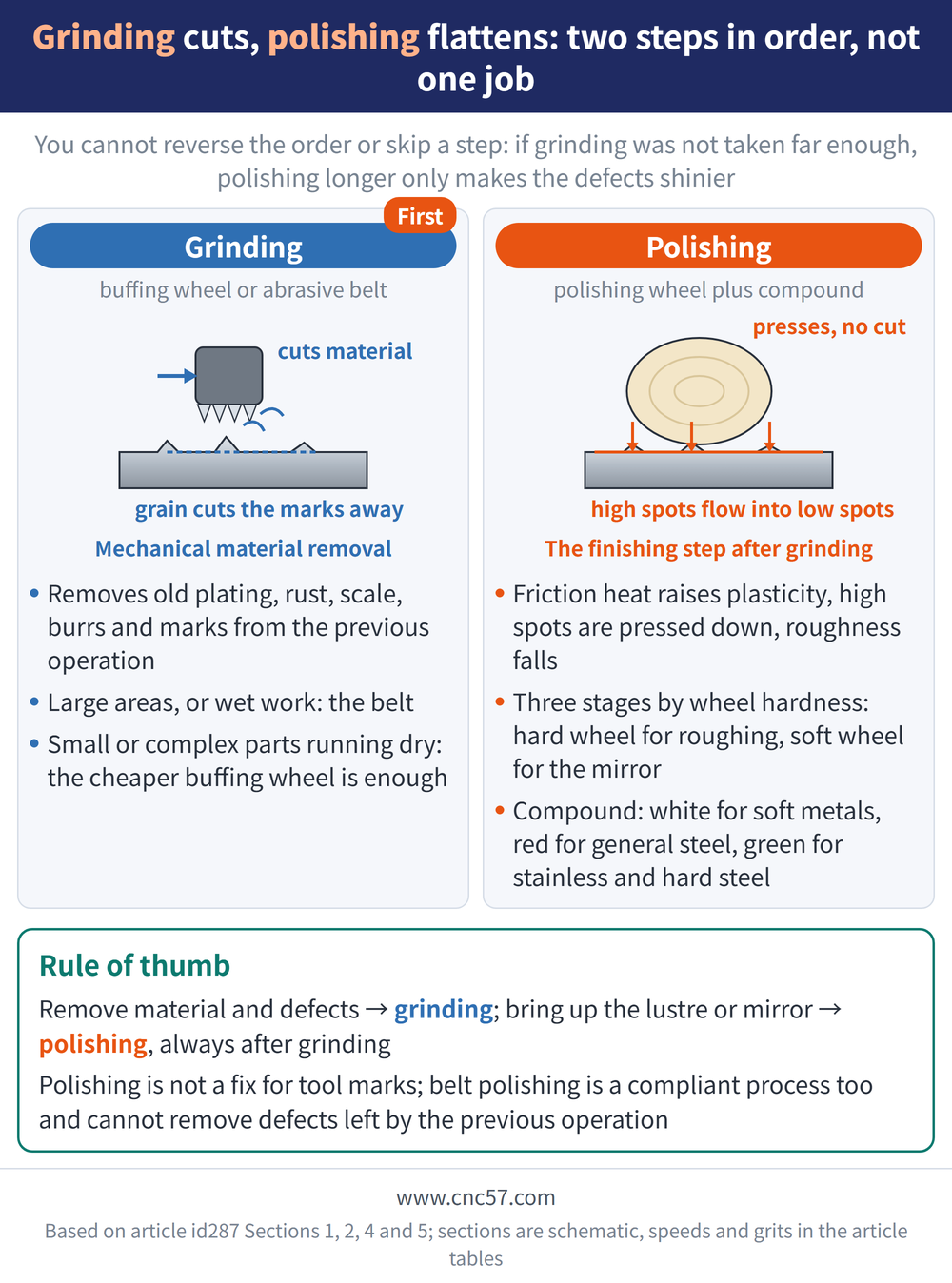
Grinding cuts with abrasive grains, removing old plating, rust, scale, burrs and marks from the previous operation. It is mechanical material removal. Polishing is the finishing step that follows: the wheel spins fast, friction against the base metal raises the temperature and its plasticity, and under polishing force the high spots are pressed down and flow into the low spots, so roughness falls. The compound's chemistry reacts with the metal at the same time and strengthens the effect. Most metal surfaces regrow a thin oxide film almost immediately after it is polished away, and it is that repeated cycle that produces a flat, bright surface.
You cannot reverse the order or skip a step. Polishing is not a fix for tool marks: it flattens the surface, it does not cut material away. If grinding was not taken far enough, polishing longer only makes the defects shinier.
2. Buffing wheel or abrasive belt
| Comparison | Buffing wheel | Abrasive belt |
|---|---|---|
| Construction | Discs of cotton cloth, special paper, felt, woollen yarn or leather around a leather core, pressed, glued or stitched | Backing (1–3 plies of fabric, paper or leather) plus bond (resin or hide glue) plus electrostatically deposited grain |
| Types | Soft wheel (soft body, complex shapes) or hard wheel (hard body, simple shapes) | By bond: resin (water and solvent resistant), hide glue (not water resistant; wood, non-ferrous metals, plastics), hide glue with a resin size coat (humidity resistant, not waterproof, best value) |
| Size range | 150–750mm outside diameter, 6–150mm thick | 1.2–2.5m long and above, 100–200mm wide (15–100mm for small parts) |
| Life and accuracy | Shorter | Larger grinding area and faster heat removal give longer life; accuracy to ±0.005mm, flatness 0.001mm, Ra 0.8–0.2μm |
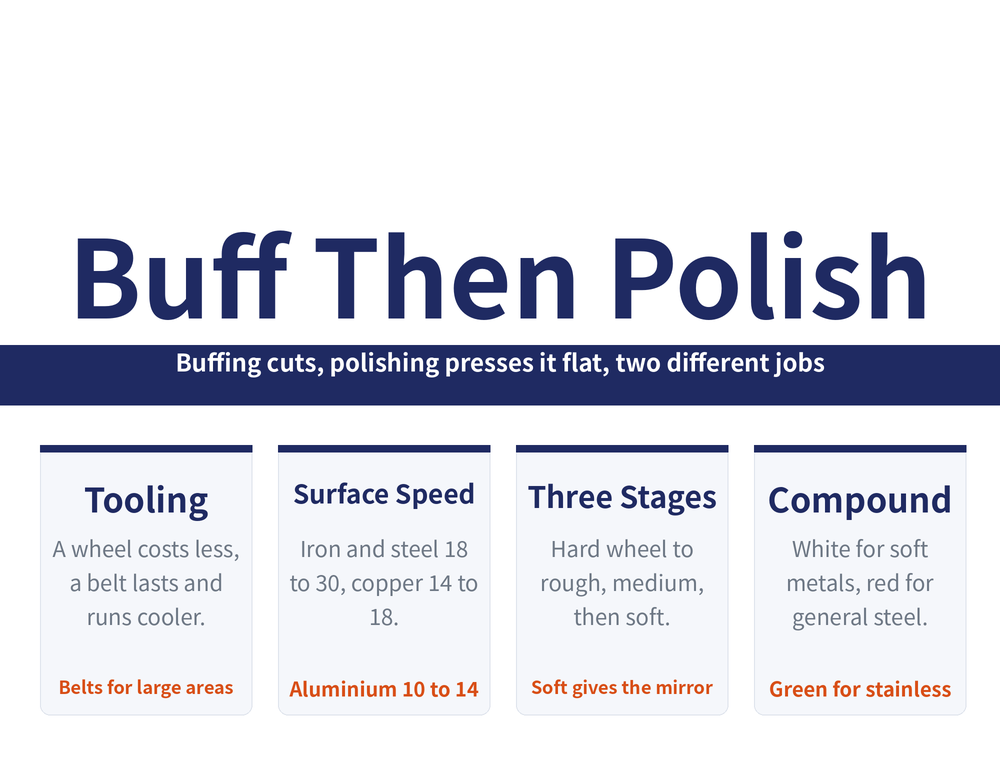
How to split them: large areas, or anything that has to run wet (resin bonded belts can), go to the belt; small or complex parts running dry are covered by a buffing wheel at lower cost.
3. Looking up surface speed and grit
Surface speed is v = πdn/60 (v in m/s, d the wheel diameter in m, n the speed in r/min), so a bigger wheel or a faster spindle both raise it. The rule of thumb: the harder the base metal and the tighter the finish, the higher the speed, though too high shortens wheel life; complex shapes and non-ferrous metals (copper, zinc, lead, aluminium) take lower speeds.
| Base material | Grinding speed | Polishing speed |
|---|---|---|
| Cast iron, nickel, chromium | 18–30 m/s (with steel) | 30–35 m/s |
| Steel | 18–30 m/s | 20–25 m/s for complex shapes; 30–35 m/s for simple ones |
| Copper alloys, silver, zinc | 14–18 m/s | 20–30 m/s for copper alloys and silver |
| Aluminium alloys, lead, tin, zinc | 10–14 m/s | 18–25 m/s |
| Plastics | 10–15 m/s | 10–15 m/s (use white compound) |
Polishing wheels usually run slightly faster than grinding wheels: higher for roughing, lower for finishing. Linear feed while polishing is generally 3–12 m/min (12 m/min on flat panels). These are the typical ranges given in the source book; adjust for the machine, wheel diameter and part in front of you.
Grit size follows two things. By base hardness: hard metals take about 120 grit, medium-hard about 180, soft metals about 240 (the harder the metal, the coarser the grain and the lower the number). By stage:
| Stage | Grit | What it has to achieve |
|---|---|---|
| Roughing | 12–40 | Strip old plating, heavy rust, scale and burrs |
| Medium | 50–150 | Remove the roughing marks and prepare for finishing |
| Finishing | 180–360 | Produce a smooth surface ready for mirror polishing |
4. Three polishing stages, three set-ups
Polishing splits into three stages by how hard the wheel is: roughing uses a hard wheel to take the already-ground surface further down; medium uses a softer hard wheel to remove the scratches roughing left and produce a moderate lustre; finishing uses a soft wheel for the final mirror. The materials change with the stage, too: canvas, pressed felt, hard fibre board, cork and leather for roughing; cotton cloth and felt for semi-finishing; fine cotton, felt and flannel for finishing, with softness and compound retention mattering more at every later stage.
| Set-up | Strengths | Limits and fit |
|---|---|---|
| Elastic polishing wheel | The most widely used, handles any shape; the rim carries 15–30% bond with 85–70% abrasive and runs at 18–35 m/s | General purpose; brown alumina, silicon carbide and chromium oxide are the usual abrasives |
| Wire wheel | Simple and cheap; low contact pressure and little frictional heat, so burning and annealing distortion are unlikely; the gaps hold abrasive and ventilate well, needing no dressing and lasting long | Suits Ra 0.32μm outside diameters and bores where accuracy is not critical; not for stepped journals; incoming roughness should be Ra 1.25–0.63μm |
| Belt polishing | Long cutting path and wide face give high output; even grain distribution resists loading; handles curved and formed surfaces; belt changes are quick | ⚠ A compliant process, so it cannot remove surface defects left by the previous operation; demands even grain, uniform thickness and a sound bond, and costs more |
5. White, red, green: pick one
| Compound | Main constituents | Character | Materials it suits |
|---|---|---|---|
| White | Calcium oxide plus a little magnesium oxide and binder | Fine grained and not aggressive; weathers in long storage, so do not overstock | Softer metals and plastics: nickel, copper, aluminium alloys, zinc, acrylic, bakelite |
| Red | Iron oxide plus aluminium oxide and binder | Medium hardness | General steel parts; rough polishing of aluminium, lead, zinc and copper |
| Green | Chromium oxide plus binder | Hard and sharp, the strongest cutting action | Chrome and nickel plating, stainless steel and high-hardness alloy steel |
One line to remember: white for soft metals, red for general steel, green for stainless and hard steel. You do not need the chemistry; three colours are three hardness tiers.
Liquid polishing compound serves the same purpose with the same abrasives, but is liquid at room temperature because oil or a water emulsion replaces the solid binder, and it is fed to the wheel from a pressure or gravity tank, or by pump, through a spray gun. That allows continuous feed, less wheel wear and less residue on the part, which suits high-volume continuous production; solid compound suits hand and small-batch work. Chromium oxide for in-liquid polishing must be filtered through 5–10 layers of fine gauze, since contamination or an uneven mix produces white spots, swirl and orange peel. Keep the area clean, and taper the chromium oxide proportion down as you move from roughing to finishing.
6. Lubricant: little and often, and never low flash point
Buffing wheels usually take a grease made from animal fats, fatty acids and waxes with a fairly high melting point, or polishing compound in its place; it extends wheel life and stops soft metal loading the grains. Belts take either a thin oil (low viscosity, resists loading and sticking) or a heavy oil (high viscosity, lowers roughness, resists loading and removes heat). The shared rule is little and often rather than a lot at once, and never a lubricant with too low a flash point, or the work can catch fire.
To pick the abrasive grain itself first, see Choosing an Abrasive Grain. Where the belt is doing real stock removal, contact wheel and parameter selection are covered in Belt Grinding.
7. FAQ
Q: Which compound do I use on stainless steel?
Green. Its chromium oxide is the only one of the three described as hard and sharp, and it suits chrome and nickel plating, stainless steel and high-hardness alloy steel. Aluminium, copper, zinc and plastics take white; general steel parts take red.
Q: Can I skip the grinding step and just polish?
No. Grinding removes material with abrasive grains, while polishing presses high spots down into the low spots. If tool marks, rust or scale are still there, polishing only makes them more visible. Belt polishing is compliant in the same way and cannot remove defects from the previous operation.
Q: Buffing wheel or abrasive belt?
Take the belt for large areas or wet work: it has a larger grinding area, removes heat faster, lasts longer and reaches ±0.005mm. For small or complex parts running dry, the cheaper buffing wheel is enough.
Q: Can I stock up on white compound?
Better not to. White compound weathers and degrades in long storage, so match stock to consumption. No such warning is given for red or green.
This article is part of Deburring and Surface Finishing: The Complete Guide - Which Tool, Which Material, and What to Do in Volume; that guide shows how the whole topic fits together.
Published: 2026-08-16|Updated: 2026-08-16