CNC Controllers Compared: Japanese, European and Taiwanese Brands
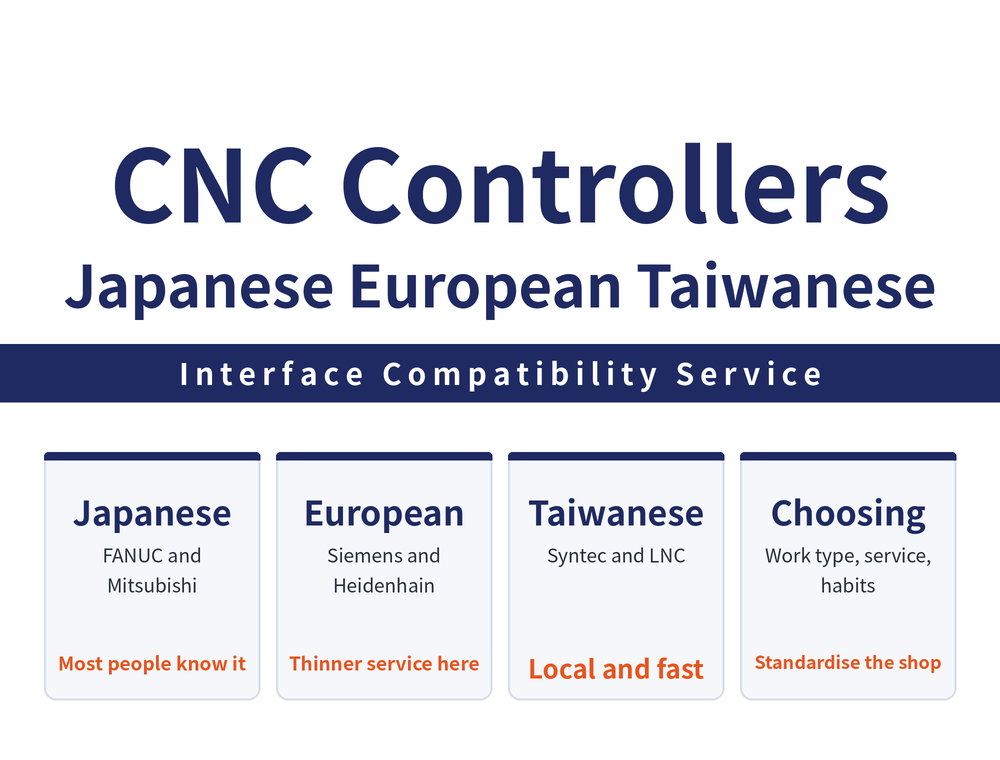
The same mechanical body with a different controller is a different machine. The controller sets the operator interface, program compatibility, and how quickly a breakdown gets fixed. This article groups the controllers on the market into Japanese, European and Taiwanese, and explains where each sits and what to look at when choosing.
1. Why the Controller Decides Which Machine You Buy
The mechanical body sets the ceiling on accuracy; the controller sets how you use it every day. Three things depend on it directly:
Interface and programming habits — whichever brand your machinists know, switching means learning again. Program compatibility — whether existing shop programs can be reused as they are. Service support — how quickly an engineer arrives and how long a part takes to source.
2. Japanese: FANUC and Mitsubishi
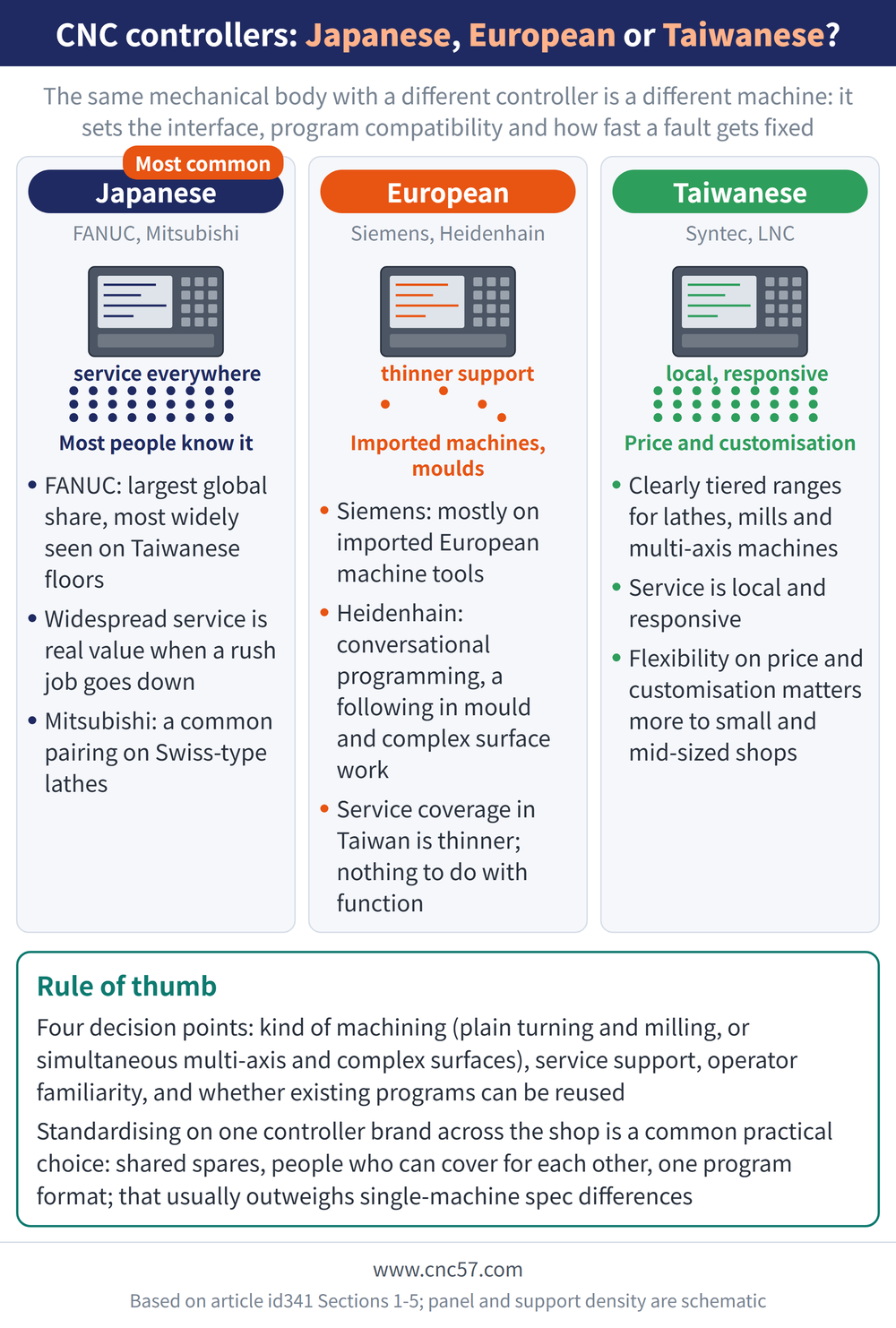
FANUC holds the largest global controller share and is also the most widely seen on Taiwanese shop floors. Its advantage is that the most people know how to use it and service resources are the most widespread — real value when a rush job goes down.
Mitsubishi is also Japanese and holds its own position on particular machine types; Swiss-type lathes with Mitsubishi controls, for example, are a common pairing in the market.
3. European: Siemens and Heidenhain
Siemens has a high share in the European market and in Taiwan is most often found on imported European machine tools.
Heidenhain is known for conversational programming and has a following in die and mould work and complex surface machining.
⚠ In Taiwan the service coverage for European controllers is thinner than for Japanese ones. That is a practical condition to weigh at selection time, and it says nothing about how good the functions are.
4. Taiwanese: Syntec and LNC
Syntec and LNC are Taiwan's two main controller makers. Their ranges are clearly tiered, with models for lathes, mills and multi-axis machines.
Local brands have two real advantages: service is local and responsive, and there is flexibility on price and customisation. For small and mid-sized shops those two things often matter more to daily operation than the differences on a spec sheet.
⚠ Terminology note: simultaneous five-axis motion appears in maker literature as "5-axis simultaneous", "continuous 5-axis" and "full 5-axis" — all describing the same thing, several axes moving in coordination at once.
5. How to Choose
| Decision point | What to look at |
|---|---|
| Kind of machining | Plain turning and milling, or simultaneous multi-axis and complex surfaces |
| Service support | Engineer response time, parts supply and spares held |
| Operator familiarity | Which brand your people know, and the cost of switching |
| Existing programs | Whether shop programs can be reused or must be regenerated |
Standardising the whole shop on one controller brand is a common practical choice — shared spares, people who can cover for each other, one program format. That consideration usually outweighs the specification differences between individual machines. For the other structural specifications to check when buying, see The Four Parts That Define a Machine Tool.
6. Frequently Asked Questions (FAQ)
Q: Can a controller be replaced later?
Technically yes but at high cost, since drives, motors and wiring all have to match. In practice it is normally decided when the machine is purchased.
Q: How do Taiwanese controllers differ from Japanese ones?
Local brands lead on service being local and responsive and on price and customisation flexibility; Japanese brands lead on how widespread they are and how many people can operate them.
Q: Can programs be moved between brands?
Basic G-code commands are common, but canned cycles, macros and parameter settings differ by maker, so in practice programs usually have to be regenerated or adjusted.
Q: Are "5-axis simultaneous" and "continuous 5-axis" different things?
They are two names for the same thing — several axes moving in coordination at once. Maker literature also uses "full 5-axis" for the same capability.
This article is part of CNC Machining Fundamentals: The Complete Guide - Know the Machine and Shop, Then Read the Drawing; that guide shows how the whole topic fits together.