
End Mill Troubleshooting Guide
When milling goes wrong, the hard part is usually not finding a cause — it is that there are too many and you cannot tell which to change first. This guide splits the common faults into two groups, those on the surface (roughness, waviness, inclination, chatter) and those on the tool (wear, chipping, fracture), and maps each to the variables you can actually move: cutting conditions, tool overhang, clamping rigidity and chip evacuation. Working backwards from the symptom tells you which one to touch.
Common End Mill Machining Problems
End mill machining problems fall into two main directions—surface defects and tool damage. Common types are listed below:
| Category | Problem type |
|---|---|
| Surface defect | Surface roughness |
| Surface waviness | |
| Surface inclination | |
| Chatter | |
| Tool damage | Tool wear & chipping |
| Tool fracture |
Surface Defects: Causes & Countermeasures
Causes and countermeasures for the four common surface defects:
| Defect | Cause | Countermeasure |
|---|---|---|
| Surface roughness | Chatter / vibration | Keep tool and overhang length to a minimum; increase workpiece mounting rigidity; use a high-gripping collet; check collet, spindle and tool-mounting accuracy; reduce depth of cut, cutting speed and feed |
| Built-up edge / adhesion | Regrind the built-up/adhered edge; use a non-water-soluble cutting oil | |
| Chip re-cutting | Increase coolant flow; use an air blast to clear chips from the cutting zone; reduce depth of cut | |
| Surface waviness | Tool geometry | Increase the number of flutes (2 → 4 → 6); reduce the helix angle |
| Excessive depth of cut / feed | Reduce depth of cut and feed | |
| End mill deflection | Increase tool diameter; check collet and spindle | |
| Surface inclination | Excessive overhang length | Keep tool and overhang length to a minimum |
| End mill deflection | Increase tool diameter; check collet and spindle | |
| Chatter | Cutting conditions | Lower the spindle speed; switch to climb milling |
| Insufficient mounting rigidity | Keep tool and overhang to a minimum; increase tool and workpiece rigidity; check collet and spindle | |
| Tool geometry | Increase tool diameter; change the flute count |
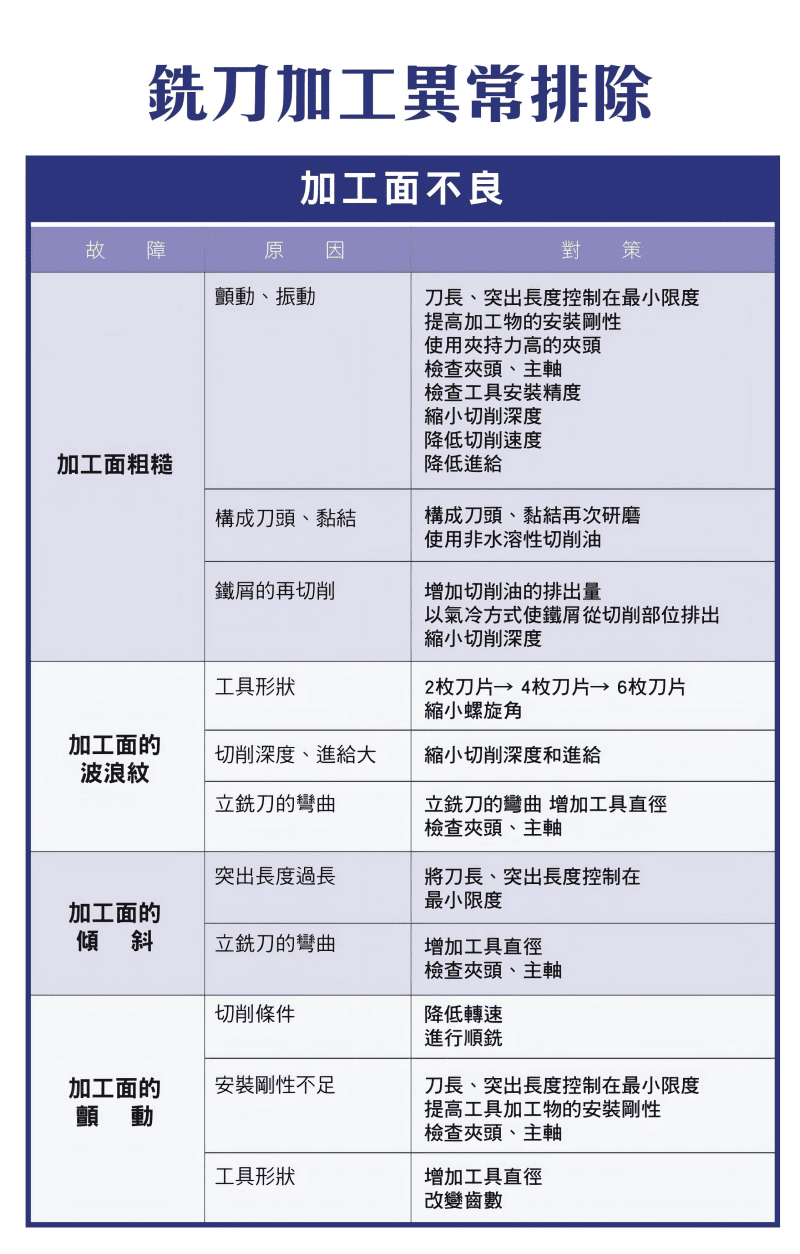
Tool Damage: Causes & Countermeasures
When the tool itself fails—wear, chipping or fracture—the causes and fixes for each are laid out in End Mill Failure Troubleshooting Guide; for wear mechanisms and tool life criteria, see End Mill Wear Analysis. Two points that are easy to miss: fracture usually comes from an over-long tool, so keep the tool length and overhang to a minimum; for chipping, switch to a corner-radius tool.
Core Troubleshooting Logic
| Step | Content |
|---|---|
| 1. Identify the problem type | Surface defect / tool damage |
| 2. Analyze the cause | Cutting conditions / tool / machine |
| 3. Adjust parameters | Speed / feed / depth of cut |
| 4. Improve equipment | Clamping / cooling / chip evacuation |
Practical Optimization Tips
| Item | Recommendation |
|---|---|
| Tool overhang | Keep as short as possible |
| Clamping rigidity | Prioritize clamping rigidity |
| Cutting load | Avoid excessive cutting load |
| Machining parameters | Establish standardized machining parameters |
Related Equipment
Worn or slightly chipped tools can be restored by regrinding and reused at far lower cost than replacement. Learn more: End Mill Grinder (Made in Taiwan, 1-Year Warranty).
FAQ
How do I improve a rough machined surface?
Identify the cause first. Chatter/vibration: shorten tool overhang, increase clamping rigidity, reduce depth of cut and feed. Built-up edge/adhesion: use a non-water-soluble cutting oil and regrind the edge. Chip re-cutting: increase coolant flow or use an air blast and reduce depth of cut.
What causes waviness on the surface?
Usually insufficient tool rigidity or deflection, or excessive depth of cut/feed. Fix: add flutes, reduce the helix angle, reduce depth of cut and feed, increase tool diameter and check the collet and spindle.
My tools keep chipping or fracturing—what should I do?
Chipping is often due to excessive cutting force, poor edge angle or vibration—use corner-radius tools and adjust conditions. Fracture is often due to excessive load, insufficient rigidity or an over-long tool—shorten the tool, lower feed and depth of cut, and improve clamping rigidity.
How do I handle machining issues caused by tool wear?
Lower the cutting speed, use wear-resistant coated tools, and regrind to restore the edge (see End Mill Wear Analysis). Regrinding allows reuse and lowers tooling cost, and can be done with an end mill grinder.
For the full reading guide on this topic, see Tool Life and Wear: A Complete Reading Guide.
This article is part of End Mills: The Complete Guide - Know the Cutter, Choose It, Set the Conditions; Toolpaths Are Another Line; that guide shows how the whole topic fits together.
Published: 2026-03-16 | Last updated: 2026-10-19









