
Which Cutter for High-Speed Roughing: Why the Round-Insert (Bull-Nose) Wins
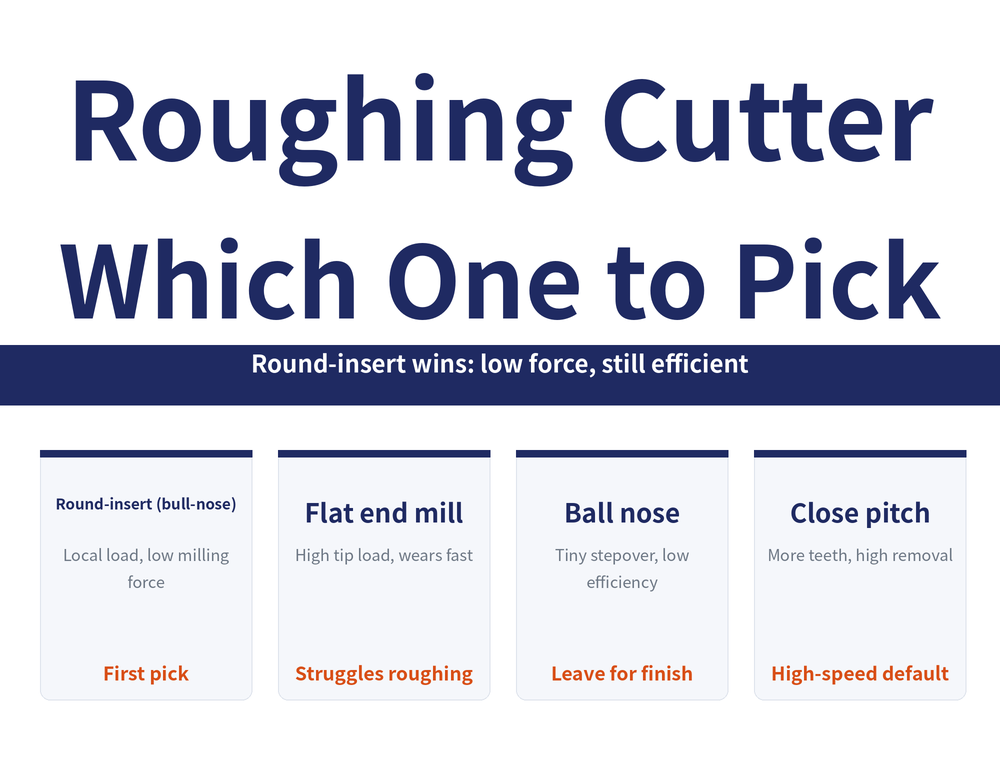
The first question in high-speed roughing is which cutter. The usual answer is a round-insert (bull-nose) cutter — not a flat end mill, not a ball nose. This guide explains why, plus how to match pitch, solid-or-indexable, and the cutting amounts.
1. Three Cutter Types for Roughing
| Cutter | How it roughs |
|---|---|
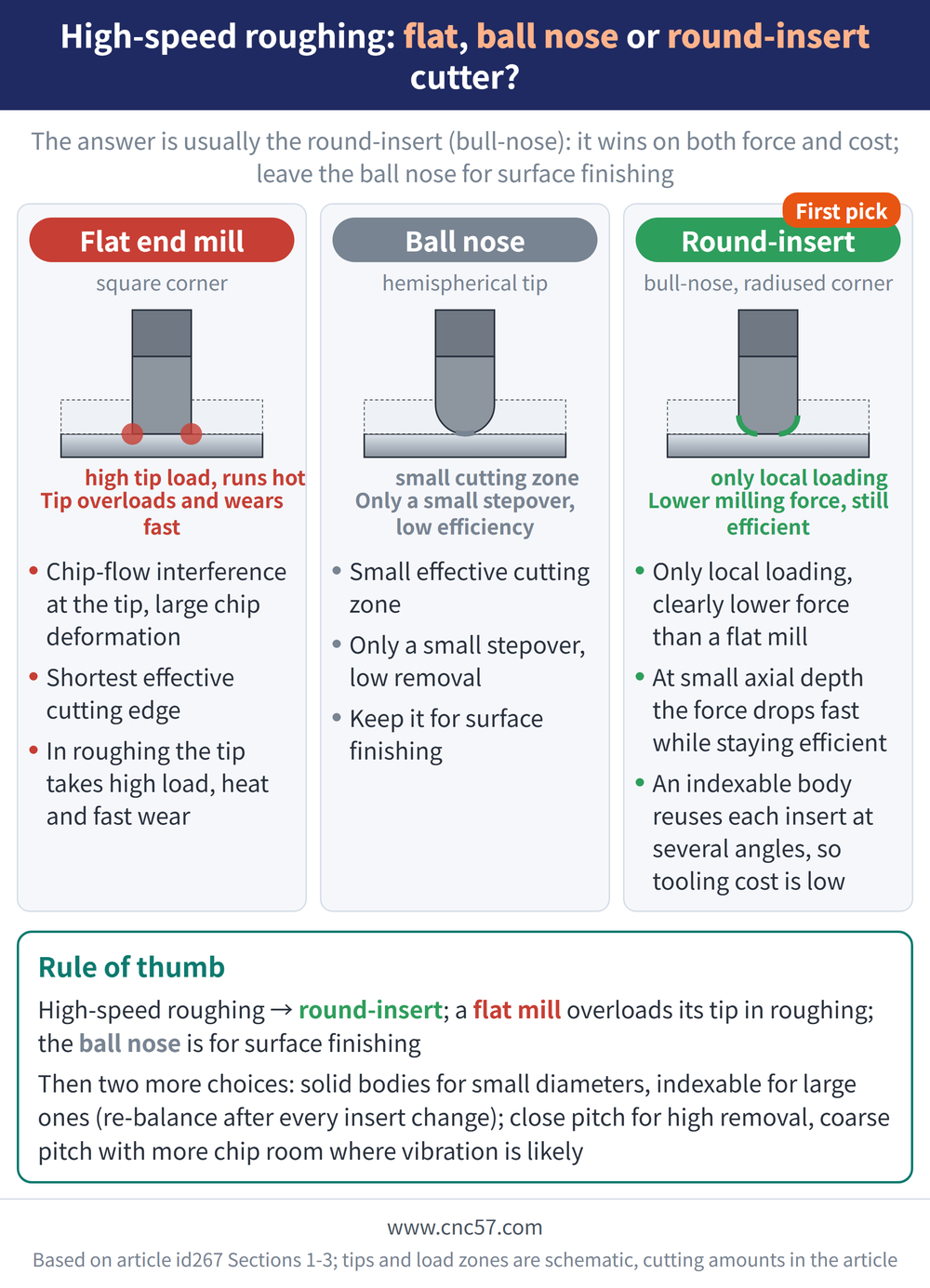
| Flat end mill | Chip-flow interference at the tip, large chip deformation, shortest effective edge → high tip load, hot, wears fast |
| Ball nose | Small effective cutting zone, only a small stepover, low efficiency |
| Round-insert (bull-nose) | Only local loading, clearly lower milling force than a flat mill; at small axial depth the force drops fast while staying efficient |
So round-insert is the first pick for high-speed roughing. And an indexable round-insert body reuses each insert at several angles, so tooling cost is low too — it wins on both force and cost. Leave the ball nose for surface finishing; a flat mill overloads its tip in roughing.
2. Solid or Indexable
Small diameters are usually solid: balanced at the factory and convenient to use. Large diameters go indexable: re-balance after every insert change; suited to lower-speed machines that give more torque. High-speed machines cap the usable diameter.
3. Matching the Pitch (Tooth Count)
Pitch is the distance between adjacent teeth, set by the tooth count:
| Pitch | Teeth / chip room | For |
|---|---|---|
| Close pitch | More teeth, medium chip room | High removal; cast iron and medium-load steel, usually the first pick for high-speed cutters |
| Coarse pitch | Fewer teeth, large chip room | Roughing and finishing steel, and where vibration is likely |
4. Four Rules for the Cutting Amounts
General rules for high-speed roughing amounts: a medium feed per tooth, a smaller axial depth, a somewhat larger radial depth, and a higher cutting speed. The actual figures depend on the cutter and workpiece — go by the maker data, as they vary a lot across tools and materials. For how to compute them, see the end mill cutting conditions guide.
5. Frequently Asked Questions (FAQ)
Q: For roughing, a flat end mill or a bull-nose?
A bull-nose (round-insert). It loads only locally with lower force than a flat mill, and the force drops fast at small axial depth while staying efficient; a flat mill overloads and overheats its tip and wears fast.
Q: Why is a round-insert better than a ball nose for roughing?
A ball nose has a small effective zone, needs a tiny stepover and is inefficient; a round-insert is efficient and gentle on load. Leave the ball nose for surface finishing.
Q: How do I choose the pitch (tooth count)?
High-speed cutters usually favour a close pitch (more teeth, high removal, for cast iron and medium-load steel); use a coarse pitch (fewer teeth, more chip room) for steel roughing/finishing or where vibration is likely.
Q: Solid or indexable?
Small diameters solid (factory-balanced, convenient); large diameters indexable (re-balance after an insert change, suited to lower-speed, high-torque machines).
This article is part of End Mills: The Complete Guide - Know the Cutter, Choose It, Set the Conditions; Toolpaths Are Another Line; that guide shows how the whole topic fits together.
Published: 2026-08-12 | Last updated: 2026-08-12