
Machining Difficult Cast Irons: Chilled, High Chromium and High Silicon
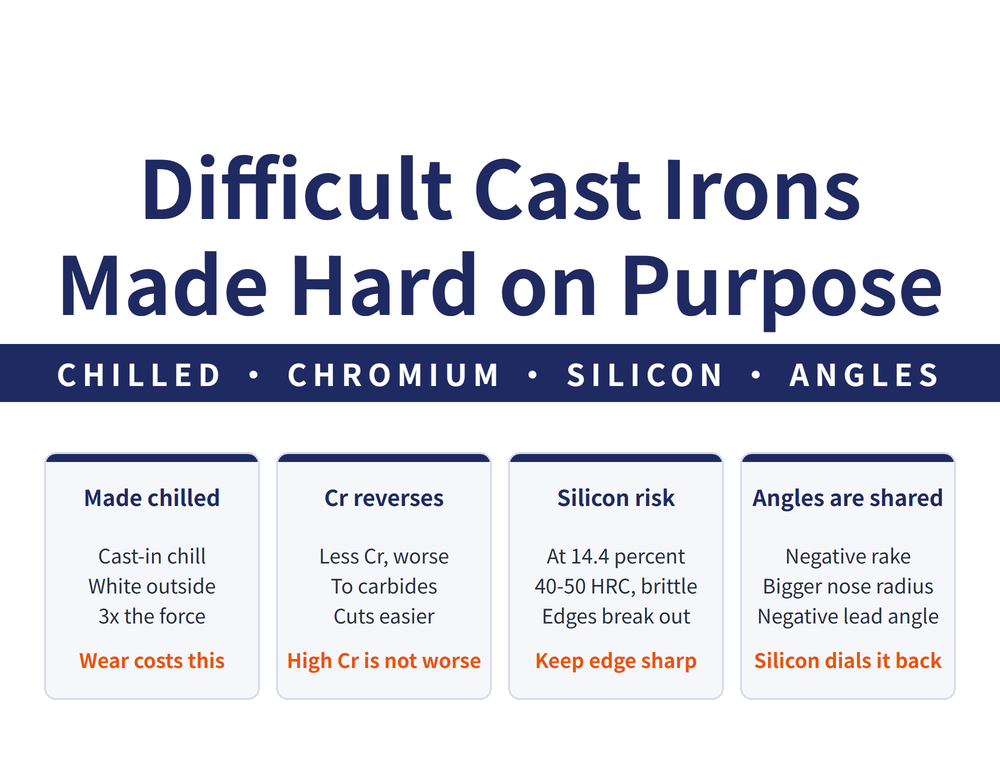
Grey iron cuts more easily than medium carbon steel, yet chilled iron takes three times the specific cutting force. That gap is designed, not accidental. This article covers the causes behind chilled, high chromium and high silicon cast irons, and why their tool angles share one logic while high silicon reverses it.
1. They were made difficult on purpose
Set the baseline first: ordinary grey iron, ductile iron and malleable iron all cut well — more easily than medium carbon steel.
🔴 Chilled cast iron at 52–55 HRC takes a specific cutting force of 3400 N/mm², three times that of grey iron HT200.
🔑 That gap is not an accident, it is a design decision. All three materials here are variants within the same cast iron family that trade away machinability to buy wear or corrosion resistance — the surface is chilled or alloyed into a white iron structure, and the price of that wear resistance is a jump in both hardness and brittleness.
⚠ So "is it cast iron?" is not enough at quotation; establish which one. For how workpiece materials are classified, see ISO Workpiece Material Classification (P/M/K/N/S/H).
2. What separates the three
| Material | What it is optimised for | Typical parts |
|---|---|---|
| Chilled iron | Wear resistance (chilling forms a white surface layer) | Mill rolls, keyway slotting tools, parting tools |
| High chromium iron | Wear, heat and corrosion resistance | Pump casings, wear castings |
| High silicon iron | Corrosion resistance (a SiO₂ film forms on the surface) | Acid-resistant castings and ductile iron |
📌 The application is the clue: a mill roll suggests chilled iron, a pump casing high chromium, an acid-resistant part high silicon.
3. Chilled iron: the white skin is deliberate
At casting, chills or a metal mould quench the surface so it forms a white iron structure (mostly cementite, wear resistant) while the core stays grey or mottled, keeping toughness and strength.
Composition is held in a narrow window: 2.8–3.8% carbon and 0.3–0.8% silicon — precisely the range where the skin will go white and the core will stay grey.
| How the difficulty shows | Consequence |
|---|---|
| Very hard and very brittle | Specific cutting force 3400 N/mm² |
| Chips break up or powder | Very short chip contact length, so force and heat concentrate at the edge |
| Blanks are castings | Stock is heavy and uneven |
⚠ By chill depth and how the layers meet, it divides further into plain chilled, nickel-chromium chilled, high chromium white, chromium-vanadium-titanium white, and indefinite chill iron — the last having no clear boundary to the chilled layer, hardness grading from edge to centre, with slightly higher mechanical strength than ordinary chilled iron.
4. High chromium iron: more chromium cuts better
Chromium densifies the structure, suppresses graphitisation and forms a Cr₂O₃ film on the surface. Three types by content:
| Type | Cr content | Main use |
|---|---|---|
| Martensitic | 12–20% | Wear and corrosion resistance |
| Austenitic | 21–28% | Heat, corrosion and mid-temperature wear resistance |
| Ferritic | 30–36% | Heat, corrosion and high temperature wear resistance |
🔴 A counter-intuitive rule lives here: at low chromium the material is harder, the structure is cementite, and machinability is poor; as chromium rises, hardness falls, the structure turns to chromium carbides, flexural strength rises and machinability improves.
⚠ So "high chromium" does not mean "hard to cut". The difficult end is low chromium; high chromium white iron can reach 62–65 HRC and machines badly. Tool material, angles and cutting data are otherwise much the same as chilled iron.
5. High silicon iron: an extra risk of breakout
At 14.4% silicon, the silicon dissolves into iron as a single α solid solution, the potential difference against graphite becomes weak and electrochemical corrosion slows; a dense SiO₂ film also forms on the surface. That is where the corrosion resistance comes from.
The price is high brittleness and hardness (HRC 40–50), with chips that come off needle-like or as powder, force and heat again concentrated at the edge, and heavy tool wear with short life.
🔴 It carries one more risk the other two do not emphasise: the material is brittle and its edges break out. What fails is not the tool but the corner of the part.
📌 Otherwise its machinability, tool material and angle selection are broadly the same as chilled iron — the difference is the single point in the next section.
6. Tool angles: one set for all three, reversed for high silicon
The angle logic is shared, and it exists to strengthen the edge:
| Item | Value and reason |
|---|---|
| Rake γo | Negative, 0 to −10 degrees, with a negative land ground on |
| Nose radius rε | Enlarged as appropriate, 1–2 mm |
| Lead angle | Reduced, strengthening the nose, easing load per unit edge length and improving heat flow |
| Inclination λs | Negative, 0 to −15 degrees, for impact resistance |
🔴 High silicon iron is the exception: it wants a sharper edge. Because the workpiece has low tensile strength and breaks out at edges, use smaller absolute values of negative rake and inclination together with a larger clearance, so the edge is keen, enters easily and rubs less.
⚠ The direction reverses: the first two push the negative angles up, high silicon pulls them back. Carry the chilled iron setup straight across and the tool survives while the part loses its corners.
7. Tool material: one direction for all three
All three point the same way: fine or ultrafine grain carbide with higher flexural strength and impact toughness and better thermal conductivity, or cermet, or ceramic. High silicon iron adds one requirement — the edge must hone keen easily.
📌 Place ceramic tooling accurately: it holds up to heat, is chemically stable, keeps hot hardness and has a low friction coefficient against metal, but strength and toughness are lower, so a smaller feed is generally appropriate.
Reported cases put cutting speed at 3–11 times that of carbide and tool life at 3–6 times — ⚠ those come from particular parts on particular machines, not a general guarantee, so prove the gain by trial cut under your own conditions.
8. Cutting data and coolant
| Material / tool | Reference data |
|---|---|
| Chilled iron (carbide) | ap 0.5–4 mm; f 0.5 mm/rev roughing, 1–4 mm/rev finishing with a wiper; vc about 0.15 m/s |
| Chilled iron (ceramic) | Roughing and semi-finishing vc 0.83–1.33 m/s (50–80 m/min); finishing 1.33–2 m/s (80–120 m/min) |
| High chromium iron | Much the same as chilled iron |
| High silicon iron | Keep speed down and feed moderate, so the chip thickness does not grow enough to chip the edge or break out the part |
⚠ Treat these as typical ranges and work from the tool catalogue or the relevant standard. On coolant, high silicon iron can use emulsion for roughing and kerosene for finishing, flooded, to extend tool life. For the wider selection picture, see Workpiece Materials: The Complete Guide - Name the Metal First, Then Match the Tool.
9. Frequently Asked Questions (FAQ)
Q: If it is all cast iron, why does some of it cut and some not?
Because the difficult ones were made that way deliberately. Ordinary grey and ductile irons cut more easily than medium carbon steel, while chilled iron takes a specific cutting force of 3400 N/mm², three times grey iron HT200. Chilled, high chromium and high silicon are variants within the same family that trade machinability for wear or corrosion resistance: the surface is chilled or alloyed into white iron, and the cost is a jump in hardness and brittleness. Establish which one before quoting.
Q: Does more chromium make it harder to machine?
The opposite. At low chromium the material is harder, the structure is cementite and machinability is poor; as chromium rises, hardness falls, the structure turns to chromium carbides, flexural strength rises and machinability improves. The difficult end is therefore low chromium, and high chromium white iron reaching 62 to 65 HRC machines badly. Tool material, angles and cutting data are otherwise much the same as chilled iron.
Q: The angles worked on chilled iron, so why do high silicon parts break out?
Because the direction has to reverse. Chilled and high chromium irons push the negative angles up to protect the edge, but a high silicon workpiece is brittle with low tensile strength, and a blunt edge crushes its corners. Use smaller absolute values of negative rake and inclination with a larger clearance, so the edge is keen, enters easily and rubs less. What is at risk is the part, not the tool, so what needs protecting is different.
Q: Is it worth switching to ceramic tooling?
Worth evaluating, with its limits accepted. Ceramic holds up to heat, is chemically stable, keeps hot hardness and has low friction against metal, and reported cases put cutting speed at 3 to 11 times carbide with tool life 3 to 6 times. The cost is lower strength and toughness, so a smaller feed is generally appropriate. Those multiples come from particular parts on particular machines rather than a general guarantee, so confirm the gain by trial cut under your own conditions.
Published: 2026-09-21 | Last updated: 2026-09-21









