
Workpiece Materials: The Complete Guide - Name the Metal First, Then Match the Tool
Deciding which tool and what cutting data to use for a piece of stock takes three steps: name the grade, understand why it cuts the way it does, and only then match it to a tool. These 27 articles are arranged in that order. Most people get stuck on step one - the drawing says SCM440, the catalogue says 4140, and it is not obvious whether those are the same thing. This guide sets out the order first, then points you to the article you need.
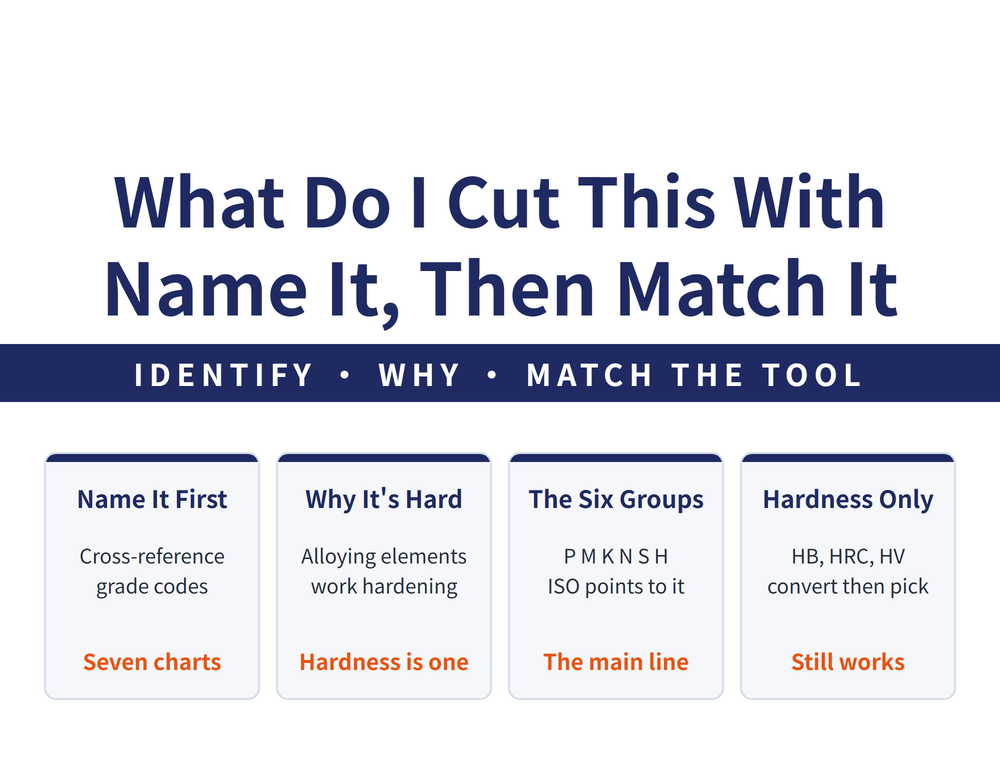
1. The Order of This Line: Identify, Understand, Then Match
These 27 articles are not parallel - they run in sequence. Skip the first two steps and go straight to a tool chart, and the answer will not fit the stock in front of you:
| Step | What it answers | Section |
|---|---|---|
| 1 Name it | Is the code on the drawing the same material as the one in the catalogue | Section 2 (8 articles) |
| 2 Know why | Why it cuts hard: composition, work hardening, or heat-treated condition | Section 3 (4 articles) |
| 3 Match it | What grade, coating and cutting data this group needs | Sections 4-7 (15 articles) |
Step one is where most people stall. The same steel carries different codes in different standards - the drawing says SCM440, the catalogue says 4140, the German standard says 42CrMo4, and all three mean the same thing. Get that wrong and everything downstream is off.
2. Step One: What Exactly Is This Stock?
Most of these eight are lookup articles. You do not read them through; you open the one that matches what is in front of you.
| Article | When to read it |
|---|---|
| Metal Material Guide | Start here. The main material families and what each is typically used for |
| Metal Material Cross-Reference | When carbon, alloy or tool steel codes will not line up |
| Carbon and Alloy Steel Cross-Reference | When sourcing a substitute, or checking a mill certificate |
| Stainless Steel Cross-Reference | Converting between SUS, AISI, DIN and EN |
| Cast Iron Cross-Reference | Matching FC, FCD, GG and QT designations |
| Mold Steel Equivalency Chart | Matching cold-work, hot-work and plastic mould steel grades |
| Reading Aluminium and Titanium Designations | When you see 6061, 7075 or Ti-6Al-4V and want the numbering rules |
| Spark Testing for Steel Identification | When the tag is lost or two heats got mixed and you need to tell the steel on the shop floor |
These charts have one use that gets overlooked: finding a substitute. When the specified material is on long lead time or unavailable, the first question is whether the alternative sits in the same group - and if it does, whether the cutting data still holds.
3. Why This One Cuts Hard: More Than One Reason
"It is hard, so it cuts hard" is only part of the story. Two pieces at the same HRC30 behave differently depending on how they got there, and stainless is not especially hard yet is often the bigger problem.
| Article | When to read it |
|---|---|
| How Easy Is a Material to Cut? | Read this first. It also covers what a machinability rating cannot tell you |
| How Metal Elements Affect Machinability | When you want to know why adding chromium and nickel makes steel harder to cut |
| Work Hardening Explained | When stainless or superalloy gets harder as you cut and the edge dulls fast |
| How Heat Treatment Affects Machinability | When the same grade needs a different tool depending on its condition |
The three causes are different in kind: composition is inherent, heat-treated condition is something you can ask about, and work hardening is something you create yourself. The last one deserves the most attention - it is the only one your own method makes worse. Too light a feed, or staying in the cut with a dull edge, both accelerate it.
4. The Six ISO Groups: Straight From Material to Tool
This is the spine of the line. ISO splits workpiece materials into six groups not for tidiness but because tooling strategy is similar within a group - work out which group you are in and half the tool choice is settled.
| Article | When to read it |
|---|---|
| ISO Workpiece Material Classification | The entry point. How the six groups are split and the tooling direction for each |
| P Steel Machining Guide | Carbon, alloy and mould steel. The largest group by far |
| M-Group Stainless Steel Machining Guide | 304, 316 and duplex stainless |
| K-Group Cast Iron Machining Guide | Grey and ductile iron. Graphite abrasion is the theme |
| Machining Difficult Cast Irons | Chilled, high-chromium or high-silicon cast iron |
| N-Group Aluminium and Non-Ferrous Guide | Aluminium, copper and brass. Built-up edge is the main worry |
| Is Magnesium Alloy Easy to Machine | Magnesium alloy. The part is easy to cut; the chips are what need care |
| S-Group Titanium and Superalloy Guide | Titanium and nickel-based superalloys. Poor conductivity is the core problem |
| H-Group Hardened Steel Machining Guide | Hard turning and hard milling of quenched material |
The six groups are not equal in size. P covers most day-to-day work, while S and H are the two where a wrong choice is expensive - the tooling costs more and the cycles run longer, so the price of picking wrong is not a few lost minutes.
5. Mould and Tool Steel: Why They Get Their Own Articles
In the ISO scheme these sit across P and H, but in practice they are one family, and the hardness range within it is wide - the same core may be pre-hardened stock at roughing and HRC60 by the time you finish it.
| Article | When to read it |
|---|---|
| Die and Mold Steel Machining Guide | Working on moulds. Six families, hardness grades and the tool choice for each |
| Tool Steel Machining Guide | Cold-work, hot-work and high-speed tool steel |
Both come back to the same question: what hardness is this piece right now, and what does that mean for the tool. Which is why the next section exists.
6. When All You Have Is a Hardness Number
It happens often enough: no grade, no mill certificate, just a hardness reading. That route still works.
| Article | When to read it |
|---|---|
| Choosing Tools by Hardness | One HB, HRC or HV figure and a tool grade and coating to decide |
Know the limit of this route though: hardness tells you what tool grade to use; it does not tell you whether the material work hardens. Stainless and superalloys are not especially hard, yet their difficulty comes from the mechanism in section 3 - so when hardness is all you have, be conservative with those two.
7. Beyond the Six Groups: Three Workpieces That Need Their Own Look
Three more kinds of workpiece come up often but are not covered by the six group guides above; each has its own article:
| Article | When to read it |
|---|---|
| Machining Thermal Spray Coatings | When the part carries a sprayed or fused alloy layer that has to be cut |
| Engineering Ceramics in Four Types | A customer brings a ceramic part; first work out which type it is |
| Grinding Monocrystalline Silicon | Grinding monocrystalline silicon or wafers |
8. Reading On: Complete Guides for Three Groups, and After Heat Treatment
The five articles below are not among this line's 27, but they are often read after the ones above. The first three are complete guides to three of the groups in section 4, pulling together the articles on that group spread across the machining categories; the last two are for when heat-treated parts come back and still need machining.
| Article | When to read it |
|---|---|
| Machining Stainless Steel: The Complete Guide | Cutting stainless and you want the route from naming the family to tool, data and finishing |
| Machining Titanium and Superalloys: The Complete Guide | Cutting titanium or nickel superalloys, tools burn fast, and you want the route from grade to cooling |
| Machining Aluminum and Non-Ferrous Metals: The Complete Guide | Cutting aluminium, copper or brass and fighting sticking and built-up edge |
| Heat-Treated Parts Come Back Wrong | Heat-treated parts show uneven hardness or distortion, or crack two days later, and you need to find where the problem lies |
| How Much Is Left to Cut on a Case-Hardened Part | A carburised or nitrided part still needs finishing and you need to know how deep you can still cut |
9. Frequently Asked Questions (FAQ)
Q: The drawing says SCM440 and the catalogue says 4140. Same material?
Both designate the same class of chromium-molybdenum steel, one from the Japanese and one from the American system; the German equivalent is 42CrMo4. But equivalent is not identical - the permitted composition ranges differ slightly between standards, so strength and response to heat treatment can vary. For day-to-day machining, treating them as one group is fine. For ordering or substituting material, read Carbon and Alloy Steel Cross-Reference in section 2, which sets out how far the equivalence can be trusted.
Q: Where should I start in these 27 articles?
It depends what you already have. If you know the grade, jump to ISO Workpiece Material Classification in section 4, find your group, then read that group's article. If all you have is a drawing with a code you do not recognise, start with the lookup charts in section 2. If it is cutting badly and you want to know why, go to section 3. If you only have a hardness reading, section 6. This line is deliberately not meant to be read front to back.
Q: Why is stainless harder to cut than steel that is actually harder?
Because hardness is not the only thing that makes a material difficult. Austenitic stainless work hardens - the layer the tool has just passed through becomes harder than the original material, so the next pass is cutting into a layer you created. It also conducts heat poorly, so the heat stays at the edge instead of leaving in the chip, and its toughness encourages built-up edge. None of those three follow from hardness. Work Hardening Explained in section 3 covers the first, which is also the one your own method can make worse.
Q: How is this line different from the cutting tool material and coating category?
They run in opposite directions. This line starts from what the workpiece is and asks which tool to use; the tool material and coating category starts from what the tool is made of and asks what it suits. In practice they meet at the same decision: choosing a cutter means answering both which group your material falls in and whether that cutter's grade and coating match it. Identify the material group here first, then go there to pick the specific tool.
Published: 2026-09-09 | Last updated: 2026-10-21









