
Pre-Thread Holes and Combined Drills: Wrong Hole Size Breaks the Tap
When a customer says taps keep breaking, the first question is hole diameter, not tap quality. This guide covers what the two hole forms actually buy you, why adding a counterbore does not improve two of them, and the third and least discussed advantage of a combined drill.
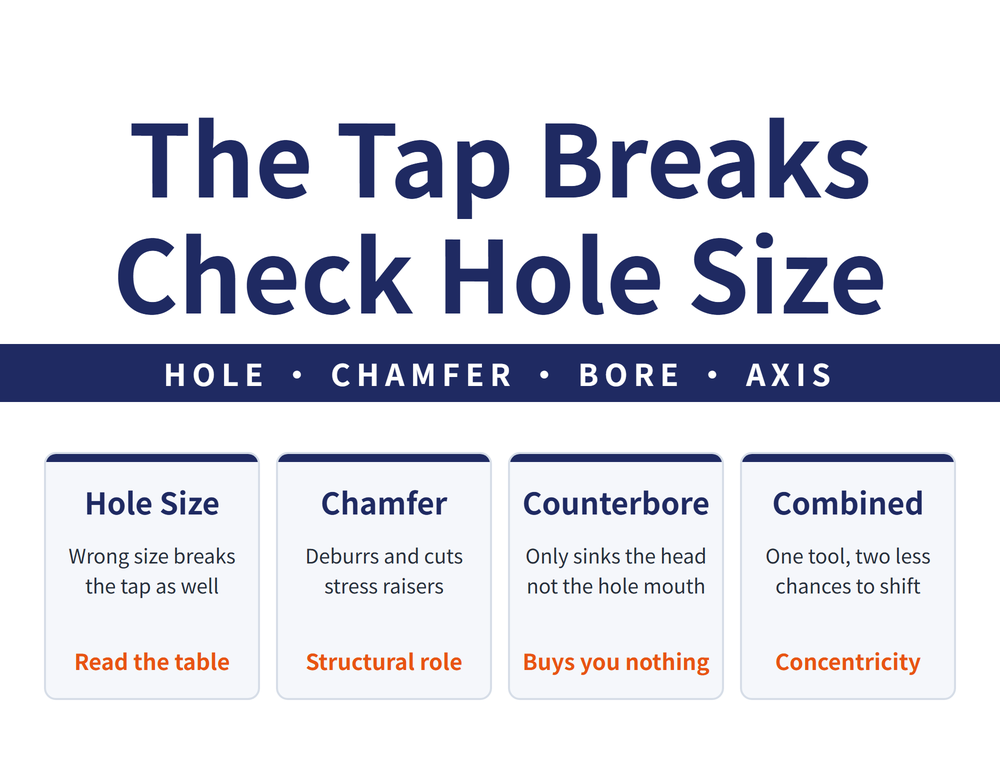
The most useful sentence for sales first
Cutting an internal thread is not a complex operation. The subtlety is in the preparation. The tool manufacturer’s own handbook puts it bluntly: if the pre-thread hole diameter is wrong, the result is not only poor thread quality but breakage of the threading tool.
🔴 So when a customer reports that taps keep breaking, the first question is hole diameter, not tap quality. Coming from the tool manufacturer’s own handbook, that carries considerably more weight with a customer than the same point made in your own words.
⚠ This article lists no hole size figures. Every thread form requires its own matching tool and its own calculated hole diameter. Use the dedicated tapping drill diameter tables and thread specification tables, not memory or conversion.
1. What the two hole forms buy, and the two blanks that matter
| Common purpose | Hole with chamfer | With counterbore |
|---|---|---|
| Deburring | Yes | — |
| Preparation for threading | Yes | Yes |
| Flush fastening of bolts and nuts | Yes | Yes |
| Reduced stress concentration | Yes | — |
| Bushing placement | Yes | Yes |
| Cosmetic enhancement | Yes | Yes |
The real information sits in the two blanks. Deburring and reduced stress concentration need only the chamfer; adding a counterbore does not improve either. A counterbore exists to sink the head, meaning flush fastening and bushing placement, not to improve the hole mouth.
Put differently, an extra counterbore buys neither of those two benefits and costs one more operation. Worth checking that row when quoting.
Reduced stress concentration deserves remembering on its own. A sharp hole edge is a classic stress raiser, so the chamfer is a structural feature, not merely cosmetic or convenient. When a drawing calls out a chamfer, it may be carrying fatigue life.
2. Three advantages of a combined drill, and the third is the point
For a chamfered or chamfered-and-counterbored hole, the best answer is a combined drill, doing several drilling operations with one tool. It has three advantages.
| Advantage | Mechanism |
|---|---|
| Higher productivity | Eliminates the non-cutting time of a tool change and reduces set-up time |
| Lower tool inventory | Fewer tool types to stock |
| A more accurate hole | With chamfer and counterbore elements present, it significantly reduces concentricity deviation between the hole elements, because it removes the table movement that an in-machine tool change requires |
The first two are cost arguments; the third is a quality argument, and the third is the one most often skipped.
🔴 Every tool change moves the table, and every move is another chance to be out of position. Produce the chamfer, counterbore and hole with three separate tools and their axes have three chances to disagree. One combined drill reduces that to one. It shows up most clearly wherever a bolt has to run in smoothly.
3. When not to use one
A combined drill ties the geometry together. The gain is concentricity; the cost is flexibility. Where hole or chamfer specifications change often, that coupling becomes a burden: change one dimension and you need a different special tool. For small batches with mixed specifications, separate operations may work out cheaper.
The other thing to check is regrinding. A combined drill has more complex geometry than a plain drill and regrinding has to hold several angles at once, so not every grinding shop can restore one. Confirm the regrinding route before buying.
4. Four checks before ordering
1. Confirm hole diameter from the table for the correct thread form. Do not convert from memory.
2. Ask whether this hole actually needs a counterbore: only flush fastening and bushings do.
3. Check whether the chamfer is a structural requirement. If it is, it cannot be dropped.
4. Decide whether the three operations justify one combined drill, based on concentricity demand and how often the specification changes.
For the full picture of hole forms and tool combinations, see Drill and Tap Process Guide.
Frequently asked questions
Taps keep breaking. Is that a tool quality problem?
Check hole diameter first. The tool manufacturer’s handbook states that a wrong pre-thread hole diameter causes not only poor thread quality but breakage of the threading tool. Once the hole is right, look at concentricity, cutting speed and chip evacuation.
Does adding a counterbore on top of a chamfer make the hole mouth more durable?
No. Deburring and reduced stress concentration need only the chamfer, and a counterbore does not improve either. A counterbore sinks a bolt head or a bushing; it is an assembly requirement, not a strength one.
Combined drills cost more. Are they worth it?
It depends what you need. Time and inventory are the first two benefits, but the valuable one is the third: producing everything with one tool significantly reduces concentricity deviation between chamfer, counterbore and hole, because the table never moves for a tool change. Worth it where concentricity matters, less so where specifications change often.
Can the chamfer on the drawing be omitted?
Check first whether it is structural. A sharp hole edge is a classic stress raiser and the chamfer is a structural feature in its own right, not just appearance or ease of assembly. Ask the design side before removing it.
Source: ISCAR Drilling Handbook (Pre-Thread Drilling with Chamfering). This article lists no hole size figures; use the tapping drill diameter and thread specification tables for the relevant thread form.
Last updated: 2026-09-14









