Steel Weight Calculation: Round, Square & Hex Bar Formulas
Steel weight can be found quickly with simple formulas for each cross-section (round, square, hexagonal) per metre — a key basis for quoting, planning and material management. For a round bar, weight comes from the diameter squared (0.00616 × d²), scaled by density (steel 7.85). This guide covers the section formulas, material densities and a weight chart to improve quoting speed and stock accuracy.
1. Weight Calculation Basics
Three keys drive steel weight: section shape, size (diameter or side) and material density. Used for procurement, cost estimation and machining planning. The core logic is "area × length × density", simplified into a coefficient formula per section.
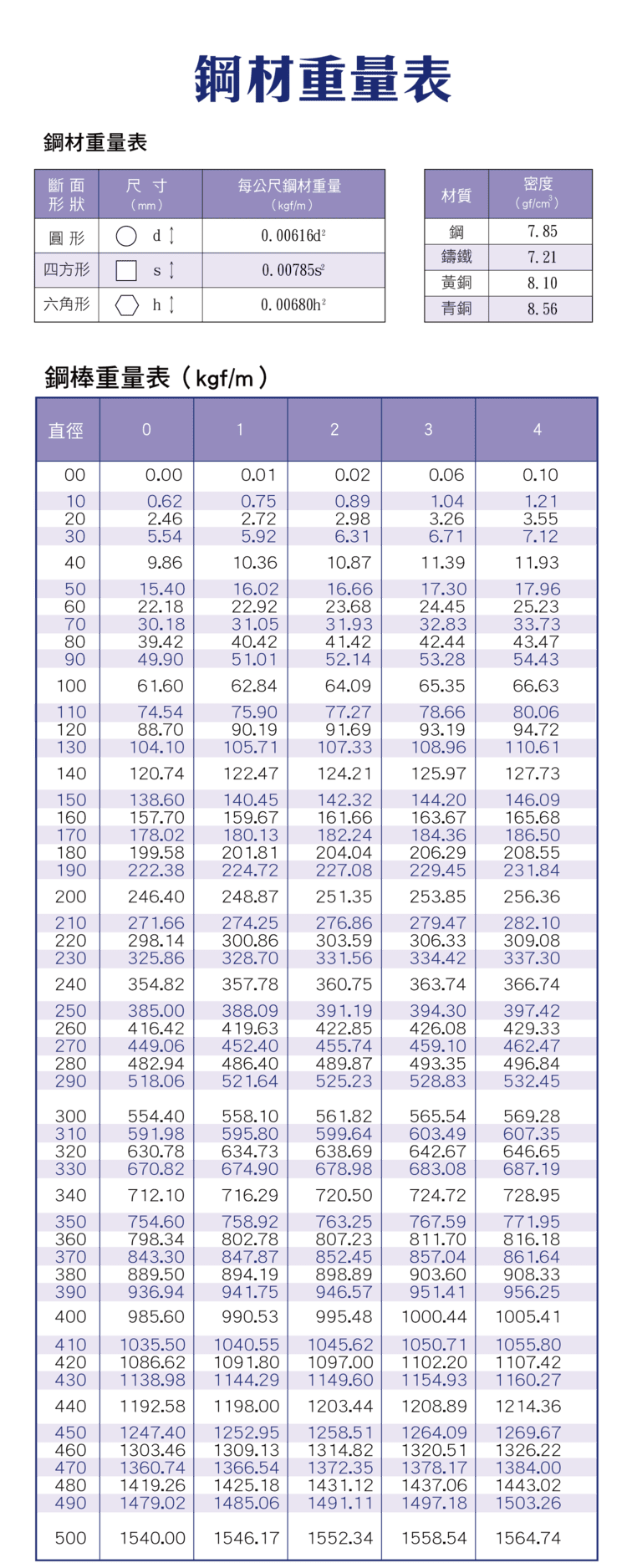
2. Weight-per-Metre Formulas (steel, density 7.85)
| Section | Formula (kg/m) | Note |
|---|---|---|
| Round bar | 0.00616 × d² | d = diameter (mm), most common |
| Square bar | 0.00785 × s² | s = side (mm), for structures |
| Hex bar | 0.00680 × h² | h = across-flats (mm), for bolts/parts |
Example: a Ø128 mm round bar → 0.00616 × 128² ≈ 100.9 kg/m; a 50 mm square bar → 0.00785 × 50² ≈ 19.6 kg/m; a 50 mm across-flats hex bar → 0.00680 × 50² = 17.0 kg/m. These coefficients assume steel (7.85); other materials scale by density.
3. Material Density Effect
| Material | Density (g/cm³) |
|---|---|
| Steel | 7.85 |
| Cast iron | 7.21 |
| Brass | 8.10 |
| Bronze | 8.56 |
| Aluminium | 2.70 |
| Titanium | 4.5 |
Aluminium and titanium are pure-metal densities; for alloys use the density from the material specification. Higher density, higher weight. From the steel formula, scale other materials by "their density ÷ 7.85".
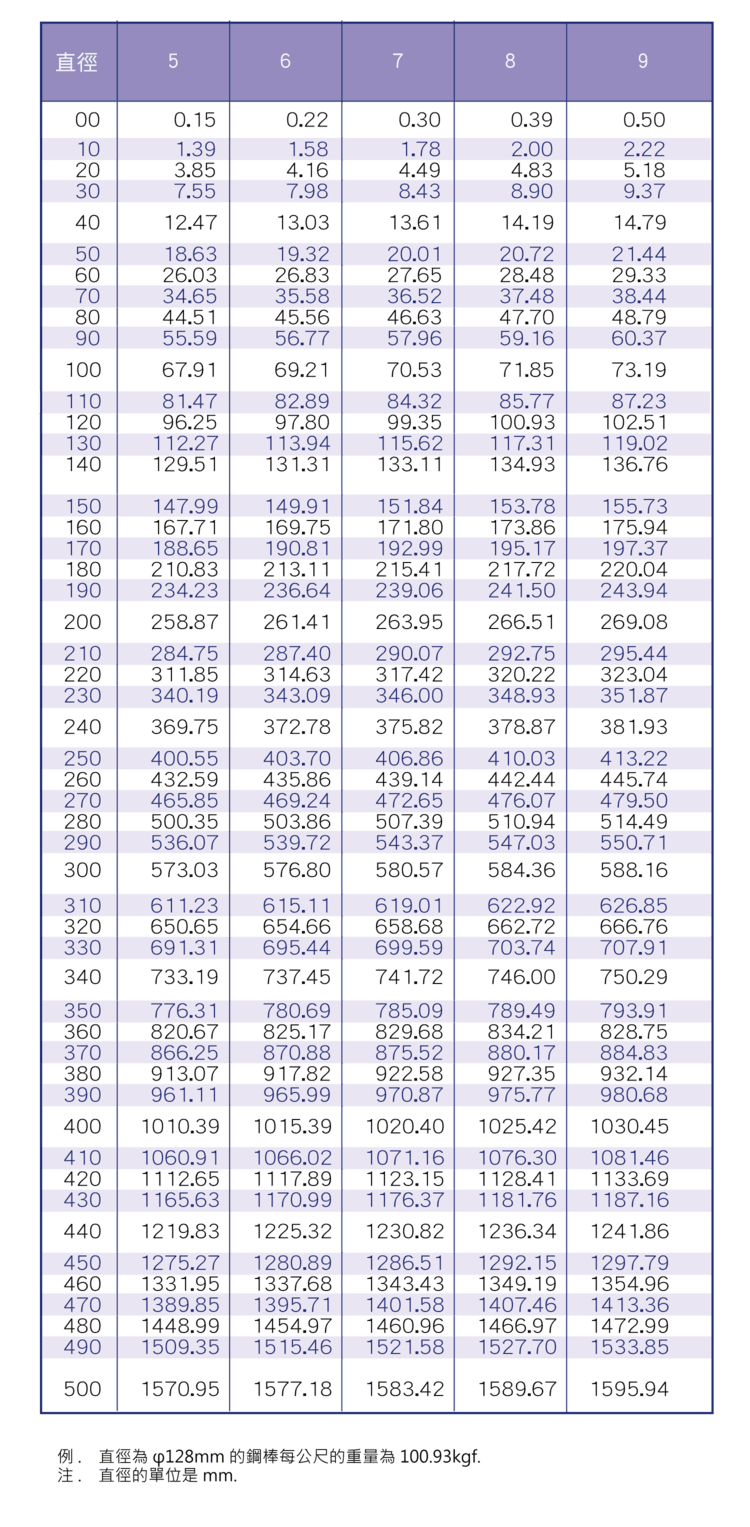
4. Round Bar Weight Chart (reference)
| Diameter Ø (mm) | Weight (kg/m) |
|---|---|
| 10 | ≈ 0.62 |
| 50 | ≈ 15.40 |
| 100 | ≈ 61.60 |
A chart gives common-diameter weights fast. In practice, cross-check with "formula + chart".
5. Notes and Practice
Keep units consistent (mm); the result is theoretical and varies slightly with material tolerance, rolling tolerance and surface condition. Cross-check formula and chart, scale by density, and consider building an internal tool or integrating an ERP/quoting system. For density and hardness see the Hardness Conversion Chart.
FAQ
Q: How do I calculate round bar weight per metre?
Steel round bar (kg/m) ≈ 0.00616 × d², d in mm. E.g. Ø50 → 0.00616 × 2500 ≈ 15.4 kg/m. The coefficient already includes steel density 7.85; other materials scale by density.
Q: Are square and hex formulas the same?
No. Square uses side s: 0.00785 × s²; hex uses across-flats h: 0.00680 × h². The difference is the cross-sectional area (a square is larger than a hex of the same size), so the coefficients differ.
Q: How about stainless or aluminium?
Compute with the steel formula, then scale by "material density ÷ 7.85". Aluminium (≈2.70) is about 2.70/7.85 ≈ 0.34× the weight of the same-size steel; stainless and other alloys vary by grade, so use the density from the material specification.
Q: How much do calculated and actual weights differ?
The formula is theoretical; actual weight varies with density tolerance, rolling tolerance and surface condition, usually by a small margin. It's fine for quoting and stock prep; for exact weight, use a scale.
Published: 2026-03-25 | Last updated: 2026-10-17