
Machining Thermal Spray Coatings: Why They Are Hard, What Tool to Use, and the Angles and Data
A sprayed coating is not a block of material but a fused alloy layer on the surface, and its machinability carries the difficulty of hardened steel and superalloy at the same time. This article covers the five mechanisms, why the tool material choice runs opposite to hardened steel, the tool angles, and why all the cutting data is finishing data.
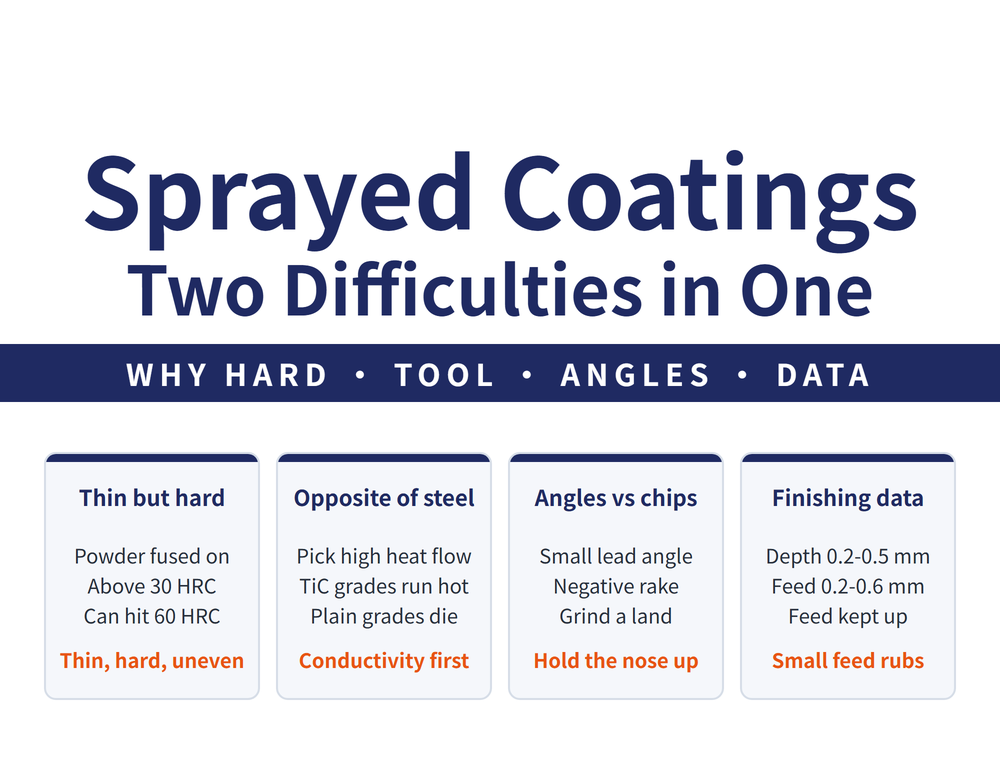
1. A coating is a layer, not a material
Start with what it is: a sprayed coating is a fused layer of alloy powder on the surface of the part, not a material in the usual sense.
A high temperature source melts alloy powder, ceramic or plastic and drives it at pressure and speed onto a cleaned surface, forming a firmly bonded layer that gives wear, corrosion, heat and oxidation resistance. Processes are grouped by heat source: oxy-acetylene, arc, plasma and detonation spraying.
📌 The use is not only protection but also repair of metal surfaces — it saves material, costs less and turns round quickly. Powders come in two families: bond coats, commonly aluminium-clad nickel (Al/Ni) or nickel-clad aluminium (Ni/Al), and working coats in nickel, cobalt, iron, copper and aluminium bases.
2. Two difficulties stacked on each other
🔑 The machinability of a sprayed coating carries both hardened steel and superalloy difficulty. That framing runs through the whole article: this is not one new material, it is two known problems at once.
Cobalt and nickel based coatings above HRC 50 are already difficult; nickel or cobalt based tungsten carbide and other refractory powder coatings, running to HRC 65, are harder still.
⚠ General machinability rating tables do not apply here, because those tables rate the material itself while a coating is a surface condition. For how workpiece materials are classified, see ISO Workpiece Material Classification (P/M/K/N/S/H).
3. Five mechanisms behind the difficulty
| Mechanism | How it arises |
|---|---|
| High hardness, high cutting force | Surface typically above 30 HRC; the solid solution structure deforms plastically and work hardens severely |
| Heavy tool wear | The layer holds dispersed hard particles — carbides, oxides and intermetallics |
| High cutting temperature | Low conductivity alloying elements, and the coating is porous, so heat concentrates at the edge |
| Cracking and chipping | Uneven hard and soft particles, porosity and an uneven surface subject the tool to high frequency impact |
| The layer can lift | Bonding to the substrate is not full fusion, and the layer is thin, so excessive force flakes it off locally |
🔴 The fifth is a failure mode unique to this work. Other difficult materials cost you a tool; here the coating comes away, the part is scrap, and the spraying operation before it is wasted too.
4. Tool material: the opposite of hardened steel
The selection criteria are high hardness, good hot hardness and wear resistance, good strength and toughness, and the ability to take impact.
🔴 With a plain carbide grade, tool life is so short the job is barely possible — not an efficiency issue but a feasibility one.
🔑 The key line: sprayed coatings want a carbide with high thermal conductivity, not low. That is the reverse of the choice for hardened steel, and the reason is the third mechanism above — a porous coating cannot shed heat, so conductivity outranks everything else.
| Case | Direction |
|---|---|
| General | High conductivity ultrafine grain carbide; some grades are developed specifically for sprayed materials, very hard and thermally stable, turning and milling coatings of 55–72 HRC |
| Nickel and tungsten carbide based | Roughing and finishing both suit CBN |
| Iron based coatings | A different CBN formulation performs better |
| Ceramic coatings | Use PCD (polycrystalline diamond) |
⚠ Grade designations differ between systems. Catalogues in Taiwan generally use the ISO classes plus each maker's own grade codes, so order from the supplier catalogue and apply the two criteria that matter here: high conductivity and impact resistance.
5. Tool angles: two opposite problems, two answers
This work pulls in two directions at once: the tool chips easily, and tool life is short. The remedies are not the same.
| Item | Value |
|---|---|
| Lead angle κr | Small, 15–20 degrees; end cutting edge angle small as well |
| Nose radius rε | Where the lead angle cannot be reduced further, use a larger nose radius of 1–1.5 mm |
| Rake angle γo | Below 50 HRC: 3 to −2 degrees; 50 HRC and above: −1 to −8 degrees |
| Clearance angle αo | Generally 6–8 degrees |
| Negative land | 0.2–0.6 mm × (−10 degrees); take the larger value on harder coatings |
📌 The whole set says one thing: increase the wedge angle and support the nose. Small lead angle for a bigger included nose angle, negative rake with small clearance, and a negative land on top — all the same move. Treat the values as typical ranges and confirm by catalogue and trial cut.
6. Cutting data: this is a finishing operation
🔑 Because the coating is thin, machining it is always a finishing operation, and the data follows finishing practice:
| Item | Typical value |
|---|---|
| Depth of cut ap | Small, 0.2–0.5 mm |
| Feed f | 0.2–0.6 mm/rev, and not too small |
| Cutting speed vc | Limited mainly by tool life; with carbide, generally 0.13–0.25 m/s |
🔴 "Feed not too small" is the counter-intuitive one. The instinct with a difficult material is to reduce feed for stability, but this coating work hardens severely — too small a feed keeps the edge cutting inside the layer hardened by the previous pass, which gets harder and wears the tool faster.
⚠ Treat the table as typical ranges; actual values move with grade, machine rigidity and coating composition, so work from the tool catalogue or the relevant standard. For matching material to tooling more broadly, see Workpiece Materials: The Complete Guide - Name the Metal First, Then Match the Tool.
7. Frequently Asked Questions (FAQ)
Q: Can a sprayed coating be treated as hardened steel?
No, and the tool choice runs the opposite way. A coating carries both hardened steel and superalloy difficulty, but it is porous with low conductivity, so heat concentrates at the edge and the grade wanted is one with high thermal conductivity — the reverse of the first choice for hardened steel. General machinability rating tables also do not apply, because they rate the material itself while a coating is a surface condition.
Q: Why can the feed not be reduced?
Because the coating work hardens severely. Too small a feed keeps the edge cutting inside the layer that the previous pass hardened, so the material gets harder and the tool wears faster. The reference range is 0.2 to 0.6 mm/rev. Depth of cut goes the other way and stays small, 0.2 to 0.5 mm, because the coating is thin and machining it is effectively a finishing operation.
Q: The edge keeps chipping. What should change?
Move the whole geometry towards a bigger wedge angle and a supported nose. Take the lead angle down to 15 to 20 degrees and the end cutting edge angle with it; where the lead angle cannot go lower, use a nose radius of 1 to 1.5 mm. Use a small or negative rake — 3 to minus 2 degrees below 50 HRC, minus 1 to minus 8 degrees at 50 HRC and above — with 6 to 8 degrees clearance, and add a negative land of 0.2 to 0.6 mm at minus 10 degrees, taking the larger value on harder coatings.
Q: The coating flaked off mid-cut. Is that the tool's fault?
Look at cutting force first. The bond to the substrate is not full fusion and the layer is thin, so excessive force lifts the surface locally. This is the failure mode unique to coated work: with other difficult materials you lose a tool, here you lose the part and the spraying operation that preceded it. The direction of the fix is lower depth of cut and lower force, with a tool material that tolerates impact.
Published: 2026-09-21 | Last updated: 2026-09-21









