What Is CNC: From the Manual Machine Tool to Numerical Control
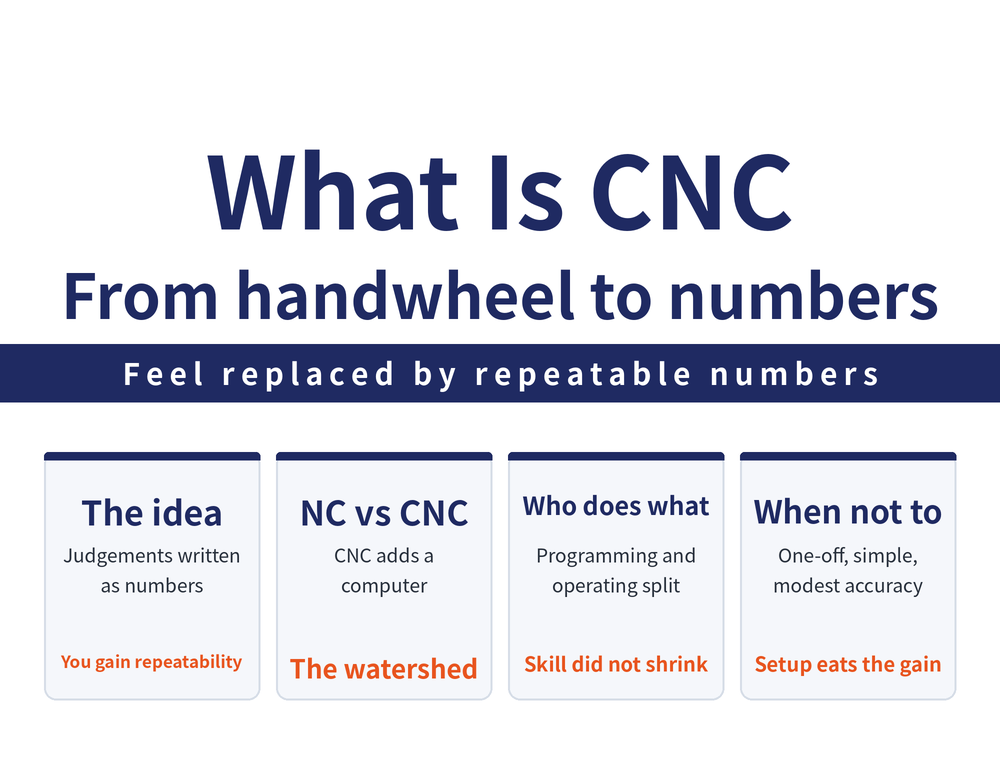
CNC, at bottom, replaces the feel in an experienced machinist's hands with a set of numbers that can be run again and again. This article covers the definitions of NC and CNC and what separates them, how the operator's role moved from turning handwheels to writing programs and tending machines, and when CNC is the more expensive answer.
1. The Short Answer
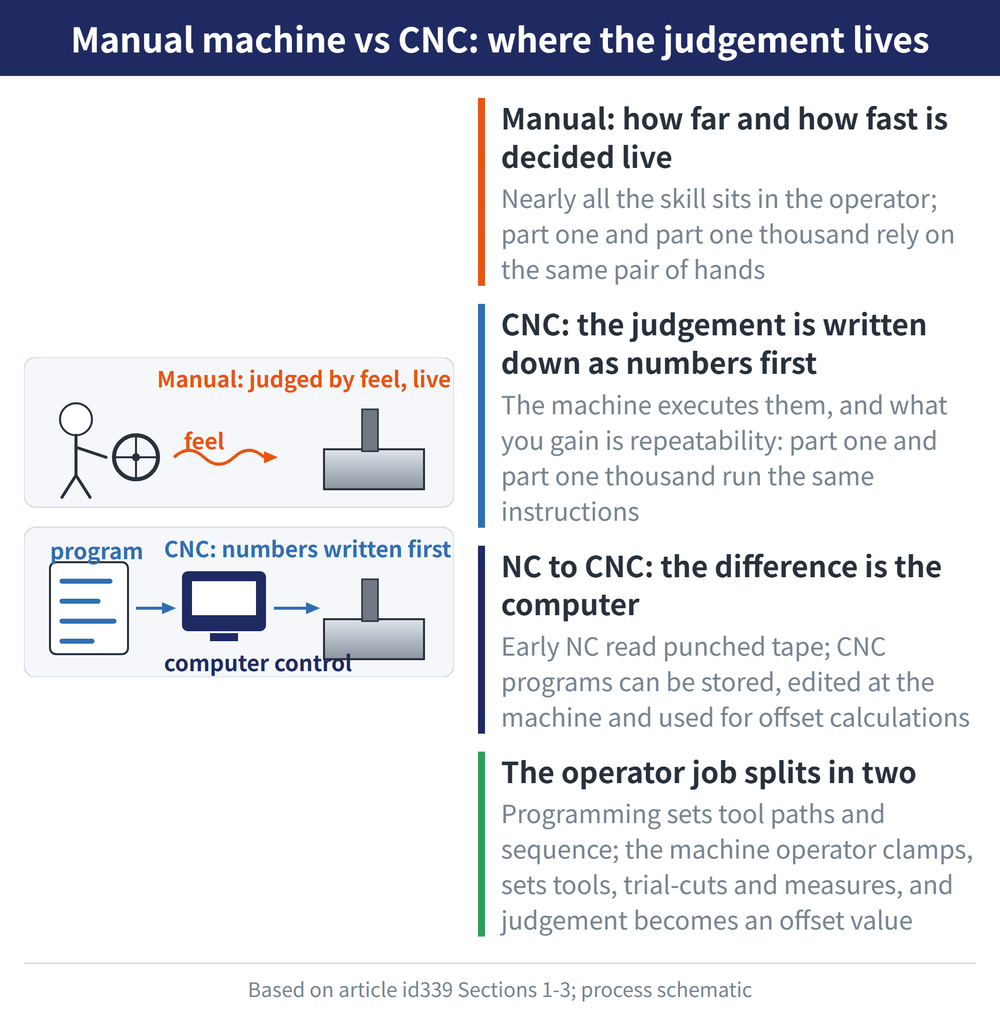
A manual machine tool depends on the feel of the operator on the handwheel — how deep, how fast, judged in real time by a person. What CNC does is write those judgements down as numbers in advance and have the machine execute them.
What you gain is not "better" but repeatable: the first part and the thousandth run the same set of commands. That is where consistency in volume production comes from.
2. What Separates NC from CNC
NC stands for Numerical Control. The concept was proposed in the late 1940s and the first machines were built in the early 1950s; it means controlling machine tool motion with numerical commands. Early NC had no computer — commands were read in from punched tape.
CNC stands for Computer Numerical Control, and the difference is exactly that computer: programs can be stored, edited at the machine, and used for offset calculations. That is the watershed in practical terms — changing one dimension no longer means punching a new tape.
3. How the Operator's Role Changed
In the manual era the skill lived almost entirely in the operator's hands. With CNC the work divides in two:
| Role | Responsible for |
|---|---|
| Programming | Tool paths, cutting conditions and the order of operations |
| Machine operation | Workholding, tool setting, test cuts, measurement and fault handling |
⚠ A split in roles is not a drop in difficulty. The person at the machine still reads the sound, the chip form and the drift in size — the difference is that the conclusion becomes an offset value rather than a change of grip.
4. How a Program Runs
The body of a program is G-code — a standardised command set telling the machine where to go, how fast to get there, and how fast to turn the spindle. In practice the three numbers being adjusted day to day are these:
| Parameter | Meaning |
|---|---|
| Spindle speed | Revolutions per minute of the tool or the workpiece |
| Feed | Speed of the tool relative to the workpiece |
| Depth of cut | How far into the material a single pass cuts |
How these three are set depends on the material, the tool and the rigidity of the machine; there is no universal value. On calculating them for milling see End Mill Cutting Conditions Calculation Guide.
5. When CNC Is Not Worth It
The cost structure of CNC is high up front, low per part: programming, tool setting and test cutting have to happen whether you make one part or a thousand.
So for a single, simple part with modest accuracy requirements, a manual machine is often faster — the setup time eats the whole benefit. The right question is not "can CNC make this" but whether the quantity justifies the setup time.
6. Frequently Asked Questions (FAQ)
Q: What is the difference between NC and CNC?
CNC adds a computer. Programs can be stored, edited at the machine and used for offset calculations, unlike early NC where changing a dimension meant making a new punched tape.
Q: Does CNC mean skill is no longer needed?
No. The skill moves into programming and judgement. The operator still reads the sound, the chips and the drift in size, but acts on it through offset values.
Q: What is G-code?
A standardised set of numerical control commands used to specify tool paths, feed rates, spindle speeds and other motions. It forms the body of a CNC program.
Q: When is CNC the wrong choice?
For single, simple parts with modest accuracy requirements. Program and tool-setting time is fixed, so with too few parts it consumes the entire benefit.
This article is part of CNC Machining Fundamentals: The Complete Guide - Know the Machine and Shop, Then Read the Drawing; that guide shows how the whole topic fits together.