BTA vs Ejector Deep-Hole Drilling: Coolant, Sealing and Machine Requirements
Gundrilling is not the only way to drill deep. What separates BTA single tube from ejector double tube is not just diameter range — it is which way coolant and chips travel, whether a sealing ring is needed, and whether you own a dedicated deep-hole machine. This guide compares the mechanisms and adds the guide pad and pilot hole rules.
1. Two Weaknesses Every Deep-Hole Drill Is Born With
Deep-hole drilling usually means a depth-to-diameter ratio above 20D. It is a separate technology, not a twist drill made longer. For how the three methods divide the work, see Deep Hole Drilling Methods Overview.
There are two inherent weaknesses. First, a deep-hole drill is not a self-centring tool, so it cannot control its own entry direction. Second, the extreme diameter-to-length ratio leaves it with inherently low radial rigidity. These two facts push the whole system design towards guiding and support rather than cutting.
Done properly, the geometric quality is clearly better than a twist drill can achieve — roundness deviation below 4 µm, and hole tolerance reaching IT8 to IT9 under recommended conditions (compiled from the ISCAR deep hole drilling handbook as a manufacturer example; use the catalogue or standard as the governing reference).
2. BTA Single Tube: External Coolant Feed, Internal Chip Removal
BTA stands for Boring and Trepanning Association, also known as STS (Single Tube System). It was developed in the 1940s specifically to solve two shortcomings of gundrilling: chips contacting and scratching the hole wall, and limited torque capacity.
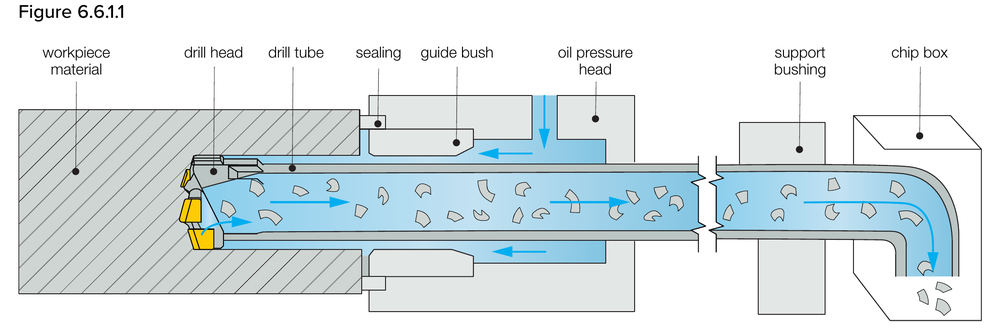
Its core principle is the reverse of gundrilling: the gundrill feeds coolant internally and evacuates chips externally along the V-flute, while BTA feeds coolant externally and evacuates chips internally. The stem diameter is smaller than the drill head, creating an annular gap between hole wall and stem — the so-called oil room. A pressure head directs filtered, high-volume coolant straight to the cutting edge, and chips travel back through the bore of the stem to the chip box.
The price is that a dedicated sealing ring is required between pressure head and workpiece, along with a dedicated deep-hole machine. The drill head screws onto the stem with a coarse rectangular thread, and the stem is the least rigid element in the whole system — its cross-section has to serve both maximum rigidity and the coolant and chip passages at once, which is a compromise in itself.
3. Ejector Double Tube: Doing Without the Seal
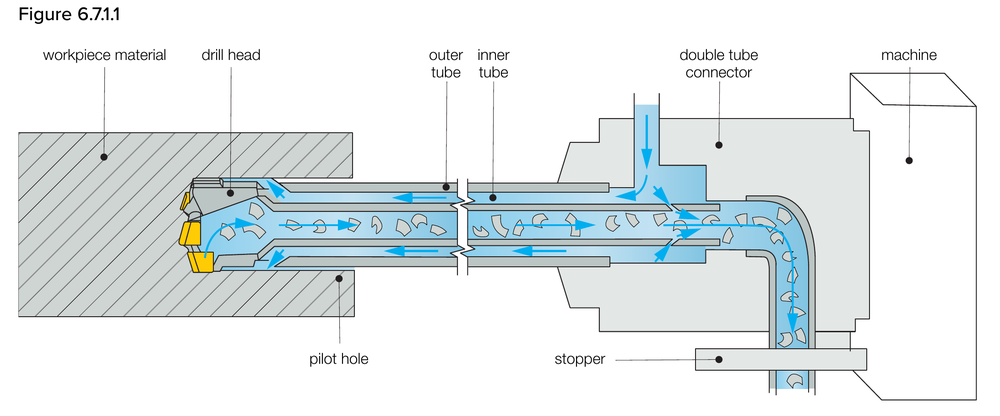
The ejector system, also called DTS (Double Tube System), was developed in the 1960s and consists of an outer and an inner tube.
Its main value is not cutting performance but that no sealing ring is needed: there is no gap to seal between workpiece and tool system, which simplifies both setup and maintenance. It can be fitted directly to an existing machining centre, horizontal boring machine, lathe or turning centre with nothing more than an external coolant pump station — no dedicated deep-hole machine required.
Chip removal works by ejector effect: a small part of the coolant flow is fed through sloped slots in the inner tube, travels along the inner tube axis towards the outlet and draws chips out of the cutting zone. The required coolant pressure is also lower than in the single tube system. One point worth noting: those slots are not placed arbitrarily — ejector drilling efficiency depends directly on the relative position of the slots, which is a fair question to ask a supplier.
A further practical advantage: the ejector system can machine interrupted holes, such as those in crankshafts and track pads.
4. All Three Systems Side by Side
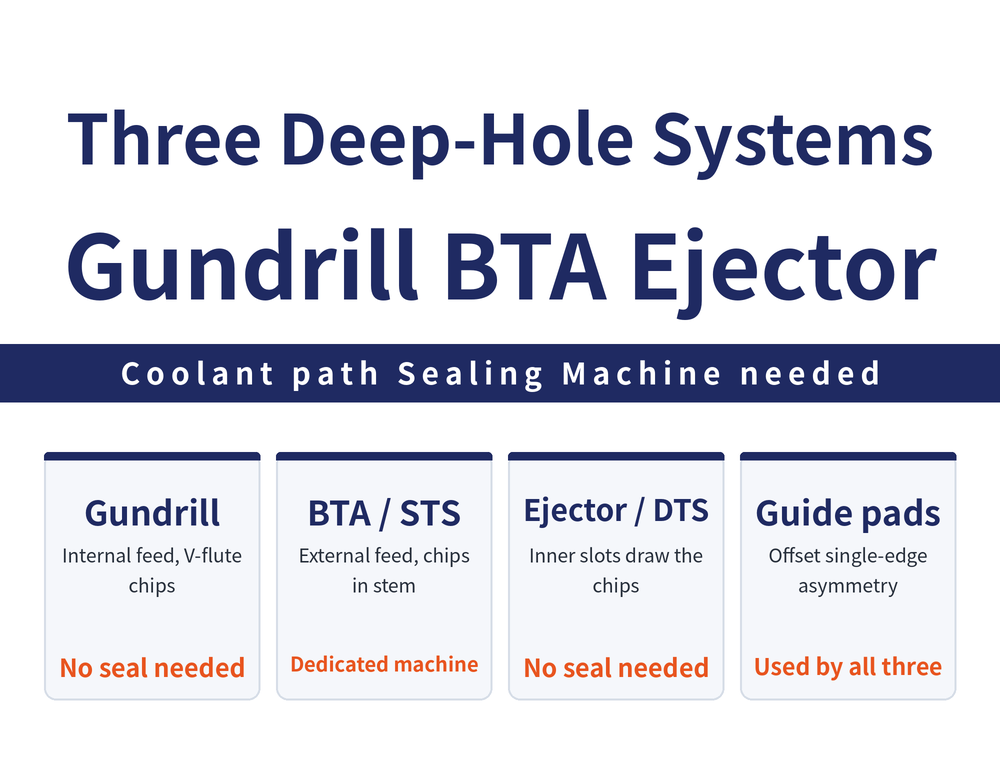
| System | Coolant and chip path | Sealing ring | Dedicated machine |
|---|---|---|---|
| Gundrill (ELB / SBL) | Internal feed, chips out along the V-flute | Not required | Preferred, but can be adapted |
| BTA (STS, single tube) | External feed, chips out through the stem | Required | Required |
| Ejector (DTS, double tube) | Inner tube ejector effect draws chips out | Not required | Not required, add a pump station |
Diameter is not the only selection criterion. The questions to ask first are about shop-floor conditions: is there a dedicated deep-hole machine? Is the added setup complexity of a sealing ring acceptable? The ejector system exists precisely as a compromise for the constraint of not wanting to buy a dedicated machine. For gundrill detail see Gun Drilling Guide.
5. Guide Pads: The Element All Three Depend On
A deep-hole drill is an asymmetric, single-edge design, and that asymmetry directly affects surface finish, hole tolerance and tool life. Guide pads exist to offset it.
Common practice is two guide pads per deep-hole tool, with double-chamfered pad edges so they enter smoothly and cause less early wear and less scratching of the hole surface. Pad size is selected according to drill diameter.
One pattern in hole tolerance: among BTA and DTS drills, indexable insert types reach IT10 while brazed tip types reach IT9 — brazed slightly ahead of indexable. This echoes a general rule in tooling: solid and brazed types usually hold tighter tolerance than indexable ones.
6. Shop-Floor Rules: Guiding, Support and Coolant
There are two routes for controlling entry direction. Dedicated deep-hole machines normally use a guide bushing whose bore equals the drill diameter; a general machining centre more often uses a pre-drilled pilot hole, after which the drill guides itself once fully engaged.
| Item | Recommended value |
|---|---|
| Clearance between guide bushing or pilot hole and drill | Not more than 0.01 mm |
| Pilot hole bottom shape | Flat bottom preferred over V-shaped |
| Support bushing spacing | Not more than 30 times the diameter |
| Pilot hole depth for hole depth 20D to 30D | 8D to 12D |
| Pilot hole depth for hole depth 60D to 80D | 30D to 40D |
| Coolant | Oil-based preferred over emulsion |
The values above are manufacturer examples from the ISCAR deep hole drilling handbook; use the catalogue for the tools in hand and your own machine conditions as the governing reference. A V-shaped bottom is discouraged because the taper makes the drill walk and shortens tool life. Two more rules of thumb: the drill should be slightly longer than the required hole depth to leave room for guide and support bushings, but within that constraint choose the shortest drill you can, because stability is better. Where conditions allow, drilling from both sides of the workpiece also reduces runout effectively.
7. Frequently Asked Questions (FAQ)
Q: What is the key difference between BTA and ejector systems?
The seal. BTA needs a dedicated sealing ring and a dedicated deep-hole machine; the ejector system needs neither and mounts on existing machines.
Q: Can deep holes be drilled without a dedicated machine?
Yes. The ejector double tube system was designed for this, mounting on a machining centre, horizontal boring machine, lathe or turning centre with an external coolant pump station.
Q: Why must a pilot hole not have a V-shaped bottom?
The taper makes the deep-hole drill walk off centre on entry and shortens tool life. A flat bottom is preferred.
Q: Why is oil-based coolant recommended for deep-hole drilling?
The chip evacuation path is long and lubrication demand is high, and oil-based coolant outperforms emulsion in this situation.
This article is part of Drill Bits: The Complete Guide - Start From Depth-to-Diameter, Then Pick the Drill and Set the Conditions; that guide shows how the whole topic fits together.