
Deep-Hole Drilling Methods: Twist, Gun and BTA Compared
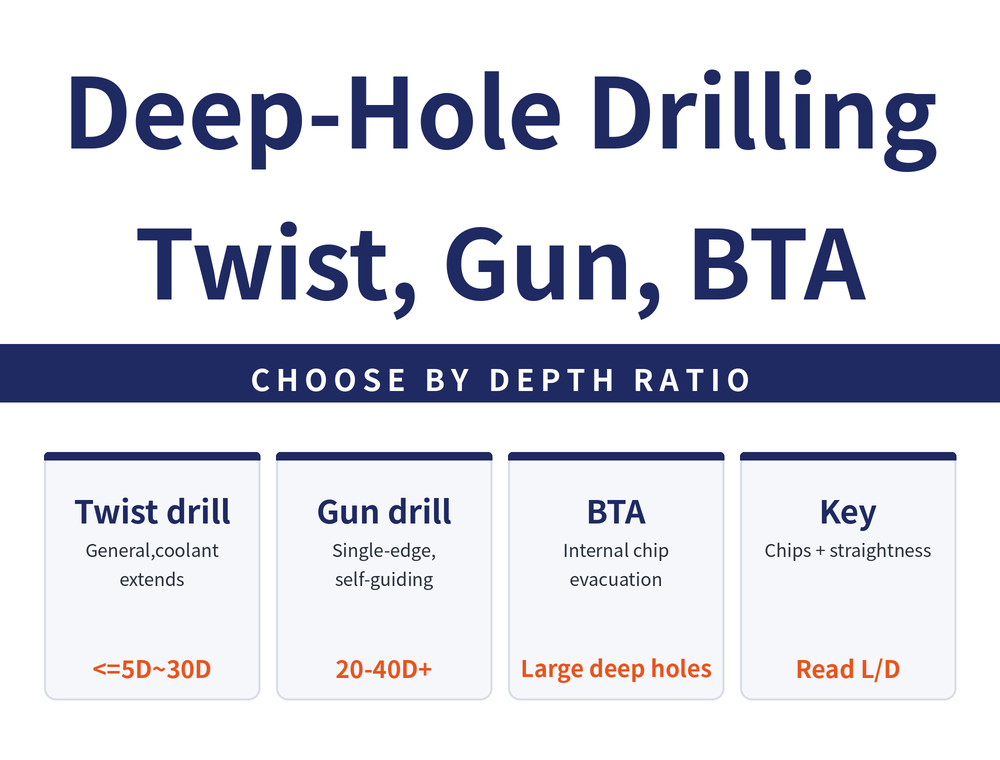
A deep hole is not the same drill running longer — past a certain depth what has to change is the method, not the parameters. This guide helps you decide which route the hole in front of you belongs to: measure the depth-to-diameter ratio and the diameter first, then check whether your equipment and batch size can carry it, and only then deal with chip evacuation and coolant. It maps where twist drills, gun drills and BTA each hold ground and where the boundaries fall, so you can judge for yourself whether to switch methods.
1. Why Depth Makes Drilling Harder
The deeper the hole, the longer the chip evacuation path and the more cutting heat accumulates; with insufficient guidance the drill deflects, and torque rises with depth. Depth is judged not by absolute value but by the depth-to-diameter ratio (L/D = hole depth / hole diameter).
Depth-to-diameter ratio L/D
L/D = hole depth ÷ hole diameter. A 100mm depth is L/D=5 in a Ø20 hole but L/D=20 in a Ø5 hole — a world apart in difficulty. Selection follows the ratio, not the depth figure.
2. How the Three Deep-Hole Methods Differ
The three mainstream methods differ in chip evacuation direction and achievable L/D. The table gives typical ranges; real capability varies with the system and material.
| Method | Typical L/D range | Chip evacuation and cooling | Best suited to |
|---|---|---|---|
| Twist drill (incl. long through-coolant) | Generally L/D≤5; with high-pressure through-coolant and peck drilling it extends to about 10–30D (system dependent) | Helical flutes carry chips upward; external or through-tool coolant | General-purpose holes, low equipment barrier |
| Gun drill (single-flute) | Typically very high, about 20–40D and beyond | Single edge, self-guiding; high-pressure coolant fed internally, chips carried out one side along the V-groove | Small to medium diameters, high-straightness deep holes |
| BTA (single-tube / double-tube) | High L/D, high efficiency | Coolant enters through the outer annulus, chips exit through the inside of the drill tube | Medium to large diameters, high-volume deep holes |
L/D and diameter ranges are typical values; refer to the catalogue or standard. Actual limits shift with machine pressure, coolant system and material.
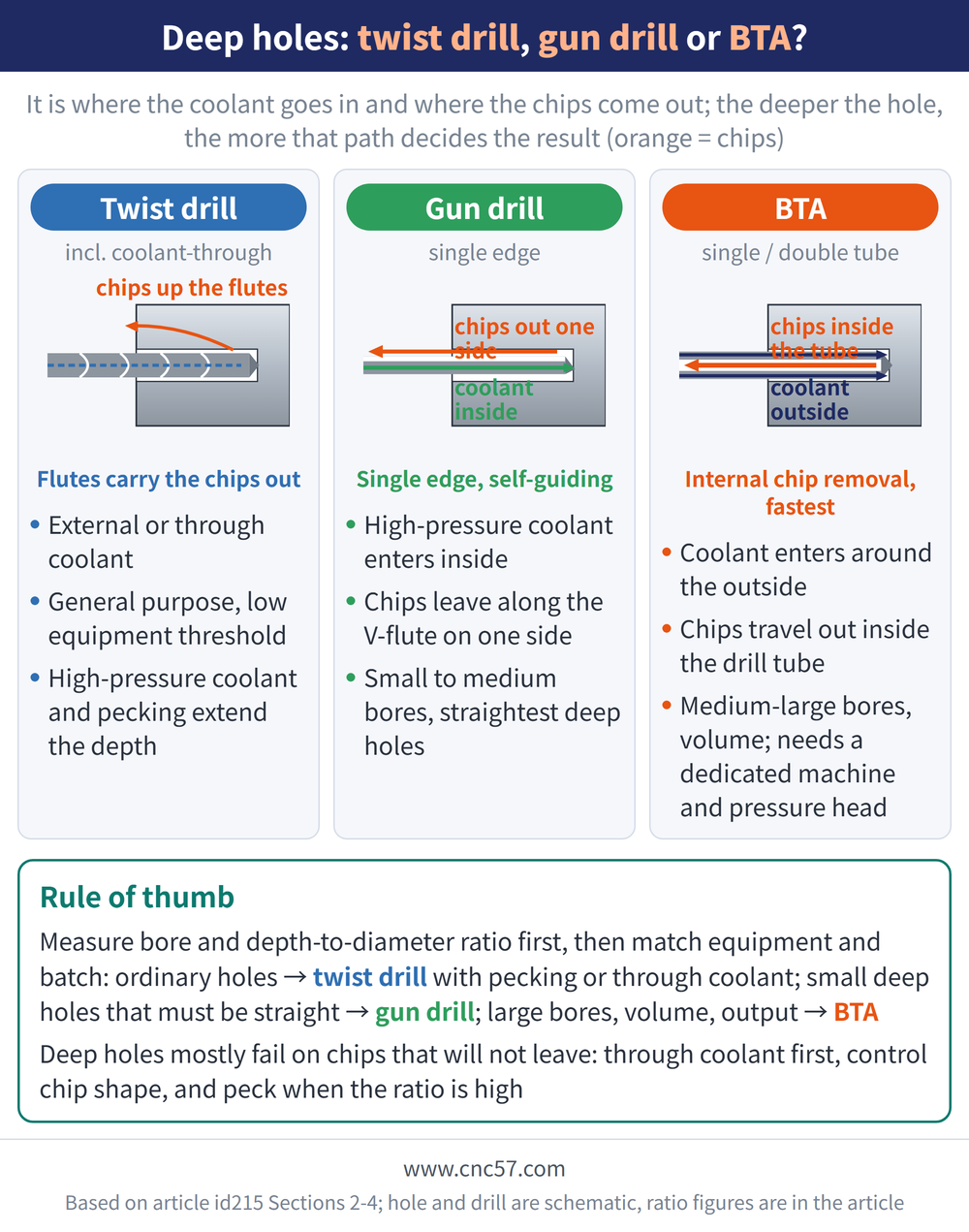
In one line: twist drills evacuate through the flutes and are general-purpose; gun drills evacuate on one side and hold straightness; BTA evacuates through the tube for the highest efficiency but needs a dedicated machine and pressure head.
3. Selection Logic: Diameter and L/D First, Then Equipment and Batch
The order is to measure diameter and L/D first, then match against the machines on hand and the batch size. The table below shows common correspondences.
| Situation | Recommended method | Reason |
|---|---|---|
| General hole, modest L/D | Twist drill + peck / through-coolant | Low equipment barrier, general-purpose; pecking and coolant clear the chips |
| Small deep hole, high straightness required | Gun drill | Single-edge self-guiding, excellent straightness, very high L/D |
| Large diameter, high volume, efficiency needed | BTA | Internal evacuation is highly efficient for production deep holes; needs a dedicated machine |
For peck settings, see Peck Drilling Guide; for the full route that brings hole accuracy into tolerance, see How to Improve Hole Accuracy; for deep-hole use of through-coolant drills, see Deep Hole Drilling Guide.
4. Chip Evacuation and Cooling Decide Deep-Hole Success
Most deep-hole failures trace back to chips that cannot get out: packed chips scratch the wall, raise torque and can snap the drill. Favour through-coolant, control the chip shape, and add peck drilling to break and clear chips at higher L/D.
For through-coolant methods and how through-coolant drills differ, see Through-Coolant Drill Guide; for how feed relates to chip shape, see Drilling Feed Rate vs Chip Formation.
Specific speeds, feeds and coolant pressures depend on material and diameter; calculate them via the Drilling Formula Handbook. This article lists no fixed figures.
Last updated: 2026-10-31
5. Frequently Asked Questions (FAQ)
Q: What L/D counts as a "deep hole"?
In practice an L/D of about 5 and above is generally treated as deep-hole drilling, where chip evacuation and straightness problems become pronounced. This is a typical threshold; refer to the catalogue or standard.
Q: How deep can a twist drill go?
A standard twist drill is generally L/D≤5; with a high-pressure through-coolant long drill and peck drilling it extends to roughly 10–30D. These are typical values; the real limit depends on machine pressure and the coolant system.
Q: How do gun drilling and BTA differ, and how do I choose?
A gun drill is single-edge with chips carried out one side along an external V-groove, suiting small to medium diameters at high straightness; BTA carries chips out through the drill tube at high efficiency, suiting medium to large diameters and high volumes, but needs a dedicated machine and pressure head. See Gun Drilling Guide: Structure, Self-Guiding and Practice for details.
Q: Why do deep holes wander, and how do I fix it?
Insufficient guidance and poor chip flow both make the drill deflect. Remedies are choosing a self-guiding method such as a gun drill, shortening overhang, drilling a pilot hole first, and strengthening through-coolant and peck evacuation.
For the full reading guides on this topic, see Chip Control: A Complete Reading Guide and Hole Accuracy: A Complete Reading Guide.
This article is part of Drill Bits: The Complete Guide - Start From Depth-to-Diameter, Then Pick the Drill and Set the Conditions; that guide shows how the whole topic fits together.









