
Choosing a Band Saw Blade: Terms, Pitch in TPI, and Tooth Forms
A band saw blade catalogue gives you a handful of numbers: width, thickness, and a pitch written as 2/3 or 3/4. This article names the eleven parts of a blade, explains why the tooth set decides whether the blade cuts at all, shows that the real difference between constant and variable pitch is resonance, and closes with four tooth forms and when a wide set is the right call.
1. Name the parts first
Before picking a blade, the words in the catalogue have to map onto real features. A band saw blade has eleven of them:
| Term | What it is |
|---|---|
| Pitch | Spacing between teeth, quoted as teeth per inch |
| Width | Width of the blade |
| Thickness | Thickness of the blade body |
| Gullet | Valley between teeth where chips are held |
| Gullet depth | How deep the gullet is, so how much chip it holds |
| Cutting face | The face the chip flows across |
| Rake angle | Inclination of the cutting face |
| Wedge angle | Included angle of the tooth itself |
| Back angle | Angle behind the tooth |
| Set width | Width of the kerf; see section 2 |
| Left / right set | How far each tooth leans to either side |
2. The tooth set: why a blade cuts at all
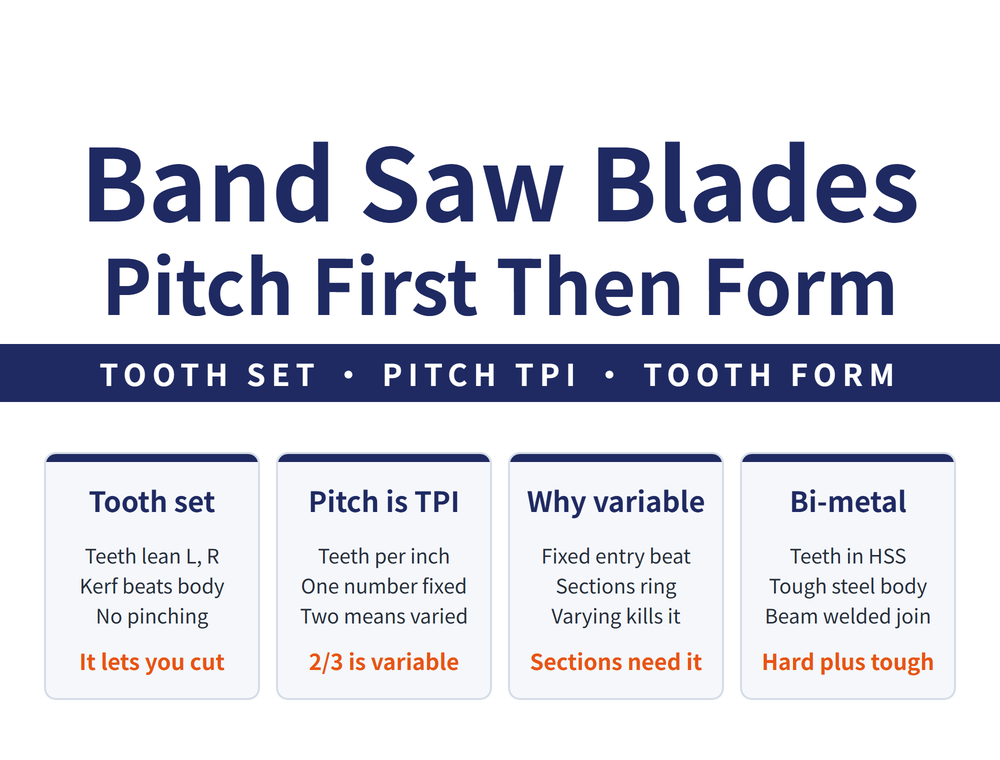
The entry on that list to understand first is the set. The teeth are not all in one plane; they lean alternately left and right.
The result is that the kerf comes out wider than the blade body. The blade runs inside the slot it just opened, and its flanks never touch the work.
🔑 That is the geometry behind "why it cuts". Lose the set, through wear or otherwise, and the kerf narrows onto the body: the blade binds, slips, heats, and wanders. For how cut-off methods compare, see Stationary Cutting: Choosing Among Five Methods.
3. Pitch is TPI: teeth per inch
The pitch quoted on a band saw blade is the number of teeth per inch (TPI).
A larger number means finer teeth, a thinner cut per tooth, and a smaller gullet. A smaller number means coarser teeth, a deeper bite per tooth, and more room for chips.
⚠ The marking itself tells you the type. A single number (2, 3, 4) is constant pitch. Two numbers (2/3, 3/4, 4/6) mean variable pitch.
4. Constant vs variable pitch: it is about resonance
| Type | How the pitch is laid out | Marking |
|---|---|---|
| Constant pitch | Pitch is fixed and teeth are evenly spaced | 2, 3, 4 |
| Variable pitch (VL) | Different pitches repeat within one tooth group | 2/3, 3/4, 4/6 |
What variable pitch buys you: on high-speed heavy cutting, or on structural sections where the cut length keeps changing, vibration and noise are lower and chip packing is eliminated.
🔴 It exists to break up resonance. On a section whose profile changes constantly — H-beams, angle — a constant pitch enters at a fixed frequency, vibration accumulates into resonance, and that shows up as noise and packed gullets. A varying pitch keeps shifting the entry frequency, so nothing accumulates.
The rule: solid round bar can run constant pitch; sections and tube, where the profile changes, should default to variable pitch.
5. Bi-metal: hard and tough at the same time
A band saw blade has a built-in conflict: the teeth must be hard enough to cut, and the body tough enough not to fatigue on the wheels. One material will not do both well.
The bi-metal answer is to choose separately and join:
| Part | Material | What it is for |
|---|---|---|
| Teeth | Premium powder or premium high-speed steel | Red hardness, holding an edge while hot |
| Body | Tough spring steel | Surviving repeated bending round the wheels |
The two are joined by electron beam welding. Knowing this has a practical payoff: a blade has two possible ends of life — the teeth dull, or the body fatigues and breaks. The causes and the fixes are not the same.
6. Picking a tooth form
| For | Type | Form and strength |
|---|---|---|
| General use | No type code | General form, from solid stock to mixed profiles |
| Solid material | H | Sharp edge plus large gullet, for high-speed cutting and good chip clearance |
| Solid material | MD | High-and-low teeth with a varied set, for low surface roughness |
| Deformed material | K / KS | Pitch and form suited to structural steel: chip-resistant, low vibration and noise |
📌 H and MD are both labelled for solid material; the question is speed or surface. H is built for throughput, MD for cut quality. Push MD for output, or ask H for a finish, and both will disappoint.
7. Wide set (WT): when the blade is being pinched
There is also a form with a wider set, coded WT. It opens a wider kerf, at the cost of removing more material and giving up some efficiency.
Its trigger is specific: cutting structural sections where the blade body gets pinched. The stated benchmark is H-beam 600 and above.
⚠ Note that this is a remedy, not a better blade in general. Fitting a wide set where nothing was binding just throws away material. For how the wider process is planned, see Manufacturing Process: The Complete Guide - Set the Datum First, Then Sequence, Allowance and Dry Cutting.
8. FAQ
Q: What does a pitch of "2/3" mean?
It is a variable pitch, not a fraction. Band saw pitch is quoted in teeth per inch. A single number such as 2, 3 or 4 is a constant pitch; two numbers such as 2/3, 3/4 or 4/6 mean two different pitches repeating within one tooth group. The slash is how you spot a variable-pitch blade.
Q: For H-beam, constant or variable pitch?
Variable. The width being cut through an H-beam changes continuously, and a constant pitch enters at a fixed frequency that accumulates into resonance — heard as noise and seen as packed gullets. A varying pitch keeps shifting that frequency. The rule is simple: changing profile means variable pitch; only a fixed profile such as solid round bar suits constant pitch.
Q: What happens when the set wears away?
The kerf narrows toward the thickness of the blade body, the flanks begin to rub the work, and the blade binds, slips, heats and wanders. The whole job of the set is to keep the kerf wider than the body, which is why remaining set is one of the real tests of whether a blade is still usable — not just whether the tips feel sharp.
Q: H and MD are both for solid material, so which one?
Decide on throughput versus surface. H combines a sharp edge with a large gullet and is designed for high-speed cutting and chip clearance; MD uses high-and-low teeth with a varied set to get surface roughness down. On the same solid stock, take H when output matters and MD when you would rather not face the cut again downstream.
For reading a bad cut back to its cause, see Band Saw Blade Troubleshooting: Five Failure Types and Two Measurable Benchmarks.
This article is part of Manufacturing Process: The Complete Guide - Set the Datum First, Then Sequence, Allowance and Dry Cutting; that guide shows how the whole topic fits together.
Published: 2026-09-21 | Last updated: 2026-10-25









