
Band Saw Blade Troubleshooting: Five Failure Types and Two Measurable Benchmarks
When a band saw cuts crooked, leaves a rough face, breaks a blade or chips teeth, the usual reaction is to fit a new blade. But these five failure types share two benchmarks you can measure on the spot, and excessive feed alone is a common cause in four of them. This article lists causes and remedies by failure type, and sets out three parameters where drifting either way produces two opposite failures.
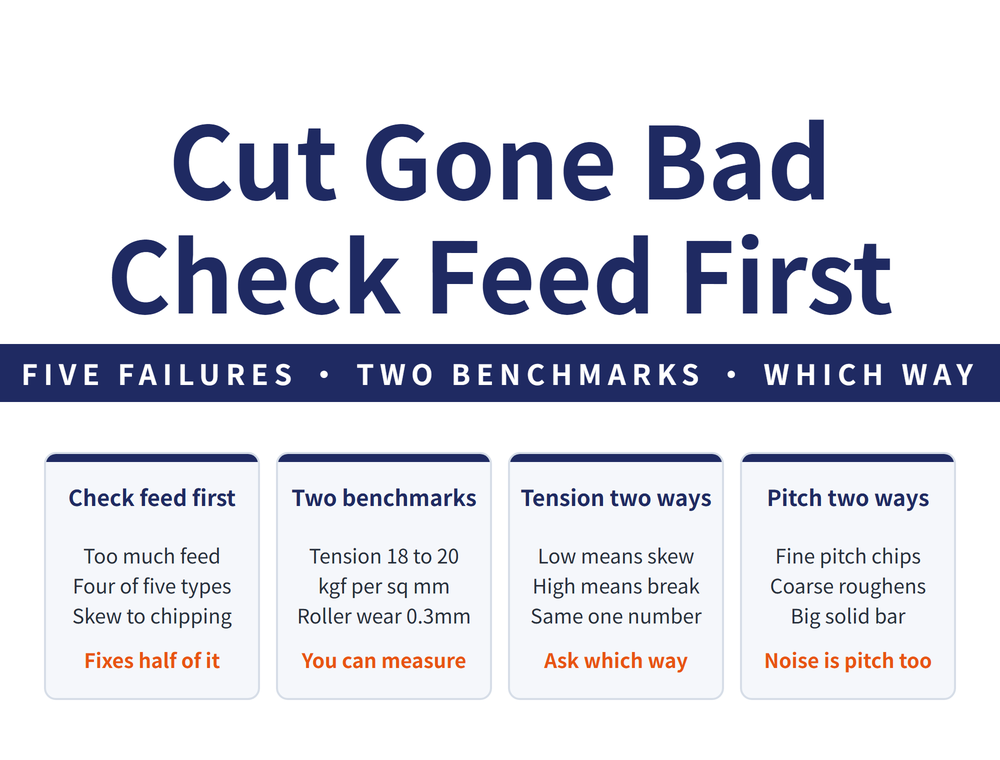
1. Check the feed first: the cause four types share
Lay the cause tables for all five failure types side by side and one entry keeps reappearing — excessive cutting feed.
It is a cause of crooked cuts, rough cut surfaces, blade breakage and tooth chipping. Only vibration and noise does not list it.
📌 So the first move on the floor is not a new blade; it is checking whether the feed is set too high. Getting that one right can clear half the symptoms at once. One seasonal note as well: hydraulic feed drifts in winter, so the same dial setting is not necessarily the same feed.
2. Two benchmarks you can measure, and three "which way" pairs
| Item | Benchmark | Which failure it touches |
|---|---|---|
| Blade tension | 18–20 kgf/mm² | Too low → crooked cut; too high → breakage |
| Back roller replacement | Replace at 0.3 mm wear or more | Breakage |
🔴 Diagnosis starts with "which way is it off", not "is it right". Three parameters produce entirely different failures depending on the direction of the error:
| Parameter | If it is too low | If it is too high |
|---|---|---|
| Blade tension | Crooked cut | Breakage |
| Pitch | Tooth chipping (worst on large solid bar) | Rough cut face, high vibration and noise |
| Cutting feed | — | Crooked, rough, breakage and chipping alike |
3. Crooked cut
| Cause | Remedy |
|---|---|
| Blade tension too low | Set it to 18–20 kgf/mm² |
| Side rollers worn | Replace, and check for uneven wear |
| Guide arms too far apart | Bring the movable guide arm as close to the work as possible |
| Cutting feed too high | Adjust the feed setting |
| Abnormal blade wear | Adjust cutting speed, or move to a higher grade of tooth material |
| Irregular contact on the blade flanks | Check side rollers and guide inserts; replace if wear is uneven |
| Workpiece not held firmly | Clamp it properly, especially when cutting bundles |
4. Rough cut surface
| Cause | Remedy |
|---|---|
| Pitch too coarse | Change to a suitable pitch, or reduce the feed |
| Cutting feed too high | Adjust the feed |
| Abnormal blade wear | Move to a higher grade of tooth material |
| Machine vibrating badly | Check guide arms, wheels and the rest for looseness and uneven wear |
For choosing pitch and tooth form, see Choosing a Band Saw Blade: Terms, Pitch in TPI, and Tooth Forms.
5. Blade breakage
| Cause | Remedy |
|---|---|
| Cutting feed too high | Adjust the feed (watch hydraulic feed drift in winter) |
| Blade tension too high | Set it to 18–20 kgf/mm² |
| Guide inserts loose | Check the inserts in both arms; correct looseness and tilt |
| Workpiece not held firmly | Clamp it properly |
| Back roller badly worn | Replace it at 0.3 mm wear or more |
| Cracks at the gullet base or the back of the blade | A crack is already the starting point of a break |
| Set rubbed off the teeth | Bring the movable guide arm as close to the work as possible |
| Many press marks on the blade | Check wire brush wear and position; clear chips from inside the wheels |
6. Tooth chipping
| Cause | Remedy |
|---|---|
| Cutting feed too high | Adjust the feed |
| Wire brush not doing its job | Replace it when worn, reposition it when misaligned |
| Not enough cutting fluid | Increase the volume and adjust nozzle position |
| Pitch too fine | Change pitch or reduce feed (watch this on large solid bar) |
| Edge impact entering or turning a corner on angle stock | Go finer on pitch, re-clamp the stock at an angle, or reduce feed (watch this on column-type machines) |
| Cut length jumps as angle or column stock finishes | Go coarser on pitch or reduce feed (watch this on hinge-type machines) |
| Blade moving up and down | Check wheels for uneven wear, guide arms for looseness, blade alignment |
⚠ Chipping has to be read together with the machine type. Cutting the same angle stock, a column-type machine is fighting impact at entry and corners, so the pitch goes finer; a hinge-type is fighting the sudden jump in cut length at breakthrough, so the pitch goes coarser. The two remedies point in opposite directions, and getting the machine type wrong makes it worse.
7. Vibration and noise
| Cause | Remedy |
|---|---|
| Cutting speed too high | Bring it back to a suitable speed |
| Blade badly worn | Move to a higher grade of tooth material |
| Pitch too coarse | Go finer on pitch, or switch to a variable-pitch form |
This is the one type of the five that does not list feed as a cause, so the search moves to speed and pitch instead.
8. Clamping: shape and bundle size decide the method
Loose clamping appears as a cause under both crooked cuts and breakage, which earns it a section of its own. The principle is blunt: without clamping suited to the shape and the number of pieces, the work moves during the cut and causes chipping, breakage and the rest.
Nine shapes have their own clamping arrangements: round bar, hexagon bar, H-beam, tube, square tube, channel, angle, C-section and rail — and for any one shape, cutting a single piece is not clamped the same way as a bundle of two to five.
⚠ This article does not attempt to describe the individual methods. Shapes multiplied by bundle sizes runs to dozens of combinations, and one wrong entry would have somebody clamping incorrectly. Work from the clamping chart supplied with the machine or by the blade supplier. For the principles behind workholding fixtures, see Workholding and Fixtures: The Complete Guide - Locate First, Then Clamp; How Much Force and Where It Comes From.
9. FAQ
Q: The blade keeps cutting crooked. Should I fit a new one?
Measure the tension first. The leading cause of a crooked cut is tension that is too low, and the benchmark is 18-20 kgf/mm2. Then work through the side rollers for wear, the movable guide arm for closeness to the work, the feed setting, and the clamping. Abnormal blade wear is only one of seven causes, so replacing the blade first often just produces a second crooked cut.
Q: Should the pitch go coarser or finer?
It depends which way the symptom points. Too fine a pitch chips teeth, most obviously on large solid bar; too coarse a pitch gives a rough cut face with high vibration and noise. The same parameter produces opposite failures in the two directions, so establish which side you are on before changing anything, rather than assuming finer teeth are always kinder.
Q: Why does the same angle stock call for finer pitch on one machine and coarser on another?
Because the teeth chip at different moments. A column-type machine is fighting edge impact at entry and at corners, so the remedy is a finer pitch and re-clamping the stock at an angle. A hinge-type is fighting the sudden jump in cut length as angle or column stock breaks through, so the remedy is a coarser pitch. The directions are opposite, so identify the machine type before chasing chipping.
Q: When should the back roller be replaced?
At 0.3 mm of wear or more. It is one of the eight causes of blade breakage, and one of the few that can be measured rather than judged by feel. Together with the other measurable benchmark, blade tension at 18-20 kgf/mm2, those two numbers are the first things to confirm when chasing a breakage.
This article is part of Manufacturing Process: The Complete Guide - Set the Datum First, Then Sequence, Allowance and Dry Cutting; that guide shows how the whole topic fits together.
Published: 2026-09-21 | Last updated: 2026-10-25









