Machine Shop Safety: Guarding, the No-Gloves Rule and What Actually Injures People
The most common injury on a machine shop floor is not a cut — it is being caught in or caught between moving parts. In Taiwan's Ministry of Labor survey of disabled occupational-injury workers (2021), caught-in and caught-between accounted for 33.5% of non-traffic occupational injuries, the highest single category. This article breaks shop-floor safety into four layers: the guarding the machine itself must have, two rules that run against instinct, what "stopping the machine" actually requires before maintenance, and how personal protective equipment is assigned — each tied to a numbered article of Taiwan's Occupational Safety and Health Facilities Regulations.
1. The most common injury is not a cut
Newcomers picture the danger as "the tool is sharp, it will cut me." The statistics say otherwise.
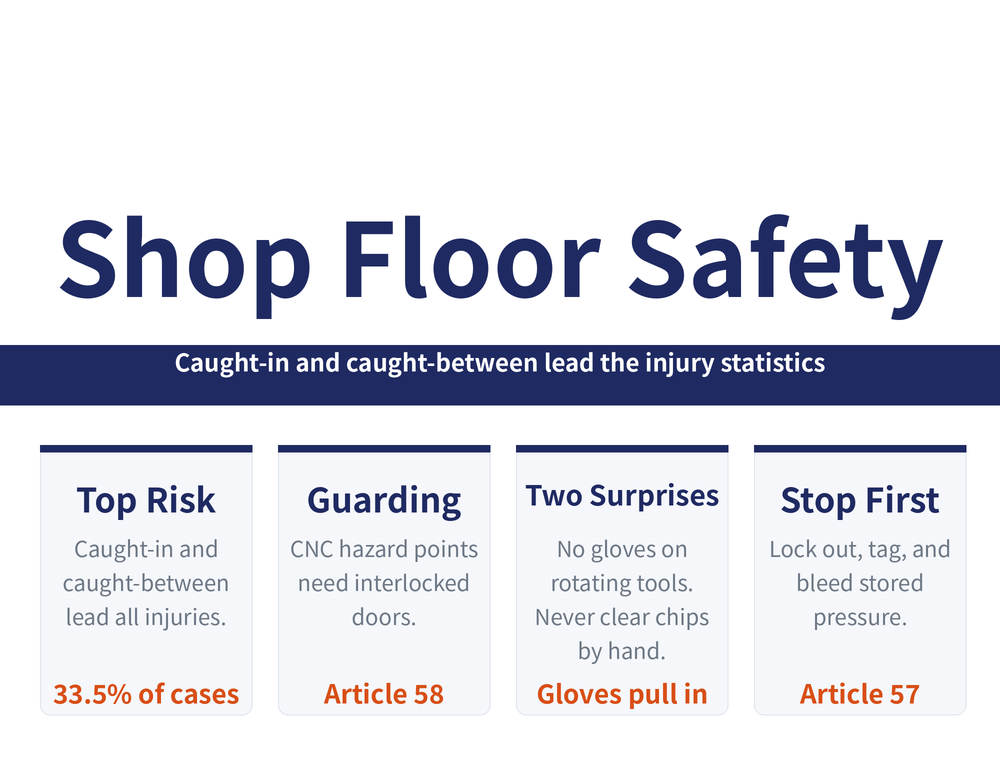
In the Ministry of Labor's June 2021 survey of disabled occupational-injury workers, "among non-traffic occupational injuries, caught-in and caught-between accounted for 33.5%, the highest, followed by punctures, cuts and abrasions at 7.4%." By industry, manufacturing led at 38.1%, followed by construction at 15.1%.
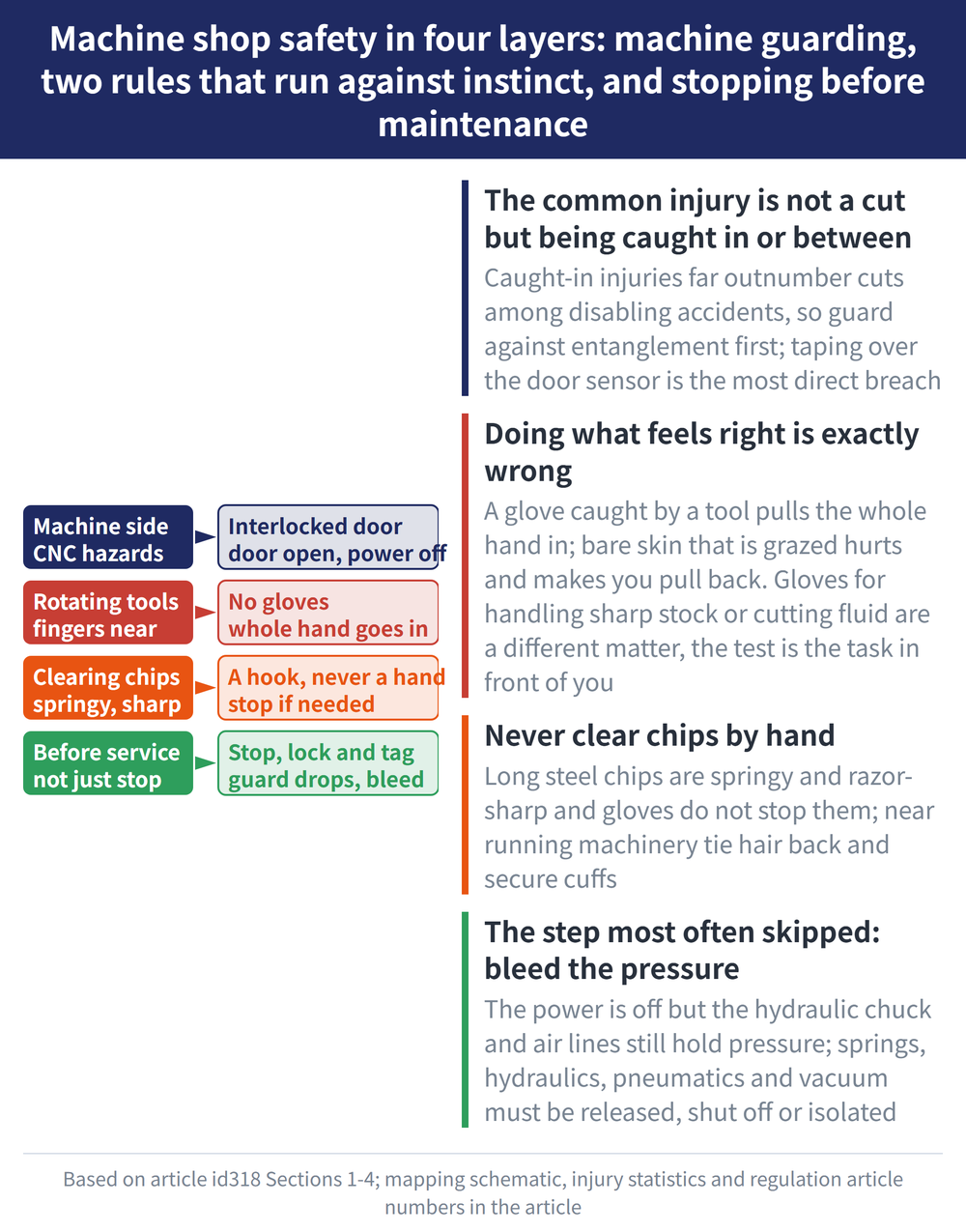
Caught-in and caught-between is more than four times the cut-injury rate. That ranking sets the order of this article: guard against entanglement before you guard against cuts.
2. The machine side: CNC hazard points need an interlocked door
Article 58, item 5 of the Occupational Safety and Health Facilities Regulations names "the hazardous parts of computer numerical control or other automated machinery" as requiring a guard, enclosure, or a safety door with interlocking capability.
Interlocked means the power cuts when the door opens. Taping over the sensor so the machine runs with the door open is the most direct way to breach this article.
| Article | Requirement |
|---|---|
| Article 43 | Shafts, gears, pulleys and belts require guards, enclosures or casings |
| Article 45 | Powered machinery with significant hazard needs a clearly marked emergency stop |
| Article 46 | Bearings must be properly lubricated; oiling during operation is prohibited |
| Article 58 (5) | Hazardous parts of CNC machinery require an interlocked safety door |
3. Two rules that run against instinct
What these two share: doing what feels right is exactly wrong.
No gloves on rotating tools. Article 56: "For work on drilling machines, mitre machines and other rotating cutting tools where the worker's fingers may come into contact, the employer shall clearly inform and post notice that gloves must not be used." A glove caught by a rotating tool pulls the whole hand in; bare skin that gets grazed hurts and makes you pull back, which protects you.
Never clear chips by hand. Taiwanese machine tool builder TMT writes in its CNC lathe safety notes: "Use a hook to clear or break chips promptly; stop the machine to remove chips when necessary, but never touch them by hand." Long steel chips are springy and razor-sharp — gloves do not stop them. On reducing long chips at source, see the complete guide to chip control.
Article 279 extends the same logic: where hair or clothing may be drawn into powered machinery in operation, workers must wear appropriate clothing and headwear — tie long hair back, secure loose cuffs.
4. Before cleaning or maintenance: stopping is not just pressing stop
Article 57 governs what must happen before cleaning, oiling, inspection, repair or adjustment. It is stricter than most people assume.
| Step | What the article requires |
|---|---|
| 1. Stop | Stop the machine and the material feed |
| 2. Lock and tag | Lock out or post notice so others cannot start it or feed material |
| 3. Falling objects | Provide equipment and measures against falling objects |
| 4. Bleed pressure | Where springs, hydraulic, pneumatic or vacuum systems hold residual pressure, release, shut off or isolate it |
Step 4 is the one most often skipped. The power is off, but the pressure in the hydraulic chuck and the air lines is still there.
5. Personal protective equipment: what the regulations list
| Article | Situation | Must be provided |
|---|---|---|
| Article 277 | General rule | Quantity at least equal to headcount, individually assigned in principle |
| Article 278 | Handling sharp or corrosive material | Gloves, apron, safety shoes, helmet, goggles, face shield |
| Article 280 | Falling or flying objects | Safety helmet and other necessary protection |
| Article 283 | High-noise workplaces | Earplugs or earmuffs, and workers must actually wear them |
| Article 288 | Substances that harm skin on contact | Impermeable clothing, gloves, boots or barrier cream |
The gloves in Articles 278 and 288 are not the same thing as the gloves banned by Article 56: the test is the task in front of you, not whether gloves are on your person.
6. Two hazards that arrive slowly
Cutting fluid. The safety data sheet for CPC Taiwan's cutting oil records that prolonged skin contact "causes defatting of the skin and dermatitis," and prolonged inhalation of oil mist "may cause fibroma and lipoid pneumonia," recommending NBR chemical-resistant gloves and splash goggles. Water-miscible fluids add a microbial problem. On selecting fluid types, see how to choose cutting fluid.
Noise. Article 300 sets permissible exposure: eight hours at 90 dB, four hours at 95 dB, two hours at 100 dB, one hour at 105 dB. The trigger is lower than most people assume: once the eight-hour time-weighted average exceeds 85 dB, or the exposure dose exceeds 50%, effective earplugs or earmuffs must be worn.
7. What to check when buying or accepting a machine
Taiwan's Occupational Safety and Health Administration requires that "numerically controlled lathes, milling machines and boring machines, combined machines and machining centres for metal cutting" complete safety information registration from 1 January 2023, precisely because "improper use or the absence of an interlocked safety door has led to recurring caught-in incidents." Manufacturers must complete testing and verification confirming conformity with CNS 15883 or ISO 23125 and display a safety label. Under Article 7 of the Occupational Safety and Health Act, manufacturers or importers in breach face fines up to NT$2 million.
In practice: at acceptance, check for a safety label or verification mark in a visible position on the machine, and check the registration status on the Administration's machinery safety information site.
8. Frequently Asked Questions (FAQ)
Q: Can you wear gloves when operating a CNC machine?
Not where fingers may contact rotating cutting tools — Article 56 states this explicitly. For handling workpieces or contacting cutting fluid with the machine stopped, Articles 278 and 288 require gloves.
Q: What is the most common injury in a machine shop?
In the Ministry of Labor's 2021 survey, caught-in and caught-between accounted for 33.5% of non-traffic occupational injuries, far ahead of punctures, cuts and abrasions at 7.4%.
Q: Once the machine is stopped, can I reach in to clear chips?
No. Article 57 requires stopping, then locking out or posting notice, and releasing residual hydraulic and pneumatic pressure; chips themselves should be cleared with a hook, never by hand.
Q: How loud does a workshop need to be before hearing protection is required?
Under Article 300, protection must be worn once the eight-hour time-weighted average sound pressure level exceeds 85 dB or the exposure dose exceeds 50%. The 90 dB figure is the eight-hour permissible ceiling, not the point at which protection starts.
Regulatory text in this article is drawn from Taiwan's Occupational Safety and Health Facilities Regulations; statistics from the Ministry of Labor's 2021 survey of disabled occupational-injury workers; source-control requirements from the Occupational Safety and Health Administration announcement. Regulations are revised over time; the current official text and the competent authority's interpretation govern.
Last updated: 2026-08-20
This article is part of CNC Machining Fundamentals: The Complete Guide - Know the Machine and Shop, Then Read the Drawing; that guide shows how the whole topic fits together.