
Chip Control: A Complete Reading Guide
Poor chip evacuation is a failure source shared by drilling, turning and tapping, and this site has 29 articles on controlling it. This page is a reading guide. It does not repeat what those articles say; it answers one question: where is your chip stuck, and which article should you open first.
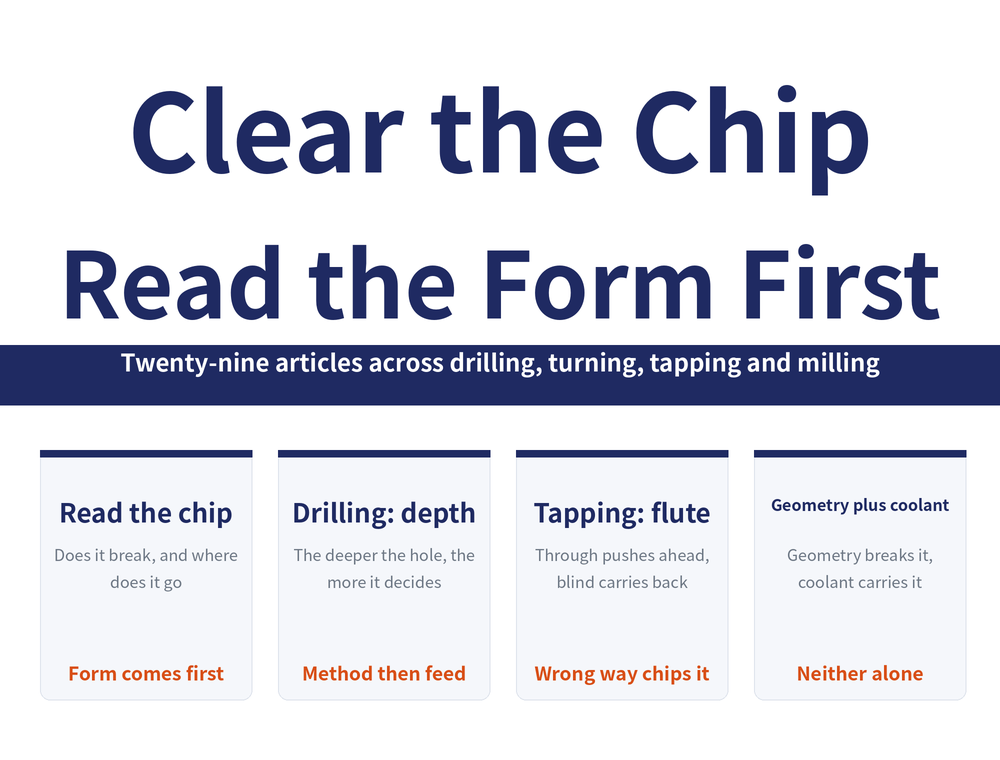
1. Understand the Chip First: Form, Breaking and Why It Matters
Whether the chip breaks and where it goes is the root of every chip problem. Reading the form beats memorising numbers.
| Article | When to open it |
|---|---|
| Drill Chip Formation Guide | The main entry point: recognise the seven chip forms first |
| Turning Chip Control Guide | Where to start on the turning side: chipbreaker, feed and conditions |
| Drilling Feed Rate vs Chip Formation | Too low and the chip will not break; too high and it packs |
| Drill Geometry and Function | Helix angle and web are chip-evacuation design to begin with |
2. Chip Evacuation in Drilling: Deep Holes, Pecking and Coolant
The deeper the hole, the more evacuation decides the result. Pick the method and coolant first, then the feed.
| Article | When to open it |
|---|---|
| Deep-Hole Drilling Methods Overview | Pick the deep-hole method first; the chip path follows |
| Peck Drilling Guide | When to peck to clear chips, and how far |
| Coolant-Through Deep-Hole Drilling | At high depth-to-diameter, coolant flushes the chip out |
| Small-Diameter Deep-Hole Drilling | In small deep holes, chip evacuation almost decides it |
| Gun Drilling Guide | The single-flute gun drill carries the chip back along its vee |
| 3-Flute Drill Guide | Three flutes leave less chip room; pull the feed back to match |
3. How Drill Design Drives Chip Evacuation
Flute length, helix angle and flute count decide whether the chip has room to leave.
| Article | When to open it |
|---|---|
| Drill Flute Length vs Rigidity | Too long a flute buys chip room but loses rigidity |
| Drill Performance Factors | Chip evacuation is one axis of performance, read with conditions and rigidity |
| Flat Drill vs Twist Drill vs End Mill | Chip-clearing ability differs a lot between these tool types |
| Indexable Drill Guide | The inner and outer edges of an indexable drill shed chips separately |
4. Turning and Boring: Chipbreaker and Chip Control
Turning and boring break the long chip with a chipbreaker, then carry it away with coolant.
| Article | When to open it |
|---|---|
| Boring Chip Control and Coolant | Boring chip control combines through-coolant and chip shape |
| Insert Angle Reference | Insert angle changes how the chip curls and whether it breaks |
| ISO Turning Insert Guide | The chipbreaker code sits inside the insert designation |
| Thread Troubleshooting Guide | Poor chip flow in threading usually traces to the infeed method |
| Parting and Grooving Troubleshooting | Parting jams first on trapped chips; check here |
5. Chip Handling in Tapping
A tap flute sends the chip forward or back; choose wrong and the thread chips.
| Article | When to open it |
|---|---|
| Tap Flute Design Guide | Straight, spiral and spiral-point flutes send chips different ways |
| Spiral-Point Tap Guide | For through holes, a spiral-point tap pushes chips ahead |
| Spiral-Point Tap Series Guide | Choosing between PO and SL by chip direction |
| Tapping Troubleshooting Guide | Poor chip flow is a common root of chipped threads and breakage |
| Pipe Tap Troubleshooting Guide | Check chip flow first for finish and chipping in pipe tapping |
| Thread Machining Solutions | Breakage, wear, oversize and chip flow in one table |
6. Milling Direction and Tool Type
Fix the cut direction and tool type first, then the chip thickness and room settle.
| Article | When to open it |
|---|---|
| Climb vs Conventional Milling | Climb or conventional decides whether the chip starts thick or thin |
| End Mill Flute Count and Helix Angle: How to Choose | Flute count and flute form set the chip room |
7. Chips by Workpiece Material
Cast iron and aluminium shed different chips, so the evacuation logic changes with them.
| Article | When to open it |
|---|---|
| Cast Iron Machining Guide | Cast iron sheds fragmented chips; the logic differs from steel |
| Aluminum and Non-Ferrous Machining | Long sticky aluminium chips need chipbreaking and evacuation together |
8. Frequently Asked Questions (FAQ)
Q: The chip keeps wrapping the tool, what now?
Identify the chip form first (see the Drill Chip Formation Guide), then work on feed, chipbreaker or peck retract, rather than just adding more coolant.
Q: A deep hole keeps packing chips, is it the drill?
Usually it is the method and the chip path. Read the Deep-Hole Drilling Methods Overview to pick the method, then decide on pecking or through-coolant; with a long drill, use the last section of How to Drill Deep Holes with a Long Drill to find which step went wrong.
Q: My taps keep chipping the thread, is that a chip issue?
Often yes. If the flute direction does not match the hole type (through or blind), trapped chips break the thread. See Section 5.
Q: Is chip control about coolant or about geometry?
Both. Geometry breaks the chip small; coolant, especially through-tool, carries it away. Neither works alone.
Published: 2026-08-11 | Last updated: 2026-10-19









