
Cutting Fluid Selection: Water-Miscible, Neat Oil, MQL and Dry
A cutting fluid has to cool, lubricate, flush chips and prevent rust at once, and the four jobs conflict: water-based fluids cool well but lubricate poorly, oil-based fluids lubricate well but cool and clean poorly, so no universal cutting fluid exists. This guide puts the four families and the process-by-process tendency into comparison tables, and explains why management goes wrong more often than selection.
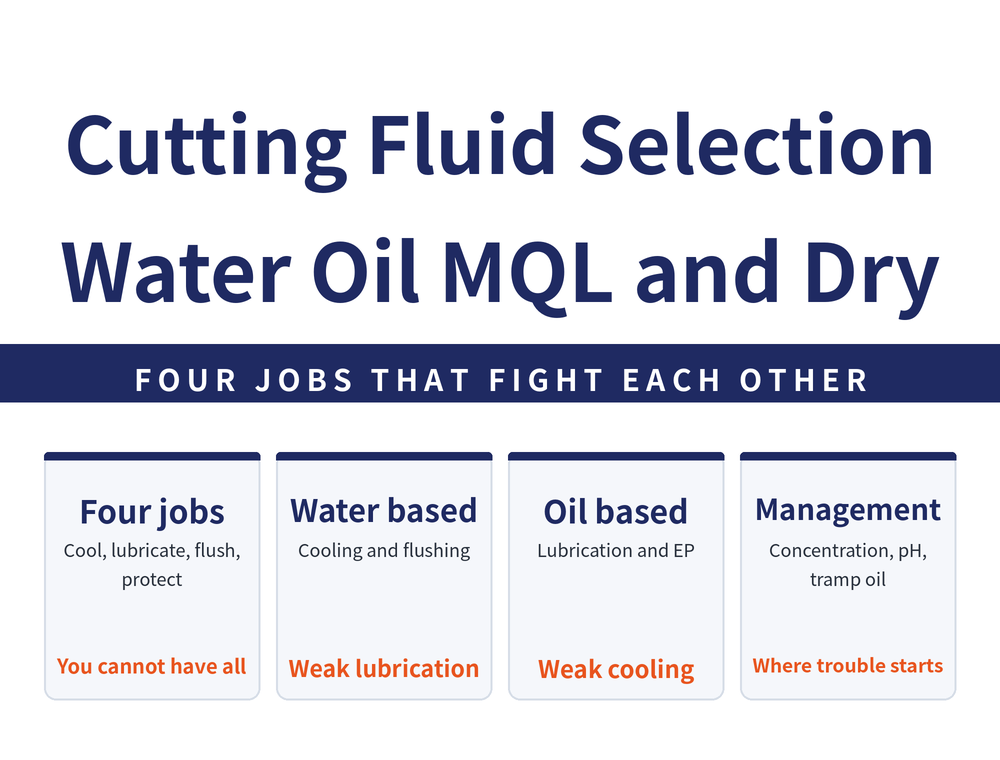
1. A Cutting Fluid Does Four Jobs, and They Conflict
| Job | How it is achieved | Stronger side | Symptoms when it falls short |
|---|---|---|---|
| Cooling | Specific heat and flow rate carry heat out of the cutting zone | Water-based | Faster tool wear, thermal distortion, size drifting batch to batch |
| Lubrication | An oil film plus extreme pressure additives (EP additives, which react with the metal under heat and pressure to form a chemical film that stops chip welding) reduce friction | Oil-based | Built-up edge, rougher surface, tapping torque rising until taps break |
| Chip evacuation | Low viscosity plus enough flow and pressure to wash chips out of the cut | Water-based | Chips recut, edge chipping, deep holes packing until the drill breaks |
| Rust prevention | Corrosion inhibitors or an oil film keep moisture and air off the surface | Oil-based | Parts and machine tables rust, leaving stains on finished surfaces |
The table gives general direction only; concentration and change intervals follow the manufacturer's instructions — not measurements taken by this site.
Selection means deciding which of the four comes first in this operation. For the cutting condition arithmetic see the Machining Formulas Cheat Sheet.
2. The Two Water-Based Families: Emulsion and Semi-Synthetic / Synthetic
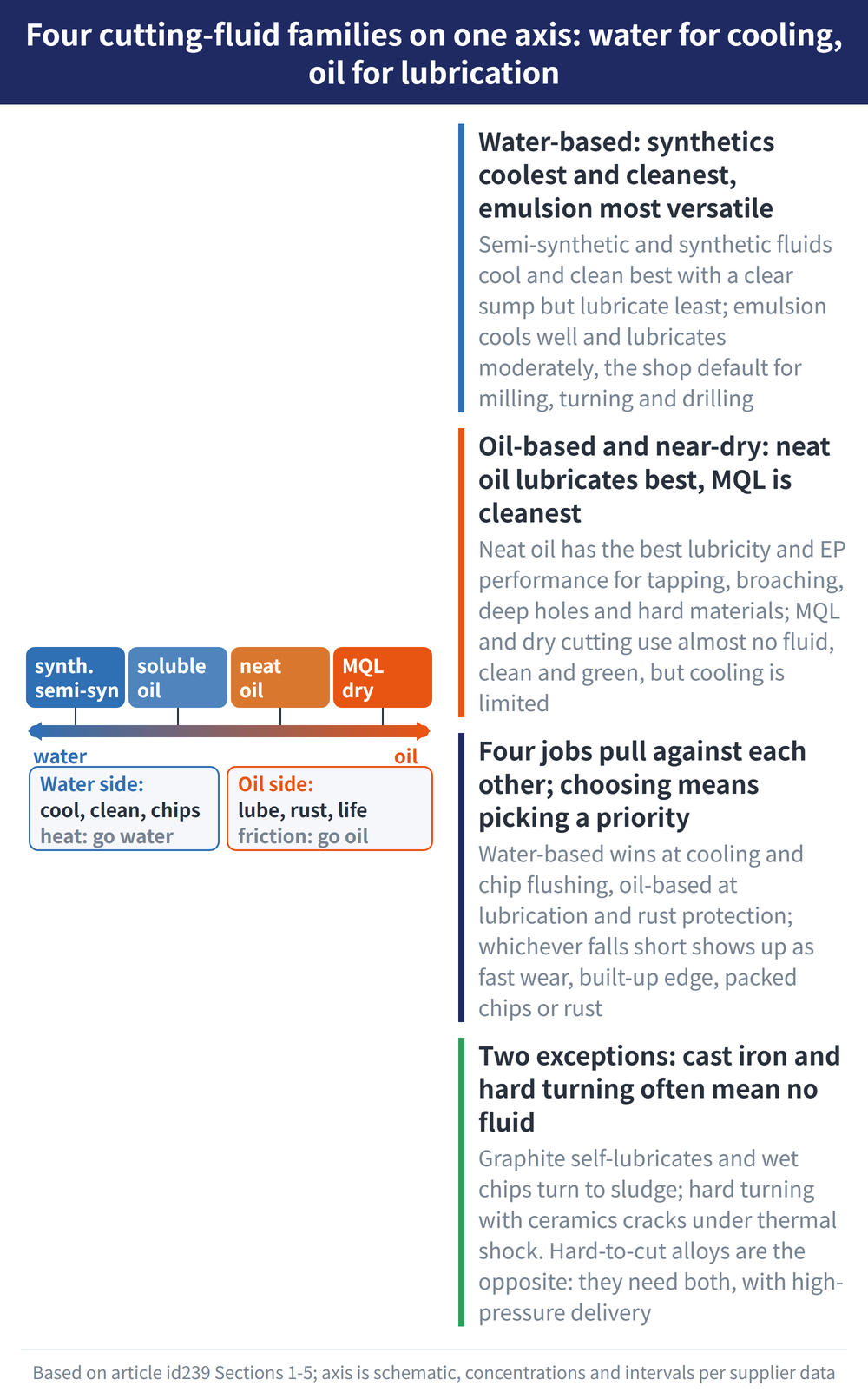
The four families sit on a single axis running from water to oil: move toward water for cooling and cleanliness, toward oil for lubrication and tool life.
| Family | Strength | Weak point | Typical use |
|---|---|---|---|
| Water-miscible emulsion (mineral oil dispersed in water by emulsifiers, giving the familiar milky sump) | Good cooling, moderate lubrication, the widest coverage | Emulsion stability depends on water quality; bacteria take hold when management slips | General milling, turning and drilling; the shop-floor default |
| Semi-synthetic / synthetic (water-based fluids with far less oil, or none at all) | Best cooling and cleanliness, clear sump, visible cut, better bacteria resistance | Weakest lubrication, so heavy loads and difficult materials overwhelm it; some formulations irritate skin | Grinding, high-speed light-load work, jobs needing cleanliness and visibility |
3. Oil-Based and Near-Dry: Neat Oil, MQL and Dry Cutting
| Family | Strength | Weak point | Typical use |
|---|---|---|---|
| Neat cutting oil (used undiluted, with no water added) | Best lubrication and extreme pressure performance, most stable tool life and thread quality | Poor cooling; oil mist, machine cleanliness and fire precautions all add burden | Tapping, broaching, deep holes and difficult-to-cut materials |
| MQL (Minimum Quantity Lubrication, a very small amount of oil mist delivered to the cutting point) and dry cutting | Almost no fluid to manage, strong on cleanliness and environment, dry chips easy to recycle | Limited cooling: heat leaves with the coating and the chips, which restricts material and process choice | Cast iron, aluminium alloys and selected dry operations, with heat-resistant coated tools |
The table gives general direction only; concentration and change intervals follow the manufacturer's instructions — not measurements taken by this site.
For the water-miscible versus non-water-miscible decision in drilling alone, see Cutting Fluid Comparison for Drilling.
4. Choosing by Process (1): Milling and Turning, Tapping, Deep Holes and Aluminium
The table states a tendency rather than a rule; shop trials still decide.
| Process / material | Tendency | Reason |
|---|---|---|
| General milling and turning | Water-miscible emulsion | Heat is high but lubrication demand is ordinary, so cooling and chip flushing come first; one sump serves many jobs |
| Tapping and broaching | Neat cutting oil (lubrication first) | Cutting speed is low and the contact area large, so friction and welding are the real problem and lubrication outweighs cooling |
| Deep-hole drilling | High-pressure through-coolant, with neat oil or a high-lubricity water-miscible fluid | Fluid that never reaches the hole bottom might as well not be there, and chip evacuation matters more than cooling; for methods see the Deep-Hole Drilling Methods Overview, for the supply path the Coolant-Through Tool Holder Guide |
| Aluminium and non-ferrous metals | Water-miscible, avoiding strongly alkaline formulations | A high-alkalinity sump attacks aluminium surfaces and leaves stains and discolouration; see the Aluminum and Non-Ferrous Machining Guide |
5. Choosing by Process (2): Cast Iron, Hard Turning and Difficult Materials
| Process / material | Tendency | Reason |
|---|---|---|
| Cast iron | Often dry, or with MQL | Graphite is self-lubricating, and wet cutting turns the fine dust into a sludge that is harder to clear; see the Cast Iron Machining Guide (ISO K) |
| Hard turning and ceramic inserts | Mostly dry | Thermal shock in an interrupted cut cracks the insert, so running dry is the more stable choice; see the Hard Turning Guide |
| Difficult-to-cut materials (titanium, superalloys) | High-concentration water-miscible or neat oil, with high-pressure delivery | Both lubrication and cooling are needed, and the chips carry little heat away; see the Titanium and Superalloy Machining Guide (ISO S) |
The table gives general direction only; concentration and change intervals follow the manufacturer's instructions — not measurements taken by this site.
Move toward oil when friction is the problem, toward water when heat is; cast iron and hard turning are the exceptions, where the answer is often no fluid at all.
6. Day-to-Day Management: Concentration, pH and Tramp Oil
Most shop-floor complaints are not about the wrong fluid but about a fluid never looked after; the gap between good and poor management often exceeds the gap between families.
| Item | What to do | What happens if you do not |
|---|---|---|
| Concentration | Measure regularly with a refractometer (a handheld instrument that reads concentration from a single drop of sump fluid) and top up; the target follows the manufacturer's instructions | Too lean: lubrication and rust protection fail, bringing corrosion and odour; too rich: sticky residue, higher cost, more skin irritation |
| pH and bacteria | Measure pH regularly and track the trend, keeping to the range in the manufacturer's instructions; a smelly sump is usually a management fault | A steadily falling pH means bacteria are active, followed by odour, emulsion breakdown and rusted parts |
| Tramp oil and chips | Skim tramp oil off the surface and clear chips and fines from the tank bottom on a schedule | Tramp oil seals out air and lets anaerobic bacteria multiply; fines wear pumps and lines and block through-tool passages |
7. Water Quality and Change-Out: Hardness, Intervals and Waste
| Item | What to do | What happens if you do not |
|---|---|---|
| Water quality (hardness) | Mixing-water hardness affects emulsion stability, so keep to one water source and confirm its hardness | Hard water throws out soap scum and scum layers; soft water foams and overflows the tank |
| Change-out and waste | Judge the change interval from the manufacturer's instructions and the condition of the sump; spent fluid is industrial waste and must be handled by a licensed contractor | A sump left too long cannot be rescued by topping up and has to be dumped; improper disposal also carries legal risk |
The table gives general direction only; concentration and change intervals follow the manufacturer's instructions — not measurements taken by this site.
Concentration is the one most often skipped: it costs almost nothing and takes a minute to check, yet it decides how hard the other four become.
Last updated: 2026-08-08
8. Frequently Asked Questions (FAQ)
Q: Can a shop run on a single cutting fluid?
A small shop with simple processes can, usually on the most versatile water-miscible emulsion. Once tapping, deep holes or difficult materials appear, it is worth keeping a high-lubricity fluid alongside it.
Q: If the coolant smells, does that mean it must be replaced?
Odour usually comes from lean concentration, accumulated tramp oil or an uncleaned tank, so check management before deciding to dump it. When the call is not clear, follow the change-out conditions in the manufacturer's instructions.
Q: Can MQL replace cutting fluid completely?
On cast iron, aluminium alloys and selected light-load work it can, and cleanliness and environment are its strengths. Cooling capacity is limited, so deep holes and difficult materials still need a full supply of fluid.
Q: Why does deep-hole drilling insist on through-coolant?
External flood cannot reach the hole bottom, and chips that cannot escape are recut until the drill breaks. For the drill side see the Through-Coolant Drill Guide, and where through-coolant is unavailable see the Peck Drilling Guide.
This article is part of Dry Machining: The Complete Guide - Losing the Coolant, and How Five Processes and Three Techniques Cope; that guide shows how the whole topic fits together.









