
Carbide Drill Regrinding Guide: Angles, X-Thinning & Honing
The regrinding quality of a carbide (tungsten) drill directly affects accuracy, cutting efficiency and tool life. Key points are chisel-edge grinding, clearance-angle setting and edge honing (R): point angle around 140°, second clearance about 8°–12°, and an X-type chisel-edge grind with an appropriate residual length. Correct grinding and angle control lower cutting resistance, improve evacuation and prevent chipping. This guide gathers standardized regrinding points as a reference for stable CNC drilling.
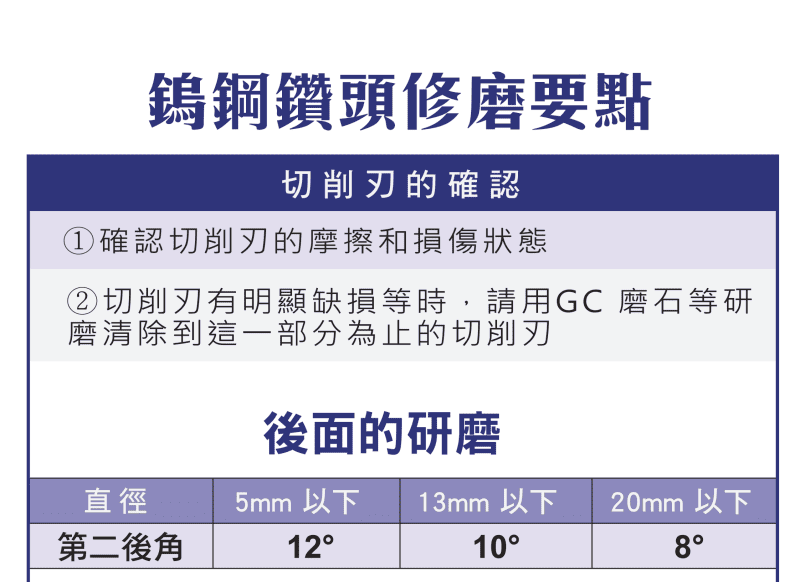
1. Purpose and Pre-Grind Check
Regrinding restores cutting performance, extends tool life and improves accuracy. Before starting, check the edge for wear or nicks, look for chipping and assess friction; if damage is obvious, true the edge first.
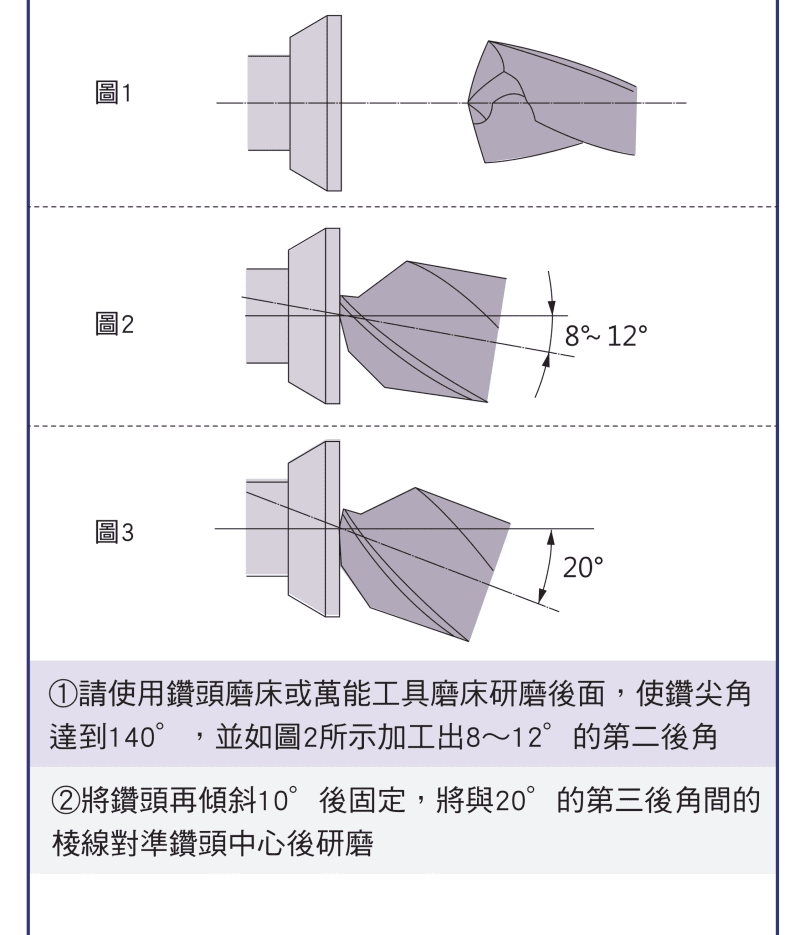
2. Clearance and Point Angles (Reference)
| Item | Reference angle |
|---|---|
| Point angle | approx. 140° |
| Second clearance (≤⌀5mm) | approx. 12° |
| Second clearance (≤⌀13mm) | approx. 10° |
| Second clearance (≤⌀20mm) | approx. 8° |
| Third clearance | approx. 20° |
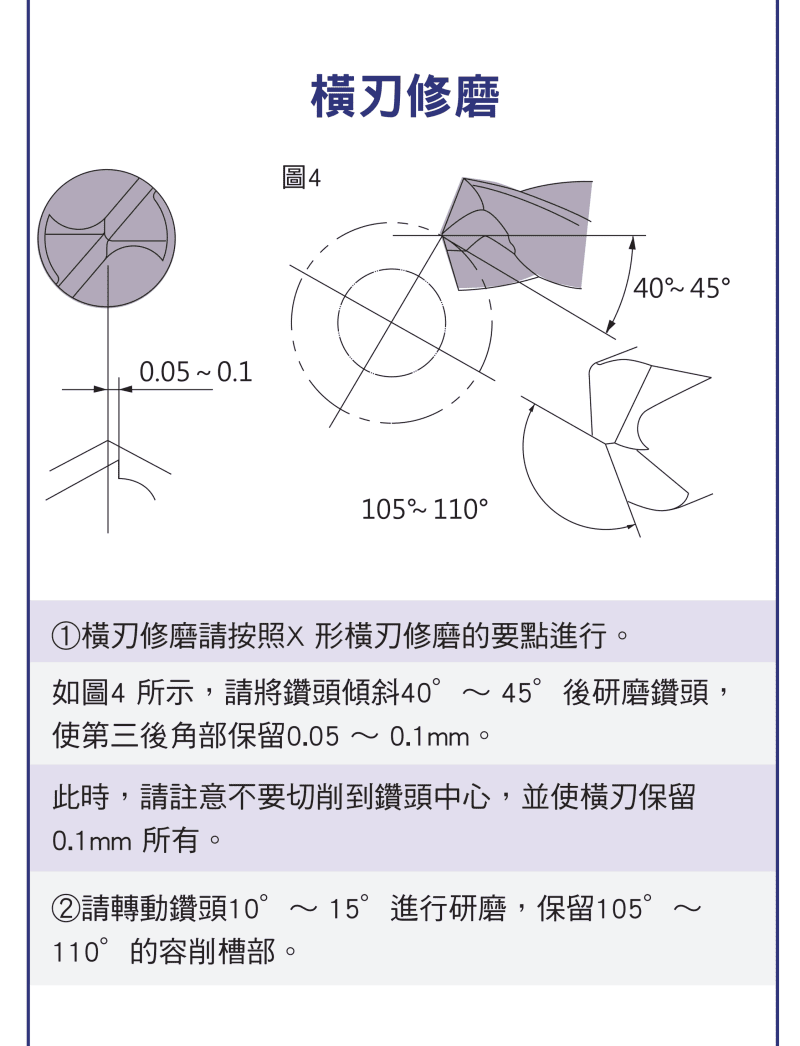
3. Chisel-Edge Grinding (X-Type)
| Control | Reference |
|---|---|
| Grinding tilt | Tilt drill approx. 40°–45° |
| Residual chisel length | approx. 0.1 mm |
| Third-clearance residual | approx. 0.05–0.1 mm |
The aim is lower cutting resistance and better entry stability; a chisel edge too long or too short affects centering and thrust.
4. Cutting Edge and Flute Design
The cutting edge can be ground rotated about 10°–15°, with the flute angle kept around 105°–110°, which improves evacuation and reduces clogging.
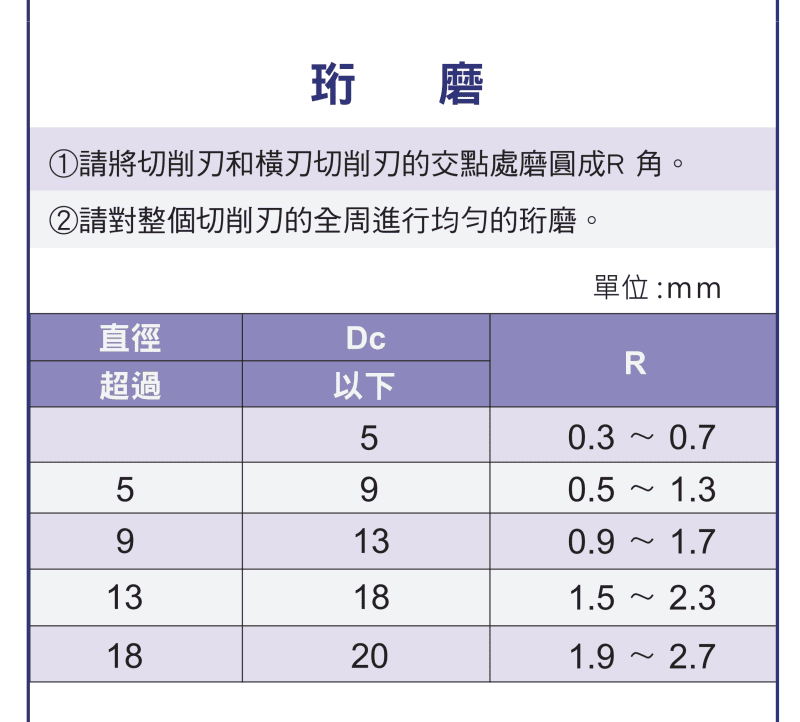
5. Edge R and Honing (by Diameter, Reference)
| Diameter | Suggested R |
|---|---|
| ⌀5mm | 0.3–0.7 mm |
| ⌀5–9mm | 0.5–1.3 mm |
| ⌀9–13mm | 0.9–1.7 mm |
| ⌀13–18mm | 1.5–2.3 mm |
| ⌀18–20mm | 1.9–2.7 mm |
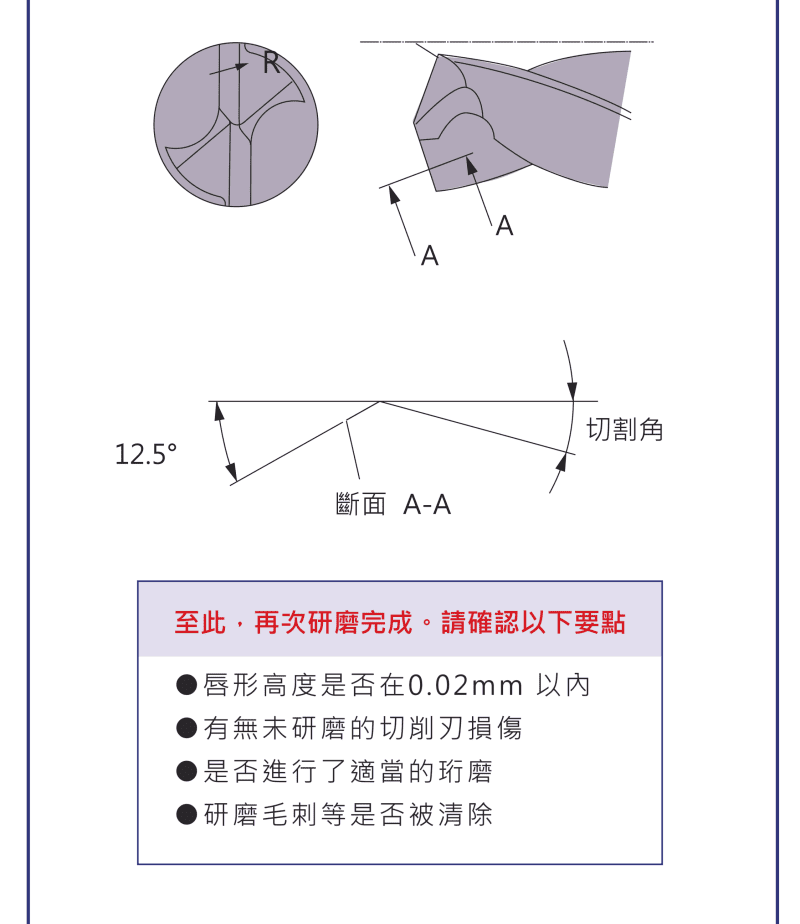
Edge honing (R) lowers chipping and raises wear resistance — an essential step in carbide-drill regrinding.
6. Honing and Surface Finishing
| Item | Requirement / tool |
|---|---|
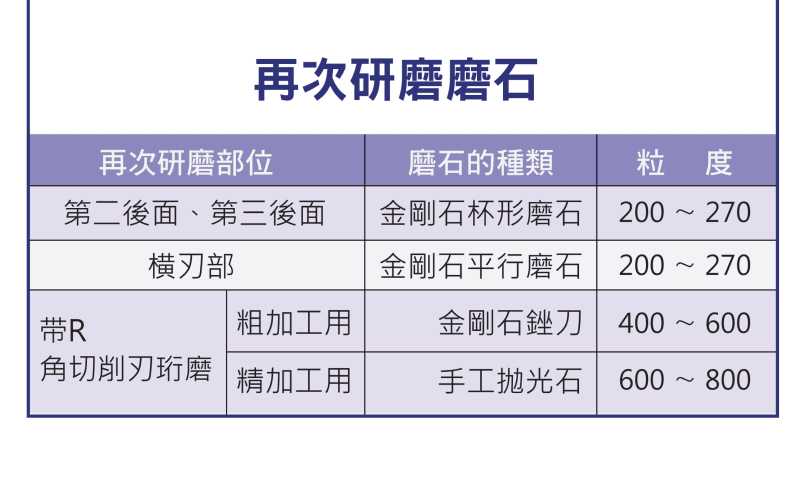
| Lip-height error | ≤ 0.02 mm, evenly honed all around |
| Deburring | Remove edge burrs thoroughly |
| Honing stone | Diamond stone (approx. #200–270) |
| Finishing grit | approx. #600–800 |
7. Common Grinding Mistakes
| Mistake | Consequence |
|---|---|
| Chisel edge too long/short | Poor centering, abnormal thrust |
| Wrong clearance angle | Higher resistance, faster wear |
| No edge honing | Higher chipping risk |
| Insufficient flute angle | Poor evacuation, clogging |
8. Optimization Tips
Standardize the grinding procedure, inspect tool geometry regularly, match cutting conditions and use a precision grinder for consistent quality. For post-grind wear reading, see the Drill Wear Analysis. The angles and sizes above are general references; follow the tool maker's or grinder's specification for actual values.
FAQ
Q: What point angle for a carbide drill?
A common reference is about 140°. Second clearance varies by diameter — roughly 12° (≤⌀5mm), 10° (≤⌀13mm), 8° (≤⌀20mm); third clearance about 20°. Follow the maker/grinder spec for actual values.
Q: Why X-type chisel-edge grinding?
It lowers cutting resistance and improves entry stability. Keep about 0.1mm of chisel edge and grind at a 40°–45° tilt; too long or short affects centering and thrust.
Q: Can I skip edge honing (R)?
Not recommended. Honing lowers chipping and raises wear resistance — an important step in carbide-drill regrinding. R size scales with diameter: larger diameter, larger R.
Q: What stone is used for honing?
Usually a diamond stone (about #200–270), then #600–800 for finishing. Hone evenly all around, keep lip-height error within 0.02mm and remove burrs.
This article is part of Tool Regrinding: The Complete Guide — Decide Whether to Grind, Then Look Up How, With What, and How to Check; that guide shows how the whole topic fits together.
This article is part of Drill Bits: The Complete Guide - Start From Depth-to-Diameter, Then Pick the Drill and Set the Conditions; that guide shows how the whole topic fits together.
Published: 2026-03-20 | Last updated: 2026-07-25









