
Tool Regrinding: The Complete Guide — Decide Whether to Grind, Then Look Up How, With What, and How to Check
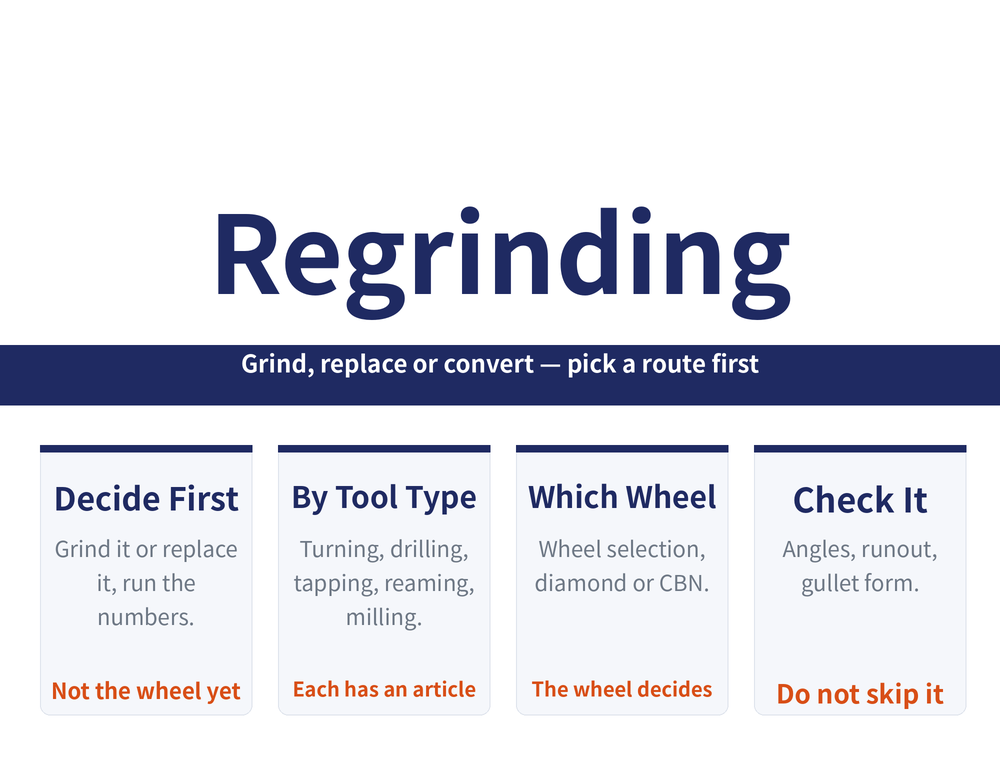
When a tool goes blunt the first question is not how to grind it but whether to grind it at all. This guide ties the whole regrinding line together: decide between regrinding, replacing and converting; then look up the method for your tool type, the wheel to use, and how to check the result. It closes with two routes that involve no grinding at all. Every section points to an article you can drill into.
1. The first question is not how, but whether
Grinding a blunt tool sounds obvious, but tool reclamation has three routes and grinding is only one of them:
| Route | What it is | Does it still hold today |
|---|---|---|
| Repair and reuse | Grind it serviceable, same job as before | The principle is age-independent, the economics are yours to work out |
| Convert to another tool | Reuse the body as a different tool | Mostly a stopgap for emergencies, small runs, no special tool |
| Convert to gauges | Calipers, scribers and so on | Not cutting tools; not covered here |
In earlier years tools were expensive and stock hard to get, which is what justified the labour of repair. Whether it pays today has to be worked out from your own tool prices and labour. For that arithmetic see Is Regrinding and Recoating Worth It, Five Signs an End Mill Needs Regrinding and In-House vs Outsourced vs New.
2. By tool type: how to grind it
| Tool | Drill into |
|---|---|
| Turning tools | The six and seven step order / What else can be ground / Twelve parting blade forms / Thread tools |
| Drills | The three angles / Ten methods and gun drills / Points by material / Carbide drills / Three points, seven edges |
| Taps | Regrind or replace / Special edge forms / Chipping and breakage |
| Reamers | Rake and flank / Carbide and special types / Oversize or worn |
| Milling cutters | Face mill three-stage order and slitting saws / Solid end mill on a tool grinder |
| Inserts | Can a worn indexable insert be reground / CBN turning tools |
| Hole finishing | Fine boring drills, core drills, counterbores / Floating boring tools |
The insert row is where people get caught. Both are called inserts, but a carbide indexable insert is one material throughout, so grinding the rake face to carry the flank wear away is a good trade; a CBN turning tool has only about 1mm of CBN on the rake face, so the rake face is off limits. Those two articles are a deliberate pair — read them together.
3. Special tools: the awkward shapes
When the edge is not a straight line, feel will not hold it — each of the three has its own difficulty.
| Tool | Drill into |
|---|---|
| Gear hobs and shaper cutters | The hob's three routes, and the shaper cutter's OD-grind method. Ground on the rake face only, but that face is helical — what to do with no hob grinder |
| Broaches | Grinding from the sizing teeth forward, and checking four slot forms afterward. Ground from the tail's sizing teeth forwards, not from the front |
| Form tools | A shop-built jig, or cutting it with wire EDM instead. When freehand grinding will not hold, a mechanism replaces the feel |
4. What to grind with: wheels and machines
| Question | Drill into |
|---|---|
| Which wheel for this tool, and how to set it | Which Wheel Grinds Which Tool (including the two height offsets) |
| Do carbide and CBN need superabrasives | Diamond or CBN Wheels |
| The wheel is blunt or out of form | Truing and Dressing Superabrasive Wheels |
| Reading the marking on the wheel | Reading a Grinding Wheel Marking |
One rule cuts across every tool type: during the finishing pass the wheel's own wear becomes the error. Face mills must be finish-ground with a diamond wheel, CBN turning tools can only be ground with one — same reasoning both times.
5. Checking the result: never stop at "ground"
Guides to regrinding share one failing — they stop at "ground". But a tool that goes back on the machine with the wrong angle or a cracked edge costs more than a blunt one. The order is look at it, then measure angles, then measure runout.
The three gauges for a turning tool, the four checks for a reamer and two formulas you can use directly are in Inspecting a Tool After Regrinding; drill and broach acceptance live in their own articles. Whether the edge needs further work after grinding is covered in Edge Preparation After Regrinding.
6. Two routes that involve no grinding
Conversion: there are many worked examples — slitting saws into parting blades, scrap taps into hole reamers, end mills into T-slot cutters, twist drills into ball-nose tools, reamers reground one size down. The principles all hold, but every one of them assumes shortage, urgency, or no special tool available. Whether that assumption still describes your shop is a purchasing question for each plant.
Wire EDM: cut the profile directly instead of grinding it — particularly worthwhile on form turning tools. Scope and limits are in Form Tools Cannot Be Ground by Feel. Note that a cut tool still needs its rake touched up and its edge honed; it is not a full substitute.
7. One practice the years have retired
One practice worth recording is hand-chiselled special files: cutting the tooth pattern one tooth at a time with a chisel, then hardening with an oxy-acetylene flame heated to cherry red (790–820℃). Machine-cut files replaced this long ago. It appears here to record that it no longer has practical value, not as a recommendation. For choosing files see Reading a File.
8. Frequently Asked Questions (FAQ)
Q: There are a lot of articles here — where do I start?
Section 1: establish whether this tool is worth grinding at all. Once you have decided to grind, find your tool type in section 2 and that article will tell you which faces to grind and to what angles. Section 4 covers wheels, section 5 covers acceptance. If your tool is not in the section 2 table, try the special tools in section 3, or conversion and wire EDM in section 6.
Q: Why can some tools only be ground on certain faces?
Because the other faces were set at manufacture and cannot be recovered. Hobs and shaper cutters are ground on the rake face only, with flank and tooth form fixed by relieving. A gun drill allows only the inner and outer relief, oil clearance and chamfer. A CBN turning tool cannot take rake grinding because the layer is about 1mm. The principle: grind the face that goes blunt, not the face that defines the tool.
Q: In-house or send it out?
First ask whether the tool may be ground freehand at all. Twist drills and turning tools can be. Gun drills, form tools and gear tools need a machine and fixturing — they should not be done by hand. Then look at quantity and consistency: many tools of one size to a common angle is what justifies a fixture or an outside service.
Q: Does anyone still convert scrap tools?
Technically it works — the principles behind those conversions hold today. But nearly all of them are written for a situation of urgency, an unavailable size, or a costly special order. Whether that route makes sense now depends on your lead times and how hard the special sizes are to get. That is a judgement for your own shop.
Published: 2026-08-18|Last updated: 2026-10-19









