
Drill Wear Analysis: Identify We/Wf/Wo/Wm & Countermeasures
Drill wear is key to hole quality and tool life. By location, common wear is outer-corner/margin wear (Wo), flank wear (Wf), chisel-edge wear (We) and land wear (Wm), plus crater wear. It arises mainly from excessive feed, uneven material hardness and vibration, leading to chipping, melting and even breakage. This guide covers identifying wear forms, their causes, the regrinding concept and countermeasures to extend drill life and stabilize hole quality.
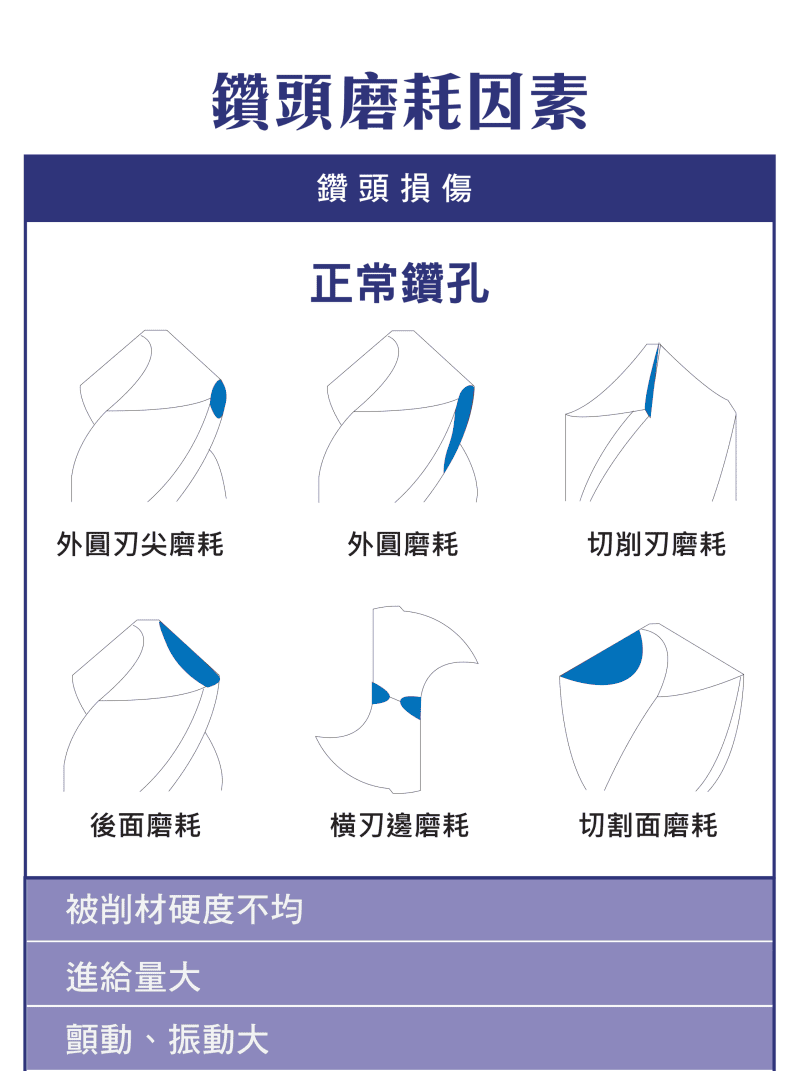
1. Identifying Wear Forms (Wo / Wf / We / Wm)
| Code | Location | Trait | Effect |
|---|---|---|---|
| Outer-edge wear Wo | Drill outer diameter | Usually the most severe | Lower diameter accuracy; life-critical |
| Flank wear Wf | Behind the cutting edge | From prolonged friction | Shorter life, rougher surface |
| Chisel-edge wear We | Central chisel edge | High resistance, heat-prone | More thrust, affects accuracy |
| Land wear Wm | Land / hole-wall contact | Friction with hole wall | Rougher wall, more frictional heat |
| Crater wear | Rake face | Heat build-up at high temp | Tool melting, strength loss |
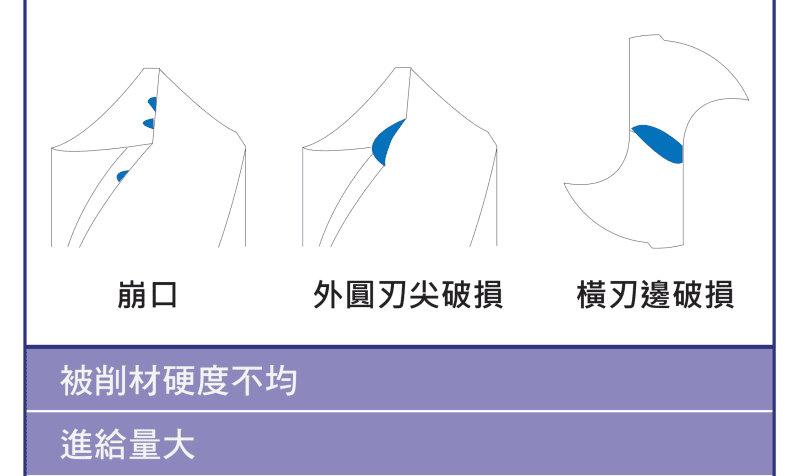
2. Normal vs Abnormal Wear
| Type | Signs |
|---|---|
| Normal wear | Even distribution, stable cutting |
| Abnormal wear | Local breakage, chipping, sharp life drop |
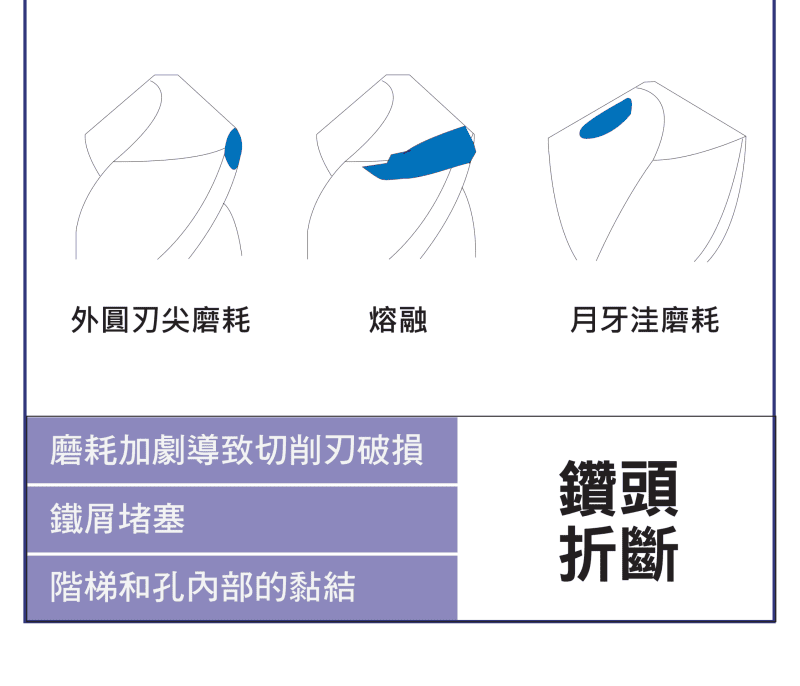
3. Main Causes of Wear
| Factor | Condition | Effect |
|---|---|---|
| Material | Uneven workpiece hardness | Local wear, uneven load |
| Cutting condition | Excessive feed | Higher force, faster wear |
| Machine | Chatter and vibration | Tool breakage, unstable cut |
| Evacuation & heat | Chip clogging, heat build-up | Tool melting, crater wear |
Excessive speed, wrong feed and poor cooling all accelerate wear and chipping; for setting conditions, see the Drilling Parameters Guide.
4. How Wear Escalates
Continued wear starts as edge nicking, then progresses to outer-corner and chisel-edge breakage, and finally drill breakage. Early identification and tool change are key to avoiding broken tools and ruined holes.
5. Regrinding Concept
| Item | Description |
|---|---|
| Definition | Remove worn material and regrind the edge |
| Applicable | Edge wear, minor damage |
| Limit | Severe damage must be scrapped |
For carbide-drill angles and regrinding points, see the Carbide Drill Regrinding Guide.
6. Countermeasures
| Direction | Action |
|---|---|
| Cutting conditions | Lower speed, adjust feed |
| Cooling & evacuation | Use through-coolant drills, improve coolant supply |
| Tool choice | Wear-resistant coating, material-matched tool |
| Equipment | Raise machine rigidity, reduce vibration |
7. Shop-Floor Judgment
| Observation | Judgment |
|---|---|
| Edge going blunt | Normal wear |
| Local chipping | Poor cutting conditions |
| Surface melting | Temperature too high |
FAQ
Q: What are We, Wf, Wo, Wm?
They denote chisel-edge wear (We), flank wear (Wf), outer-edge/margin wear (Wo) and land wear (Wm). Outer-edge wear is usually the most severe, directly affecting hole accuracy and tool life.
Q: How do I tell normal from abnormal wear?
Normal wear is even and stable; abnormal wear shows local breakage, chipping and a sharp life drop. A dulling edge is usually normal, local chipping means poor conditions, and surface melting means excessive temperature.
Q: Must a worn drill be replaced?
Not necessarily. Edge wear or minor damage can be restored by regrinding; severe damage (big chips, breakage) must be scrapped. See the carbide-drill regrinding article for details.
Q: How do I extend drill life?
Control speed and feed, improve evacuation and cooling, use wear-resistant coatings and raise machine rigidity; also inspect wear form regularly and adjust or change tools early.
For the full reading guide on this topic, see Tool Life and Wear: A Complete Reading Guide.
This article is part of Drill Bits: The Complete Guide - Start From Depth-to-Diameter, Then Pick the Drill and Set the Conditions; that guide shows how the whole topic fits together.
Published: 2026-03-19 | Last updated: 2026-10-31









