
Climb Milling vs Conventional Milling
Climb milling vs conventional milling is the most critical cutting-direction choice in CNC milling, directly affecting tool wear, surface quality and tool life. Conventional milling tends to cause chip re-cutting—especially in stainless steel, SKD11 and SUJ2—accelerating wear and reducing stability; climb milling effectively reduces wear and improves chip evacuation. Choosing the right direction is key to efficiency and quality.
Main Problems of Conventional Milling
Common issues in conventional (up) milling include chips adhering to the tool and re-entering the cutting zone (re-cutting), as summarized below:
| Problem | Cause | Effect |
|---|---|---|
| Chips adhering to the tool | Poor chip evacuation, chips sticking to the edge | Accelerated tool wear |
| Chips re-entering the cutting zone (re-cutting) | Chips fail to evacuate and return to the cutting zone | Unstable surface quality |
| Cutting heat build-up | Re-cutting increases friction and resistance | Rising cutting temperature |
How Material Affects Machining
Certain materials make the problem worse in conventional milling:
| Material | Key Characteristic | Problem in Conventional Milling |
|---|---|---|
| Stainless steel | High work-hardening | Shortened tool life |
| SKD11 / SUJ2 | Poor chip evacuation | Prone to chip re-cutting |
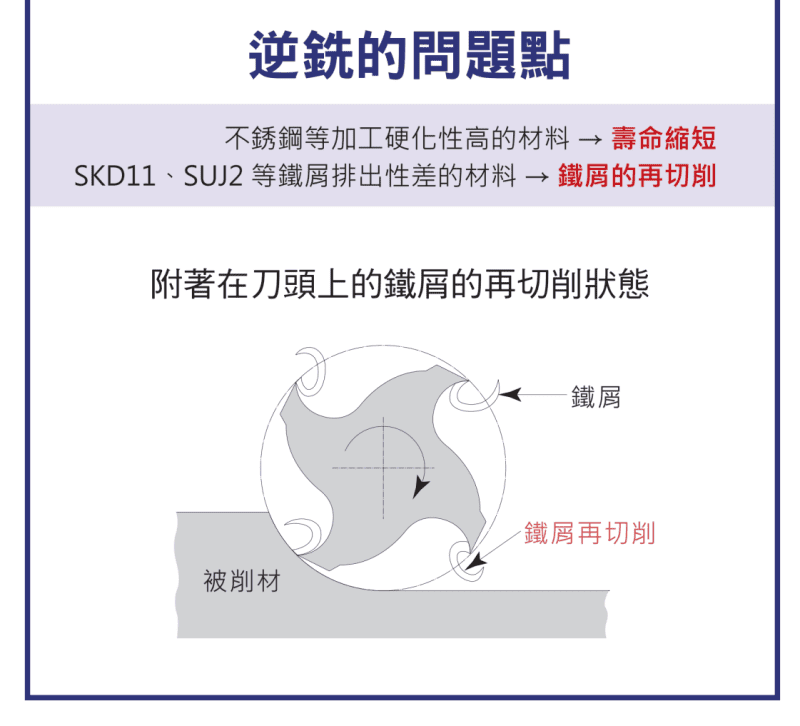
The Chip Re-cutting Mechanism
When chips cannot evacuate properly, they adhere to the edge and are cut again, increasing cutting resistance, accelerating wear and roughening the surface.
Cutting Differences: Climb vs Conventional
| Item | Climb Milling | Conventional Milling |
|---|---|---|
| Cutting action | Tool cuts from thick to thin | Tool cuts from thin to thick |
| Chip evacuation | Smooth chip evacuation | Prone to re-cutting |
| Tool wear | Less tool wear | Faster wear |
| Surface roughness | Depends on conditions; see below | Depends on conditions; see below |
Neither direction always wins on surface roughness: general machining texts usually say climb milling gives the better finish, but in Sumitomo’s side-milling test (S50C, φ10 two-flute end mill, radial depth ae 0.5 mm) conventional milling gave lower Rz in both the feed direction and the perpendicular direction. If a finished face has a tight roughness requirement, test-cut a short length each way and measure before deciding.
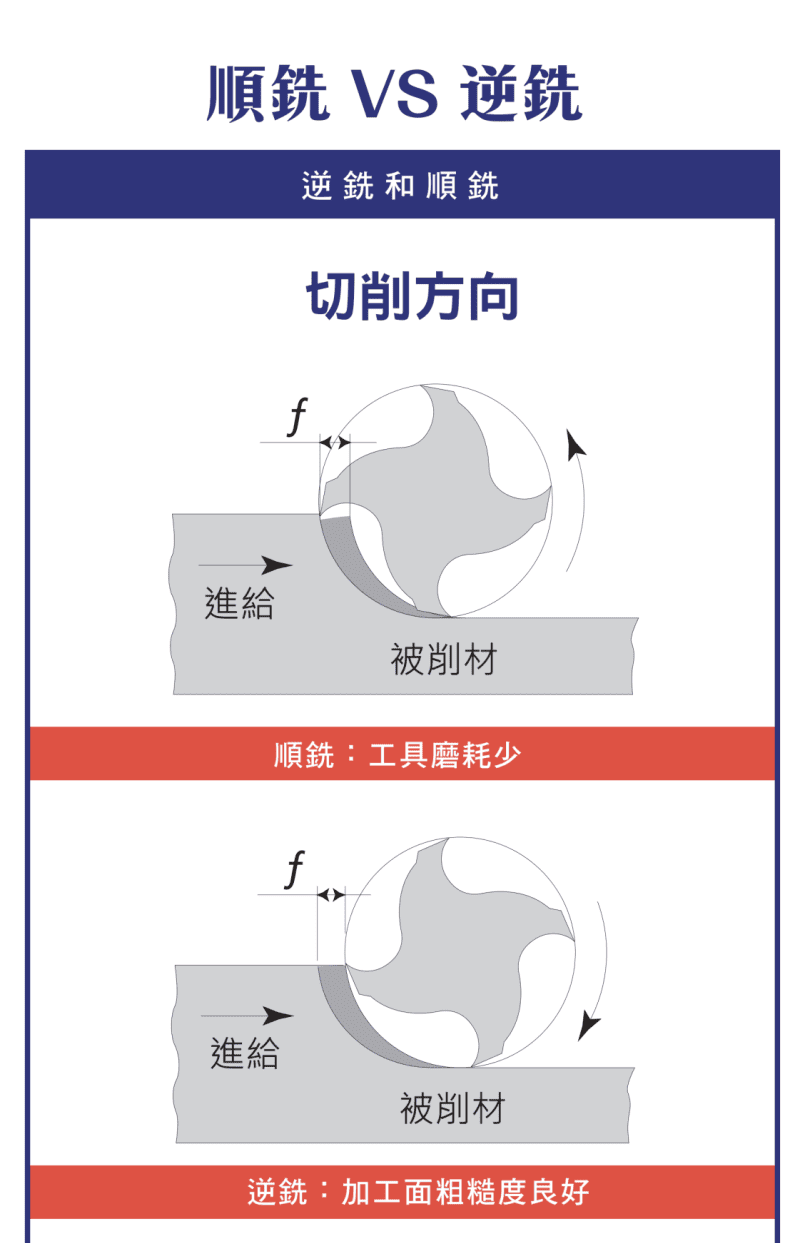
Effect of Cutting Direction on Quality
| Cutting Direction | Main Advantages |
|---|---|
| Climb advantages | Lower tool wear, better chip evacuation, lower cutting heat |
| Conventional advantages | Suitable for some surface finishing; more stable when machine rigidity is insufficient |
| Conventional use 1: machine backlash | On a machine with large lead-screw and nut backlash, climb milling makes the table move in jerks; switch to conventional |
| Conventional use 2: scale on the workpiece | Hard scale or hard spots on forged or cast blanks: conventional milling enters from the already-cut side, so the teeth do not hit the scale first |
So “prefer climb milling” has two preconditions: the machine has a backlash eliminator (CNC mills usually do), and the workpiece surface no longer carries hard scale. For planning roughing toolpaths through scale, see High-Speed Roughing Toolpaths: Layers, Climb vs Conventional, Trochoidal, Re-roughing.
Optimization Tips
| Recommendation | How to Apply |
|---|---|
| Prefer climb milling | The first choice for general CNC work, extending tool life |
| Avoid conventional-milling problems | Improve chip evacuation, use suitable cutting fluid, adjust feed and speed |
| Material countermeasures | Stainless steel → reduce work-hardening; SKD11 → enhance chip evacuation |
For the abnormal wear that conventional milling can cause, see End Mill Wear Analysis for wear mechanisms and when to regrind.
FAQ
What's the difference between climb and conventional milling?
In climb milling the tool cuts from thick to thin with smooth chip evacuation and less wear; in conventional milling it cuts from thin to thick, prone to chip re-cutting, but it is steadier on low-rigidity machines; neither direction always gives the better surface roughness.
Why does conventional milling wear tools faster?
In conventional milling chips tend to stick to the edge and get cut again (re-cutting), increasing cutting resistance, speeding up wear and roughening the surface—especially in stainless steel, SKD11 and SUJ2.
Should I choose climb or conventional milling for general work?
For general CNC work, prefer climb milling to reduce wear, improve chip evacuation and lower cutting heat; conventional milling is for some surface finishing, low-rigidity machines, tables with backlash, or workpieces with hard scale.
How do I avoid conventional-milling problems on stainless steel / SKD11?
For stainless steel, use suitable parameters to reduce work-hardening and avoid mid-cut stops; for SKD11/SUJ2, enhance chip evacuation (cutting fluid, air blast, adjusted feed/speed), and prefer climb milling.
For the full reading guides on this topic, see Tool Life and Wear: A Complete Reading Guide and Chip Control: A Complete Reading Guide.
This article is part of Milling Toolpaths: The Complete Guide - Roughing Strategy, Where to Plunge, and Choosing a Finishing Pattern; that guide shows how the whole topic fits together.
Published: 2026-03-16 | Last updated: 2026-10-19









