
Reading a Coated Abrasive Spec: Grain, Grit, Coating, Bond and Backing
A grinding wheel carries its whole specification on the rim. A belt or a sheet carries just as much information, only not in one place. Buying one means deciding five things: grain, grit, coating density, bond and backing. This takes the five fields one at a time — what to look at, what goes wrong if you get it wrong — with reference tables for grain and grit.
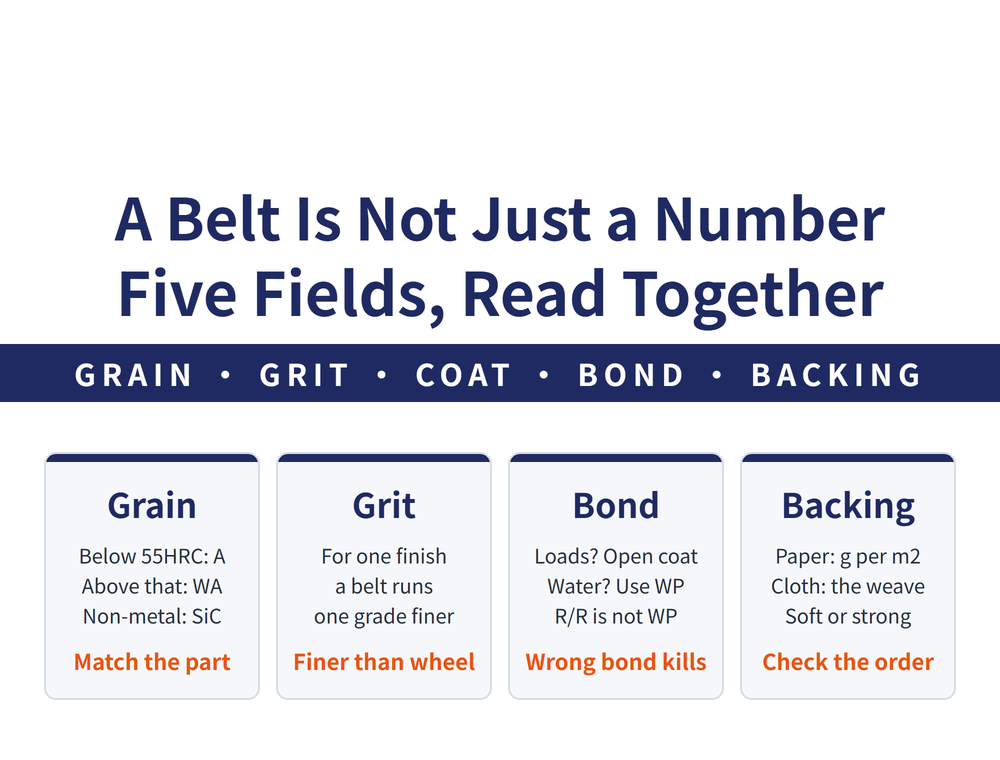
1. A coated abrasive spec has five fields
A wheel prints its specification on the rim and you read it in one pass (see Reading a Grinding Wheel Marking). Belts and sheets are less concentrated, but there is just as much to decide, and the order is fixed:
| Order | Field | What it solves |
|---|---|---|
| 1 | Grain | Whether it cuts the material at all |
| 2 | Grit | The trade-off between rate and finish |
| 3 | Coating density | Whether swarf will clog it |
| 4 | Bond | Whether it tolerates water and load |
| 5 | Backing | Conforming to a curve, or holding at speed |
🔴 The common mistake is to talk only about the number. The number is field two, while short life, poor cutting and sudden breakage almost always trace back to the other four. This article covers how to read the spec; how contact wheels and parameters are set is in Belt Grinding: How It Differs from Wheels, and Choosing the Contact Wheel.
2. Grain: 55HRC is the dividing line
The wheel rule — pick the grain by workpiece hardness and tensile strength — applies to belts and sheets as well. The thresholds are what matter:
| Grain | Suits | Threshold |
|---|---|---|
| Aluminium oxide (A) | Carbon and alloy steel, malleable iron, non-ferrous metals, hard bronze | Below 55HRC, tensile below 700 MPa |
| White aluminium oxide (WA) | Hardened steel, high-carbon steel, stainless, harder alloy steels | Can go above 55HRC |
| Chrome alumina | Stainless, heat-resistant alloy steel, titanium, brass, bronze, grey iron, nickel-chrome and cobalt-chrome alloys | — |
| Black silicon carbide (C) | Low-tensile, tough materials: glass, glass fibre, ceramics, wood, fibreboard | — |
| Green silicon carbide (GC) | Hard and brittle: tungsten carbide, glass, single-crystal silicon, engineering ceramics, high-grade finishes | — |
In one line: aluminium oxide for ordinary steel, white aluminium oxide once the part passes 55HRC, silicon carbide for brittle non-metals. How the grains themselves differ is covered in Choosing an Abrasive: Match the Grain to Your Workpiece and Problem.
3. Grit: for the same finish, a belt runs one grade finer
This is where belt specifications get copied wrongly. Belt grains sit deeper and almost all of the surface layer cuts, so a belt removes faster than a wheel. To reach the same finish, the belt grit goes one grade finer than the wheel: surface grinding with a P36–P46 wheel becomes P46–P60 on a belt; a P60–P80 cylindrical wheel becomes P80–P100.
Five more factors shift the choice:
| Factor | Coarser | Finer |
|---|---|---|
| Belt speed | Low | High |
| Material | Non-metal | Metal |
| Dry or wet | Dry | Wet (finer still with oil) |
| Contact area | Large (surface work) | Small (cylindrical work) |
| Toughness | Tough or soft (copper, aluminium, lead) | Hard steel |
Grit by material for the three stages:
| Material | Form | Rough | Medium | Fine |
|---|---|---|---|---|
| Steel and iron | Belt | 24–60 | 80–120 | 150–400 |
| Steel and iron | Disc | 16–40 | 50–80 | 100–240 |
| Non-ferrous | Belt | 24–60 | 80–150 | 180–320 |
| Wood | Belt | 36–80 | 100–150 | 180–240 |
| Glass | Belt | 40–80 | 100–150 | 180–400 |
| Paint | Belt | 80–150 | 180–240 | 280–800 |
Reference values. ⚠ More than one grit numbering system exists; both a P-prefixed series and plain mesh numbers are in use. Confirm with your supplier which system a quotation uses, and do not compare numbers across systems.
4. Coating density: whether swarf will clog it
A belt that still looks perfect but has stopped cutting is usually not worn out — it is packed with swarf. The traditional answers are flood coolant, compressed air or a brush, but some materials should never see coolant (soft wood, high-grade lacquered wood) and some shops cannot tolerate coolant contamination. The specification offers two answers:
| Option | How it works | Where |
|---|---|---|
| Open coat | Wider spacing between grains so swarf has somewhere to go | Soft and resinous woods, rubber goods, aluminium and its alloys, some leather |
| Supersize coating | An extra anti-loading chemical layer over the grain | Where open coat still loads: high-grade lacquered panels, titanium alloys |
A belt that dies instantly on aluminium or titanium is usually a coating-density problem, not a grit problem. Material-by-material tactics are in Grinding Aluminium, Stainless and Steel: Deburring and Finishing by Material.
5. Bond: dry-use and waterproof are two families
The bond decides whether a belt can meet water and how much load it takes. Running a dry-use bond in damp conditions, or a waterproof one bone dry, both fall short of what you expect.
| Type (code) | Character | Where |
|---|---|---|
| Hide glue G/G | Flexible and cheap; low bond strength, absorbs moisture, can mould | Hand sheets and wood papers, light-duty belts. ⚠ Above 20 m/s or under heavy load it sheds grain and can break |
| Semi-resin R/G | Hide-glue make coat with a resin size coat; keeps the flexibility, improves damp and wear resistance | Machine sanding of plywood, particle board, leather, plastics, rubber. Particularly suited to humid climates |
| Full resin R/R | Resin throughout, sharp and wear resistant, high bond strength | The mainstay for machine belts, discs and flap wheels. 🔴 Still dry or oil use only — the backing is not waterproofed and swells if soaked |
| Waterproof WP | Waterproofed paper or cloth backing with varnish or resin; stable when soaked | Wet work: hand wet-and-dry sheets on metal and lacquered surfaces; machine belts on blade profiles, stainless vessels, medical and food equipment |
🔴 Full resin is not waterproof. This is the field buyers get wrong most often. R/R does resist damp far better than G/G or R/G, but it is not a waterproof product; for wet work, look for WP. Wet working lowers heat, improves surface quality, washes swarf away and extends belt life.
6. Backing: flexible for hand work, strong for machines
The backing decides whether the belt conforms to a curve and whether it holds at speed. Hand work needs flexibility; high-speed machine work needs tensile strength plus resistance to alternating and frictional loads.
| Backing | Spec / character | Use |
|---|---|---|
| Paper, light | 65–100 g/m², thin and soft, low tensile | Sheets, hand or orbital use; curves and finish coats |
| Paper, medium | 110–130 g/m², thicker, good flexibility | Hand-held machines; metal de-rusting, primer sanding |
| Paper, heavy | 160–230 g/m², high tensile, low stretch | Machine paper belts; drum and wide-belt sanders, belt grinders |
| Cloth, light (twill) | Soft and thin, moderate tensile | Hand or light machine use; metal de-rusting and polishing |
| Cloth, medium (heavy twill) | Flexible, thick, high tensile | Machine and heavy-duty belts; tools, silicon steel, blades |
| Cloth, heavy (satin) | Thick, weft stronger than warp | Heavy duty; wide spliced belts, large panels |
| Composite | Very thick, resists creasing, tearing and stretch | Heavy-duty belts and discs; panels, flooring |
| Vulcanised fibre | Very thick, very strong, low stretch, heat resistant | Discs; weld dressing, de-rusting, scale removal |
Paper backings are graded by weight per square metre and cloth backings by weave — a field that appears on the purchase order and is routinely ignored. Non-woven backings also exist; their specification was outside the scope checked here and is not listed.
7. Frequently Asked Questions (FAQ)
Q: We use a P60 wheel. Is P60 right for the belt too?
No, that would be too fine. A belt cuts faster than a wheel, so for the same finish the belt runs one grade finer: a P60–P80 cylindrical wheel becomes P80–P100 on a belt.
Q: Can a full-resin belt be used wet?
No. Full resin (R/R) resists damp far better than hide glue, but the backing is not waterproofed and swells after prolonged contact with water. For wet work, specify the waterproof WP series.
Q: Belts load up immediately on aluminium. Is that the grit?
Usually not the grit but the coating density. Soft, tough metals such as aluminium and copper pack the spaces between grains, so specify an open coat; if that still loads, move to a supersize-coated product.
Q: Belts keep breaking. Is it a quality problem?
Check the bond and backing first. Hide-glue (G/G) belts shed grain and can break above 20 m/s or under heavy load. Heavy-duty machine work needs full resin on a medium or heavy cloth or composite backing.
This article belongs to the line covered in Grinding Wheels and Machines: The Complete Guide - Reading the Wheel, Mounting It, Dressing It, and Tracing Defects, which shows where to start and where to go next.
Published: 2026-09-17|Updated: 2026-10-22









