
Reading a Grinding Wheel Marking: Abrasive, Grit, Grade, Structure and Bond
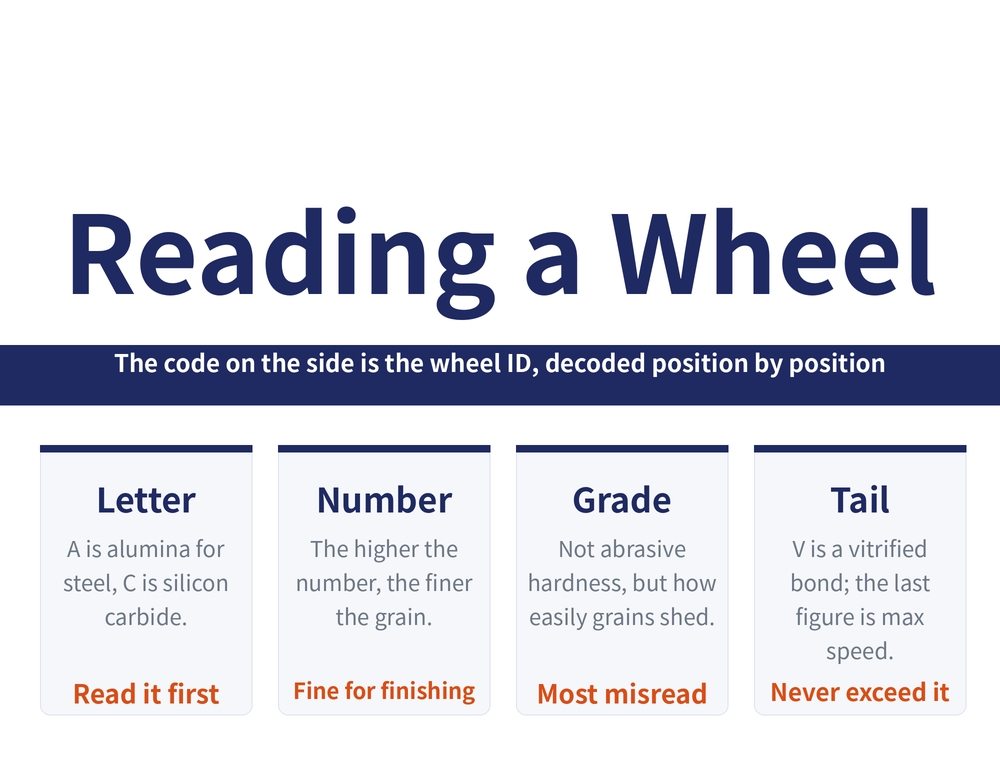
The code on the side of a grinding wheel, for example 1-300×50×75-A60L5V-35, is its ID: in order it gives shape, outer diameter, thickness, bore, abrasive, grit, grade, structure, bond and maximum speed. This article decodes it position by position per GB/T 2484, especially the most misread field—grade, which is not about how hard the abrasive is.
1. What a wheel marking looks like
A wheel's specification is written as a code string, ordered per GB/T 2484. Using the maker's example 1-300×50×75-A60L5V-35, it decodes position by position as follows.
| Position | Value here | Meaning |
|---|---|---|
| Shape | 1 | Straight (flat) wheel |
| OD × thickness × bore | 300×50×75 | OD 300mm, 50mm thick, bore 75mm |
| Abrasive | A | Brown aluminium oxide |
| Grit | 60 | Grit 60# |
| Grade | L | Hardness grade L |
| Structure | 5 | Structure No. 5 |
| Bond | V | Vitrified (ceramic) bond |
| Max speed | 35 | Max working speed 35 m/s |
The next sections explain the four fields you most need to read: abrasive, grit, grade, and structure with bond.
For the shape field this article follows the example and uses a number (1 = straight wheel); the letter form (such as P) is covered in Grinding Wheel Shape Codes: Straight, Cup, Dish and Special Series in One Table. How the two map onto each other is still being verified, so they are not cross-referenced here.
2. Abrasive: the letter tells you what it grinds
The letter right after the size is the abrasive code. Common abrasives split into two families: the alumina family (A group) is tougher and leans toward steels; the carbide family (C/GC etc.) is harder but more brittle and leans toward hard-brittle materials.
| Code | Name | Material it suits |
|---|---|---|
| A | Brown aluminium oxide | Carbon steel, alloy steel, malleable iron, hard bronze |
| WA | White aluminium oxide | Finish-grinding hardened steel, HSS, high-carbon steel, thin-wall parts |
| SA | Single-crystal alumina | Stainless steel, high-vanadium HSS and other strong, tough materials |
| C | Black silicon carbide | Cast iron, brass, aluminium, refractories and non-metals |
| GC | Green silicon carbide | Carbide, gemstone, ceramic, glass |
Quick rule: A for general carbon steel, WA for finish-grinding hardened steel, a self-sharpening type (SA etc.) for stainless, GC for carbide. For choosing the abrasive of a grinding-machine wheel by workpiece and job, see Choosing Grinding Wheel Grit, Grade, Bond and Structure: Workpiece First, Then the Job, Then the Defect; for matching the grain of handheld tools (flap discs, flap wheels) to shop-floor problems, see Choosing an Abrasive: Match the Grain to Your Workpiece and Problem.
3. Grit: a bigger number means a finer grain
The number after the abrasive letter is the grit, i.e. grain size. In the common F system (GB/T 2484), a higher number means a finer grain; choose fine grit for a low roughness finish, coarse grit for high stock removal.
| Grit | Typical use |
|---|---|
| F4–F24 | Grinding ingots, deburring castings, cutting billets |
| F30–F46 | General surface, cylindrical and centerless grinding |
| F54–F100 | Finish grinding and tool sharpening |
| F120–F220 | Finishing, honing, thread grinding |
| F230–F1200 | Fine lapping, mirror grinding |
Rule of thumb: the finer the grain, the better the ground surface finish. Coarse grit for heavy stock (larger pores, less clogging and heat); fine grit for small finishing stock.
4. Grade: L, M, K is not about how hard the abrasive is
This is the most misread field on a wheel.
Wheel grade is how easily the abrasive grains shed from the bond under force. Grains that shed easily give a soft wheel; grains that hold give a hard wheel. It is not the hardness of the grain or the bond itself, and has nothing to do with metal hardness.
Grades run from soft to hard as letters (GB/T 2484):
A B C D E F G H I J K L M N P Q R S T Y (soft → hard)
Grade is set mainly by the amount of bond: more bond means a harder wheel, less bond a softer one; forming density and firing temperature and time also matter. How to choose soft or hard is covered in Choosing Grinding Wheel Grit, Grade, Bond and Structure: Workpiece First, Then the Job, Then the Defect.
5. Structure number and bond code
Structure is the volume relationship between abrasive, bond and pores, shown as a structure number. The rule: 62% grain ratio is No. 0, and every 2% drop in grain ratio adds one number; GB/T 2484 runs 0 to 14. A higher structure number means a lower grain ratio and a more open structure.
Bond holds the grains into a shape with strength, shown as a letter code:
| Code | Bond | Character |
|---|---|---|
| V | Vitrified (ceramic) | Cheap, heat-resistant, unaffected by water/oil/acid/alkali; but brittle, low elasticity |
| B | Resinoid | Slight elasticity, can be made 0.2–4mm thin discs; but weak against alkaline coolant |
| R | Rubber | High strength, most elastic; but dense, small pores, poor oil resistance |
| Mg | Magnesite | Cures at room temperature, no firing; non-working face needs a paint seal |
Practical note: resinoid (B) bonds dislike alkaline coolant—when a customer complains a wheel wears too fast, coolant pH is a variable you can check directly.
6. That last number: maximum speed and safety
The final number is the wheel's maximum working speed (m/s). It is a safety field, not a performance one. A wheel is a brittle body spinning fast, so running over speed risks bursting.
As a rule, a safety factor of 2 is used below 60 m/s and 1.8 above 80 m/s; wheels over 150mm diameter, besides the "8"-block tensile test, must also pass a high-speed spin test. Before mounting, confirm the marked maximum speed is not below the peripheral speed the machine's rpm produces.
7. FAQ
Q: Is the L, M or K in the marking the hardness of the abrasive?
No. That is wheel grade—how easily grains shed from the bond under force, not how hard the abrasive itself is. Letters run A (soft) to Y (hard).
Q: Does a bigger grit number mean coarser or finer?
In the common F system a higher number is finer. Use coarse grit (small number) for heavy stock removal and fine grit (large number) for a low-roughness finish.
Q: A and WA are both alumina—what's the difference?
A (brown) is tougher and cheaper, for general carbon and alloy steel; WA (white) is harder and less tough, for finish-grinding hardened steel, HSS and thin-wall parts.
Q: Do I really need to read the last number?
Yes. It is the maximum working speed (m/s), a safety limit. A wheel spinning over speed can burst, so before mounting confirm it is not below the machine's peripheral speed.
This article is part of Tool Regrinding: The Complete Guide — Decide Whether to Grind, Then Look Up How, With What, and How to Check; that guide shows how the whole topic fits together.
This article is part of Grinding Wheels and Machines: The Complete Guide - Reading the Wheel, Mounting It, Dressing It, and Tracing Defects; that guide shows how the whole topic fits together.
Published: 2026-08-16|Updated: 2026-10-24









