
Grinding Wheels and Machines: The Complete Guide - Reading the Wheel, Mounting It, Dressing It, and Tracing Defects
When grinding goes wrong, the answer is usually not in the parameter table but further back: the wrong wheel, mounted off, dull and undressed, or a machine that is already out of tolerance. This guide lays the work on a grinder out as one route: read the marking on the wheel, then mount and balance it, dress it when it dulls, pick the right grinding method, deal with the heat, and finally trace defects and decide whether you can safely go faster. Every section points to an article you can read next.
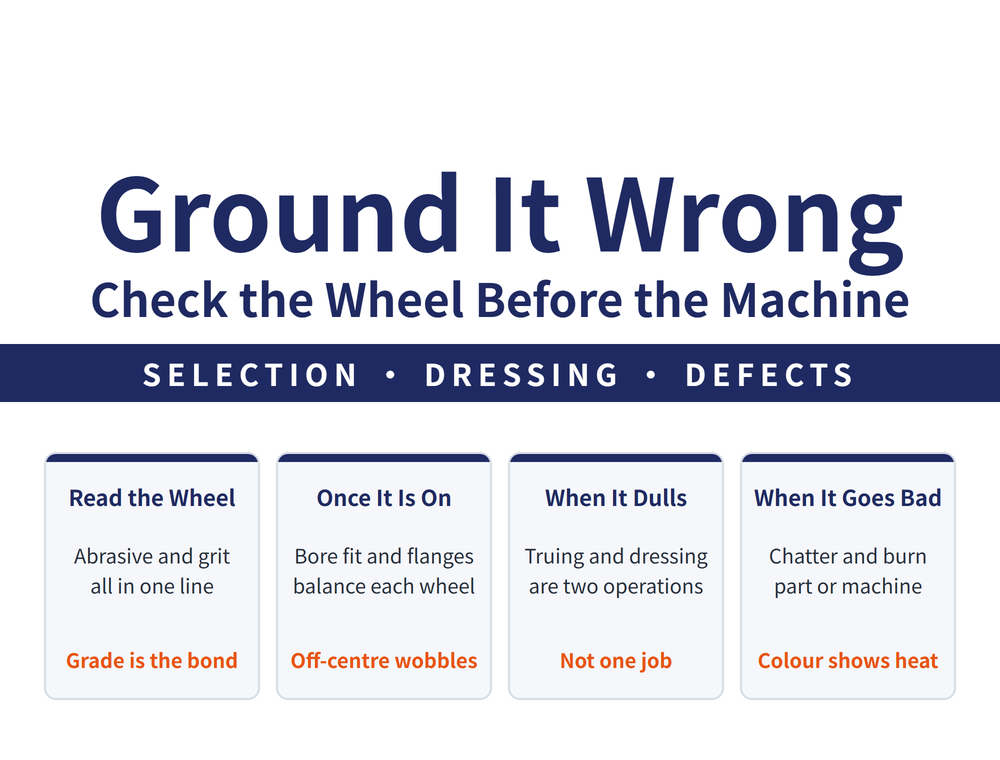
1. First: This Line Is About Work on a Grinder
On the shop floor "grinding" covers three different jobs, and looking in the wrong one wastes the search:
| What you are doing | Typical situation | Where to look |
|---|---|---|
| Grinding a part on a machine (this guide) | Part held on a grinder, size and finish to hold | Read on |
| Working a part by hand | Deburring, blending welds, polishing; burrs, files, wire brushes | A separate line - see Deburring and Surface Finishing: The Complete Guide |
| Putting a cutter back to work | Drills, end mills and turning tools that have gone dull | Tool Regrinding: The Complete Guide |
All three use abrasive, but what has to be controlled is different: on a grinder it is size and surface consistency, by hand it is feel and not damaging the part, in regrinding it is the geometry of the edge. This guide covers only the first.
2. Start by Reading the Marking
Wheels are not simply coarse or fine. The marking carries abrasive, grit, grade, structure and bond in one line, and if you cannot read it the only option left is trial and error, paid for in parts.
| Article | When to read it |
|---|---|
| Reading a Grinding Wheel Marking | The entry point for this whole line. Each field explained, including the maximum operating speed at the end |
| Choosing Grinding Wheel Grit, Grade, Bond and Structure | Once you can read the marking and need to pick a spec. Workpiece first, then the job, then the defect |
| Diamond or CBN Wheels | When grinding carbide, ceramics or hardened steel and an ordinary wheel is not enough. The reason for choosing between them is chemistry, not hardness |
The grade field is the one most often misread: it describes how firmly the bond holds the grain, not how hard the abrasive is. Hold it too firmly and dull grains stay put; too loosely and the wheel wears away. Get this field wrong and every parameter afterwards is compensation.
3. Mounting: Fit, Flanges, Balance
The right wheel mounted badly still grinds badly. Too tight a bore can burst it, too loose runs it eccentric, and at speed eccentricity stops being an accuracy problem and becomes a safety one.
| Article | When to read it |
|---|---|
| Mounting and Balancing a Grinding Wheel | Whenever you fit a new wheel. Four pre-mount checks, bore clearance, two flange rules, and why a new wheel is balanced twice |
| Why Grinding Wheels Burst | At goods-in, in storage and before mounting. Which choices weaken a wheel, the unbalance limit, and how long it may be stored |
One criterion from that article is worth carrying: how far to take the balancing is set by two thresholds, not done to the finest level every time. Overdoing it wastes hours; underdoing it leaves chatter marks on the part. Acceptance is by measured amplitude, not by feel.
4. Dressing: Truing and Sharpening Are Two Jobs
A wheel in use goes dull, loses its form and loads up with swarf. Bringing the form back is truing; exposing fresh grain is dressing - conventional wheels often get both in one pass, diamond and CBN wheels need two separate operations, and confusing them wastes the work.
| Article | When to read it |
|---|---|
| Dressing a Grinding Wheel | Conventional wheels. When to dress, how to choose among turning, crush and grinding methods, and the single-point diamond in daily use |
| Truing and Dressing Diamond and CBN Wheels | Diamond and CBN wheels. Four truing methods, six dressing methods, and how grit, concentration and grinding data follow |
Neither substitutes for the other: the truing tools for a diamond or CBN wheel cost more than the parts being ground, so a wrong method is expensive in a way it is not with conventional wheels.
5. Three Grinding Methods, Three Ways of Holding the Part
Cylindrical, internal and surface grinding all look like a wheel against a part, but how the part is held sets the ceiling on what is achievable. Internal grinding is the hardest not because the wheel is small but because long overhang, low rigidity and poor chip clearance all arrive together.
| Article | When to read it |
|---|---|
| Cylindrical, Internal and Surface Grinding | Workholding, motions and grinding data for the three basic methods. Includes traverse and plunge, magnetic chucks, peripheral and face grinding |
| Centerless Grinding | High volumes of slender parts, or parts you cannot mount between centres. Four methods, regulating wheel and blade setup |
| Grinding Parameters by Material | Grinding stainless, hardened steel, carbide or titanium and you need speeds and depths. The tables are a starting point |
| Grinding Practice Rules | Writing shop rules for the grinders, or before a new operator starts. 22 rules on workholding, wheel and operation |
| Creep Feed Grinding | Reaching size in one or a few deep passes. Without the cooling, the result is burn |
Centerless gets its own article because its location logic is entirely different - no centres, just the relationship between regulating wheel, blade and part centre height. Its symptoms when set up wrong differ from the other three as well.
6. Belt Grinding: A Different Kind of Contact
Same abrasive, different mechanics. A belt is elastic contact, a wheel is rigid contact. That single difference sets what belts are good at - following curved surfaces, taking off a lot of stock, resisting burn - and what they are not: holding a tight dimensional tolerance.
| Article | When to read it |
|---|---|
| Belt Grinding | When weighing a belt against a wheel. The wrong contact wheel makes the best belt useless - that section is the important one |
| Reading a Coated Abrasive Spec | When buying belts or sheets. Five fields; for the same finish, a belt runs one grade finer than a wheel |
7. Getting the Heat Out: Fluid and Slotted Wheels
Grinding chips are tiny and the contact arc is long, so most of the heat stays in the part. Burn and cracking both start here, and there are two routes: carry the heat away, or generate less of it in the first place.
| Article | When to read it |
|---|---|
| Choosing a Grinding Fluid | When weighing oil against water based. The underlying trade-off is lubrication versus cooling, and you cannot have both |
| Slotted Wheels and Interrupted Grinding | When carbide tooling keeps cracking during regrinding. Slots work through self-sharpening and heat escape; slot count and angle matter |
8. Tracing Defects: Part or Machine First
This section is where the line comes out. The same symptom can come from the wheel, from the parameters, or from the machine itself, and without separating those you end up adjusting parameters that were never the problem.
| Article | When to read it |
|---|---|
| Grinding Defects | Read this one first. Chatter, burn, cracks and size error traced separately; the burn section reads colour as a thermometer |
| Grinding Machine Accuracy | When you suspect the machine rather than the setup. Which defect each spindle and slideway error produces, plus the four acceptance tests |
| Grinding Machine Troubleshooting | Vibration, table stick-slip, reversal problems. Three hydraulic root causes and two levels of maintenance |
The order is deliberate: use the first article to decide which class the symptom belongs to, and only go on to the machine articles if it points that way. Starting at the machine usually costs a lot of time before returning to an unbalanced wheel.
9. Before Going Faster: Three Things to Settle
Raising wheel speed is the most direct way to raise output, but it is not a matter of turning the dial up - machine, wheel and safety all have to move together, and leaving one behind is the risk.
| Article | When to read it |
|---|---|
| Three Things to Settle Before High Speed Grinding | While deciding whether to adopt it. What counts as high speed, the six machine changes, and where the wheel is reinforced |
| High Speed Grinding Wheels and Parameters | Once the decision is made and you need a wheel and a set of parameters. Includes the k value chart and a parameter table |
The figures in both articles come with stated conditions (part material, wheel specification, machine class) and hold only under those conditions. Read the conditions with the numbers; do not lift a number on its own.
10. Which Grinder Is It: Know the Machine Before the Method
Grinders fall into a few broad classes by the surface they work and what they are for. Identify the class of machine in front of you first, and you know which section to read; the accuracy and faults of the machine itself are in section 8.
| Class | What it grinds | Where to read |
|---|---|---|
| Cylindrical grinder (including centerless) | Outside diameters | Sections 5 and 11 |
| Internal grinder | Bores | Sections 5 and 11 |
| Surface grinder | Flat faces; vertical and angled faces depend on the setup | Sections 5 and 12 |
| Universal tool and cutter grinder | Cutters and tools | The tool regrinding line, see section 1 |
| Other dedicated grinders | Threads, gears, crankshafts, pistons and similar | Thread grinding in section 12 |
Take the surface grinder as an example: the wheel must run inside a guard, and the spindle rises and falls to set the grinding depth. The table reciprocates and traverses by handwheel on small machines; medium machines move to hydraulic reciprocation, and large machines run both motions hydraulically. Checking the machine's accuracy and tracing its faults are in section 8; this section does not repeat them.
11. Choosing the Method by Part Shape (1): Outside Diameters and Bores
Section 5 covers the three basic methods. Once the part has a shoulder, a taper or an awkward bore, the answer is rarely in the grinding parameters and usually in how the part is held, how the wheel travels and what is done first.
| Article | When to read it |
|---|---|
| Check the Centre Holes First | Parts between centres coming out of round. Centre-hole forms, accuracy and five ways to restore them |
| Grinding a Stepped Shaft | Parts with a shoulder. Reversal, which side to infeed, relief grooves and radiused corners |
| Choosing a Taper Grinding Method | Grinding a cone. Cone angle and part length decide, not the machine you happen to own |
| Why Internal Grinding Is the Hardest | Before grinding a bore. The four built-in limits; get the wheel and quill wrong and no parameter makes up for it |
| Blind Bores, Keyways and Thin Sleeves | Bores that are not clean through bores, and thin sleeves. The answers are mostly in holding and sequence |
| Jig Grinding | Holes placed by machine coordinates. The planetary motion and its sixteen methods |
12. Choosing the Method by Part Shape (2): Flat Faces, Ways and Threads
Flat work is no different: a vertical or angled face, a thin part, or a specialised surface such as a machine way or a thread is mostly a question of setup and wheel path.
| Article | When to read it |
|---|---|
| Vertical and Angled Faces on a Surface Grinder | Vertical or angled faces on a surface grinder. The setup changes, not the parameters |
| Thin Parts Bow After Grinding | A thin part bows once released. Thermal and clamping distortion have opposite fixes |
| Way Grinding | Grinding machine tool ways. Four methods and five measures against distortion |
| Thread Grinding: Single-Rib or Multi-Rib | Precision taps, thread gauges, lead screws. Single-rib for accuracy, multi-rib for output |
| Grinding Wheel Shape Codes | Working back from the job to a wheel shape. The code series in one table |
13. Honing: It Corrects Form and Finish, Not Position
Honing expands a set of stones against the bore wall while the head rotates and strokes up and down. It removes the roundness, cylindricity and waviness left by the previous operation and leaves a cross hatch that holds oil; it does not improve the position of the bore. Use the first article to decide whether it is the right process.
| Article | When to read it |
|---|---|
| What Honing Can and Cannot Do | Read this one first. What it corrects and what it cannot, and how five finishing processes divide the work |
| Choosing a Honing Head and Fluid | Choosing head and fluid. The bore decides the head, the material decides the fluid |
| Superabrasive Honing Stones | Diamond or CBN stones, external or flat honing. Includes ultrasonic honing |
| Fixing Plateau Honing Cross Hatch | Plateau honing hatch comes out wrong. Four defects traced back; accept by bearing area ratio |
| Diagnosing Honing Defects | The honed bore fails inspection. For cylindricity, check overrun first |
14. FAQ
Q: With this many articles, where should I start?
Start with Reading a Grinding Wheel Marking in section 2. The marking is the shared vocabulary of this whole line, and without it every later discussion of dressing, parameters and defects loses half its information. After that, go by situation: a wheel just fitted, section 3; the wheel stops cutting or the finish drops off, section 4; unsure which grinding method suits the part, section 5; burn or cracking, sections 7 and 8; already chasing a defect, jump to section 8; a shoulder, a taper, a thin part or an awkward bore, sections 11 and 12; honing, section 13.
Q: There is chatter on the part. Is that the wheel or the machine?
It can be either, and the order of elimination matters. Check wheel balance and mounting first - it is the cheapest cause to rule out and the most common one, which is exactly why a new wheel is balanced twice. Only once balance and rigidity are confirmed should you go to the machine and look at spindle and slideway. Done the other way round, a lot of time goes into the machine before it turns out the wheel was never balanced properly.
Q: For burn, is turning up the coolant enough?
Not necessarily. There are two routes for heat: carry it away, or generate less of it. Coolant is the first, but the contact arc in grinding is long and the chips are fine, so coolant may not reach the contact zone at all. What often works is the second route - a softer wheel that breaks down and self-sharpens, less depth of cut, or a slotted wheel for interrupted grinding. The fluid article adds one more caution: the underlying trade-off between oil and water based is lubrication versus cooling, and if the direction is wrong, more flow will not fix it.
Q: Does this line cover deburring with an angle grinder?
No, that is a separate line. Both use abrasive, but what has to be controlled differs: on a grinder it is size and surface consistency, by hand it is feel and not damaging the part, and even the test for "did I do it right" is different. Rotary burrs, mounted points, flap wheels, wire brushes, files, barrel finishing and buffing belong to the deburring and surface finishing line; a cutter that has gone dull and needs regrinding belongs to the tool regrinding line. Both have their own articles here.
Published: 2026-09-08 | Last updated: 2026-10-24









