
Drilling Coolant: Chase Flow, Not Pressure
Turning the pressure up does not give you maximum flow. Past the system limit the relief valve opens and actual flow falls, while the gauge still reads normal. This guide covers the two pressure-flow relationships, the two things most often got backwards, and why there is no standard answer to "how many bar is high-pressure coolant".
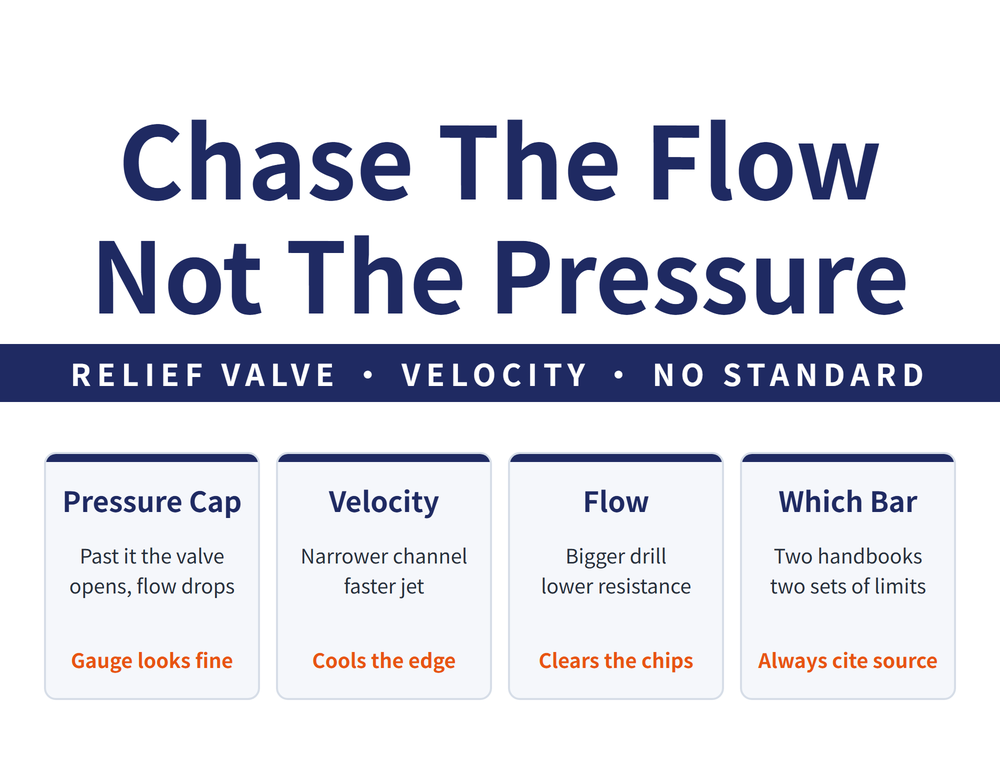
The counter-intuitive part first
The goal is maximum flow, not maximum pressure. A coolant system has a pressure ceiling. Once liquid pressure exceeds the system setting, the relief valve opens, and the result shows up as restricted flow. Keep winding the pressure up and less coolant actually reaches the cutting edge.
🔴 The awkward part is that the panel does not show it. Once the relief valve opens the gauge still reads normally while chip evacuation is already deteriorating. Watch the flow, not the pressure.
1. Coolant does three jobs at once
| Job | What it actually does |
|---|---|
| Heat removal | Plastic deformation and friction raise cutting-zone temperature sharply, accelerating tool wear and distorting the part, hole quality and geometry |
| Chip evacuation | Pressure pushes chips out of the hole and keeps them from packing into the flutes. The deeper the hole, the more coolant matters here |
| Lubrication | Reduces friction at the part-tool, chip-tool and chip-part interfaces, lowering the force needed to evacuate chips and the heat generated |
Of the three, chip evacuation is the hidden axis when selecting. A higher material removal rate needs higher flow. Raising cutting parameters is therefore not an isolated change: push the feed up and coolant flow has to follow, or chips pack.
2. Two relationships, trends only
Velocity follows how narrow the channel is: flow velocity equals volumetric flow divided by coolant channel cross-section. Push the same flow through a smaller section and velocity rises. Coolant leaving the outlet at high velocity is what cools the chip and protects the edge.
Flow follows how hard the tool is to push through: pressure equals that tool’s hydraulic resistance times flow squared. Higher inlet pressure means more flow through the drill; conversely, more flow requires more inlet pressure. And a larger drill has wider channels and lower hydraulic resistance, so at the same inlet pressure a larger drill passes more flow.
⚠ These relationships describe trends and cannot be used to compute absolute values. Hydraulic resistance is a property of each individual tool, and this article gives no actual figure for any tool. To know what your drill will pass, measure it or ask the supplier.
3. The pair most often got backwards
"Smaller holes give higher velocity" and "bigger drills give higher flow" sound contradictory. They are answering different questions. The difference is what you held constant.
| Statement | Held constant | Varying | Therefore |
|---|---|---|---|
| Smaller channel, higher velocity | Flow | Cross-section | The same volume through a narrower pipe moves faster |
| Bigger drill, higher flow | Inlet pressure | Hydraulic resistance | The same pressure pushes more volume |
Both hold at once, and each covers a different job: a big drill gets the flow that clears chips; a small channel gets the velocity that cools the edge.
4. Internal beats external, but channel form has no stated answer
Internal coolant supply is generally preferable to external. Two channel designs are common: a single central hole and twisted twin holes.
⚠ This article lists these two forms without comparing them or giving selection criteria. Base the choice on your actual conditions and supplier guidance.
5. There is no standard answer to "how many bar"
This deserves its own section, because it is where quoting a number goes wrong most easily. Two publications from the same manufacturer do not agree on where the pressure classes begin.
| Class | Publication A | Publication B (2019) |
|---|---|---|
| Low | Up to 20 bar | 10 to 15 bar |
| Medium | 20 to 70 bar | Up to about 50 bar |
| High | 70 to 200 bar | 70 to 80 bar |
| Ultra-high | Above 200 bar | 100 to 200 bar or higher |
The only point the two tables share is that high pressure starts at 70 bar. Every other boundary differs. One of them says so itself: high and ultra-high pressure have no strict official definition. They are industry conventions, and they drift upward as the technology moves.
🔴 So always name whose definition it is and the year alongside the number. Saying "high-pressure coolant means 70 bar and above" without naming whose definition it is sounds like a standard and is not. Each table proves only that that publication classifies it that way; neither establishes an industry standard.
6. The working order
1. Find the maximum flow the machine can deliver and set that as the target.
2. Set pressure just below the relief valve and no higher.
3. When you raise the feed, check flow as well, not just speed and feed.
4. The deeper the hole, the more weight chip evacuation deserves.
5. When you see a "high pressure coolant" spec, ask whose definition and from what year.
For which coolant to use and how it is delivered, see Oil-Hole Drill Coolant Types and Drilling Cutting Oil Comparison. The other half of the chip-evacuation answer is the cycle, covered in Choosing a Drilling Cycle.
Frequently asked questions
Is maximum coolant pressure better?
No. The system has a pressure ceiling, and beyond it the relief valve opens and actual flow is restricted while the gauge still reads normally. Aim for maximum flow and set pressure just below the point where the valve opens.
Why do some say smaller holes give higher velocity and others say bigger drills give more flow?
The two statements hold different things constant. The first fixes flow and varies cross-section: the same volume through a narrower pipe moves faster. The second fixes inlet pressure and varies hydraulic resistance: a bigger drill has wider channels and passes more volume. Both are true, and they cover chip evacuation and edge cooling respectively.
Can I use those relationships to calculate the pressure for my drill?
No. Hydraulic resistance is specific to each tool and this article gives no actual value for any of them, so the relationships describe trends only. Get real figures by measurement or from your supplier.
So how many bar is high-pressure coolant?
There is no standard answer. Across the two publications checked, only the 70 bar threshold for high pressure agrees; every other boundary differs, and one of them states outright that this is industry convention rather than an official definition. When you meet such a spec, ask whose definition it is and from which year.
Sources: ISCAR Drilling Handbook (Coolant in Drilling / Pressure Vs. Flow); pressure classification cross-checked against ISCAR Machining Titanium (2019). Both pressure tables are manufacturer conventions, not international standards; quote them with source and year. The two relationships in this article describe trends and must not be used to compute absolute values.
Last updated: 2026-09-14









