
Choosing a Drilling Cycle: G81, G73 and G83 as a Three-Step Fallback
Peck drilling is not the default. It is what you fall back to when chip evacuation fails. This guide covers the three fixed cycles, the order in which to use them, and why the retract-height command never raises an alarm but can still crash the tool.
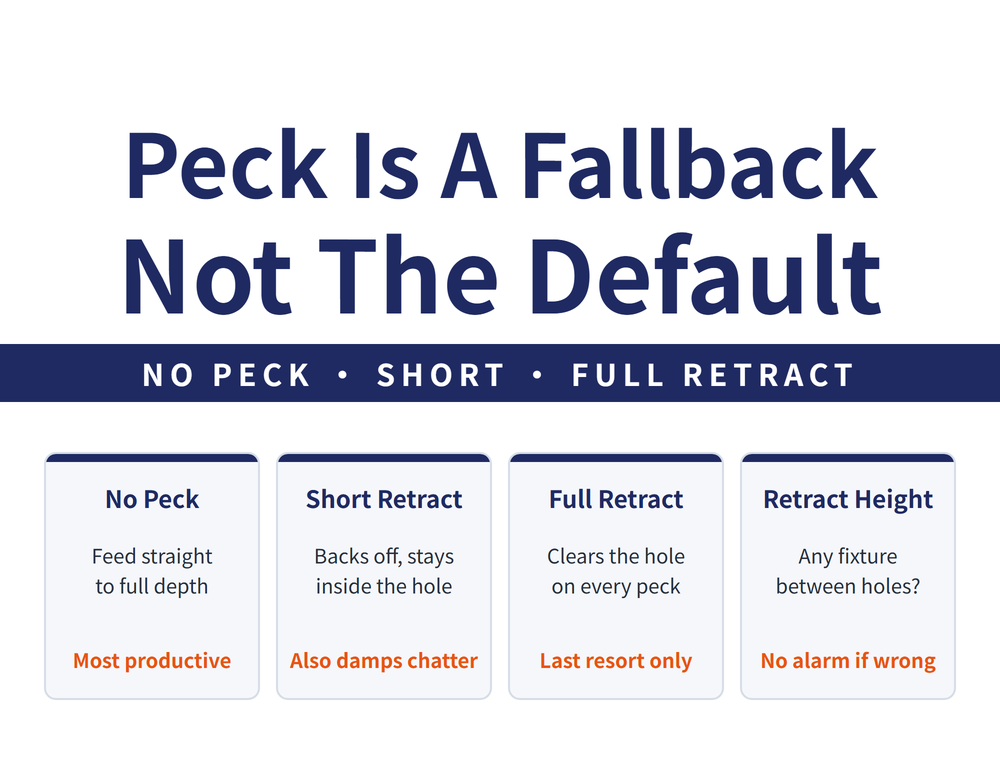
The conclusion first: pecking is a fallback, not a default
Many programs apply peck drilling to every hole on the grounds that it is safer. Two independently sourced drilling handbooks say the same thing: not pecking is the first choice. Pecking is what you reach for once chip evacuation becomes a problem. One states plainly that continuous feed is the most productive method; the other says pecking may be used "if no other solution can be found".
Read the order that way and three familiar shop-floor puzzles resolve: why pecking sometimes wrecks the drill, why long drills should not fully retract, and why the same program crashes on a different machine.
1. Three cycles, differing only in where the drill retracts to
| Cycle | Common name | What the drill actually does |
|---|---|---|
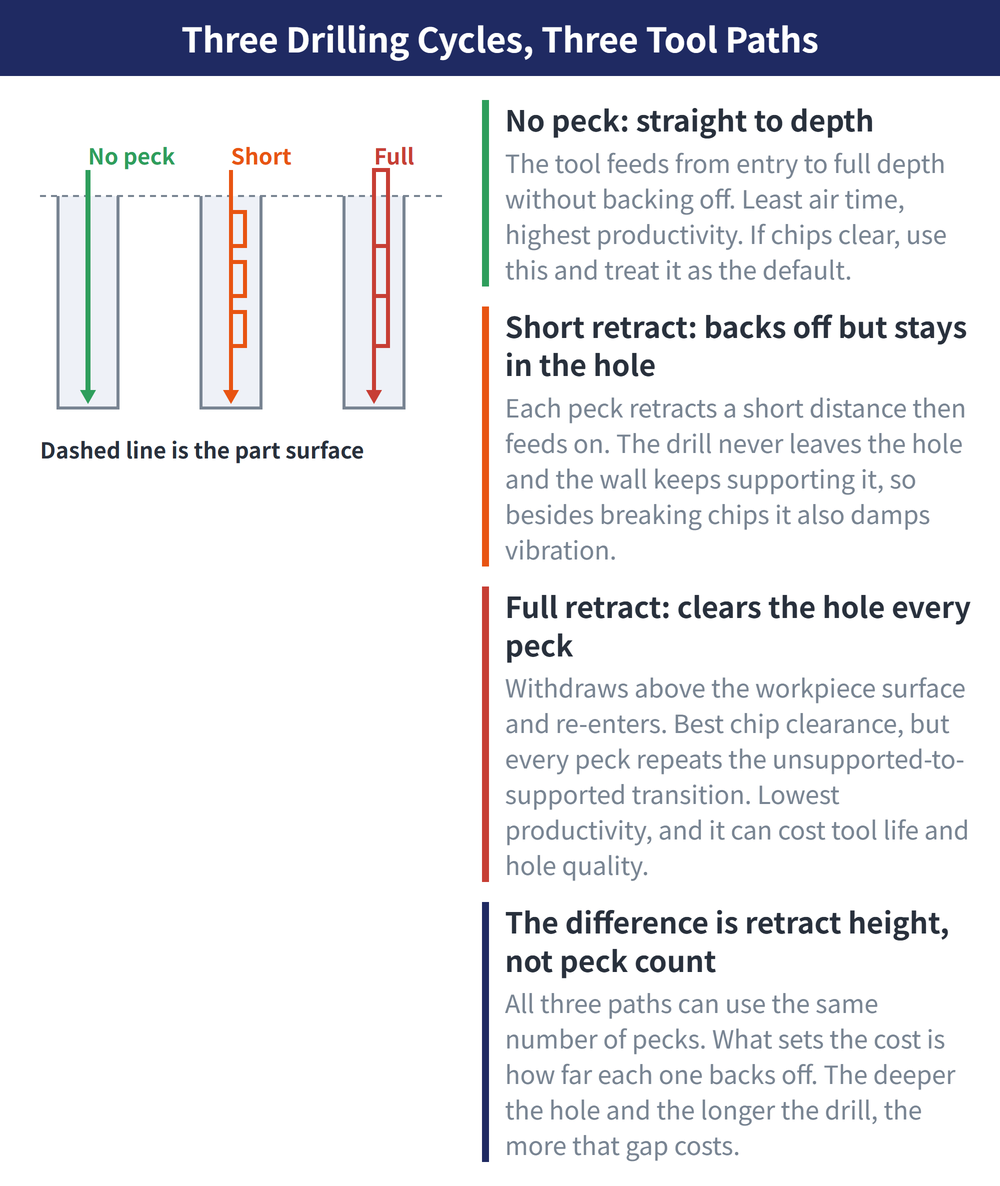
| G81 | Basic drilling (no peck) | Position over the hole, rapid down to the R point, then feed continuously to depth and rapid out |
| G73 | Short-retract peck | Retracts a short distance each peck; the drill never leaves the hole |
| G83 | Full-retract peck | Fully withdraws from the hole each peck, back to the R point |
All three are standard fixed cycles under ISO 6983-1 and are not tied to any CAM package, so the names carry across controllers. The parameter set is the same: hole position, drilling depth, R point and feed rate, with peck depth added for the two pecking cycles. Boring cycles are covered separately in Choosing a Boring Cycle: How G76 and G85-G89 Differ.
2. A three-step fallback, each step with a price
These are not three equal options. They form an ordered path. Use the best one; drop a step only when it stops working.
| Rank | Cycle | When to use it | What it costs |
|---|---|---|---|
| 1 | No peck | Use this by default | Nothing. This is the most productive method |
| 2 | Short retract | Chip evacuation starts to fail | Retract time, in exchange for two benefits (below) |
| 3 | Full retract | Only when neither of the above clears chips | Lowest productivity, and it may shorten tool life and degrade hole quality |
What triggers the fallback is neither the material nor the diameter. It is the depth-to-diameter ratio. Deeper holes evacuate chips less easily. So the order is: look at hole depth, check whether chips are actually clearing, and only then decide whether to drop a step.
3. Short retract has a second benefit most people miss
Everyone knows pecking breaks and clears chips. The short retract does something else as well: it suppresses vibration, because the drill never leaves the hole and the wall keeps supporting it.
That explains a common shop-floor rule: for a long drill, prefer the short retract over the full retract. A full retract re-enters the hole on every peck, repeating the unstable transition from unsupported to supported each time. The deeper the hole and the longer the drill, the more that costs.
4. Retract height: no alarm, but it can crash
| Command | Where the drill retracts to after each hole |
|---|---|
| G98 | The initial point, higher up |
| G99 | The R point, lower down |
The rule is a single question: is there anything between the holes? Retract to the initial point when fixtures, bosses or similar features sit between holes. With nothing in the way, retract to the R point, which travels less and runs faster.
🔴 The dangerous part is that this never raises an alarm. It sets the clearance height between holes, and whether that height is enough depends on your fixture layout, which the machine knows nothing about. Move the program to another machine, or change the fixture, and a previously safe height may no longer clear. Re-check this line on the first run after any fixture change.
5. Two independent sources, one conclusion
This conclusion is worth trusting not because one manufacturer says so, but because two separately sourced handbooks reach it independently, each supplying what the other lacks.
| Source A | Source B | |
|---|---|---|
| Short retract | Gives a specific suggested retract distance, aimed at best productivity | Retract distance is set by the machine; adds vibration reduction as a second reason |
| Full retract | Aimed at best chip evacuation | States it is the least productive and may harm tool life and hole quality |
| Is pecking the first choice? | Use pecking if no other solution can be found | Not pecking is preferred; pecking is the fallback |
Together they are complete: one supplies the number, the other the standard name and the reasoning.
6. The working order
1. Start without pecking and treat it as the default.
2. Watch the chips. If they clear, change nothing. Only drop to the short retract when they do not.
3. If the short retract still will not clear them, go to the full retract and accept the cost in productivity and hole quality.
4. Re-check the retract-height line every time the fixture changes.
For when segmented feed is needed and how to set peck depth, see Peck Drilling: When Segmented Feed Is Needed and How to Set It. Past a certain depth the drill is no longer the right system at all, which is covered in Deep Hole Drilling Methods: Twist Drill, Gun Drill and BTA.
Frequently asked questions
Is it not safer to peck every hole?
Not recommended. Both independently sourced handbooks rank no-peck first, and the full retract is described outright as the least productive option that may shorten tool life and degrade hole quality. Pecking everything makes the worst option your default; you pay in cycle time and do not necessarily buy safety.
How far should each peck retract?
The short-retract distance is set by the machine, and the standard gives no universal value. One source publishes a suggested figure, but that is its own recommendation and should not be treated as a general default. Check your controller settings for the actual value.
Short retract or full retract for a long drill?
Prefer the short retract. The drill stays in the hole and the wall keeps supporting it, so vibration is lower. A full retract re-enters the hole every peck, and the longer the drill the more that unstable transition costs.
What happens if the retract height is wrong?
No alarm, but a possible crash. It sets the clearance height between holes, and whether that is sufficient depends on fixture layout, which the machine has no knowledge of. Re-check it on the first run after a fixture change.
Sources: ISCAR Drilling Handbook (Technological Drilling Method); Sandvik technical information (two peck-drilling methods). Cycle codes follow ISO 6983-1. Syntax strings and program examples are deliberately omitted; refer to your controller manual for parameter behaviour.
Last updated: 2026-10-31









