Sequencing Machining Operations: Stages, Concentration vs Division, Heat Treatment
Sequencing decides more than throughput — it decides whether the accuracy holds. Whether to split roughing from finishing, whether to concentrate or divide operations, and which cut heat treatment goes before are three decisions that pull on each other. This article takes them together, with the timing of five heat treatments and three inspection types.
1. Why split roughing from finishing
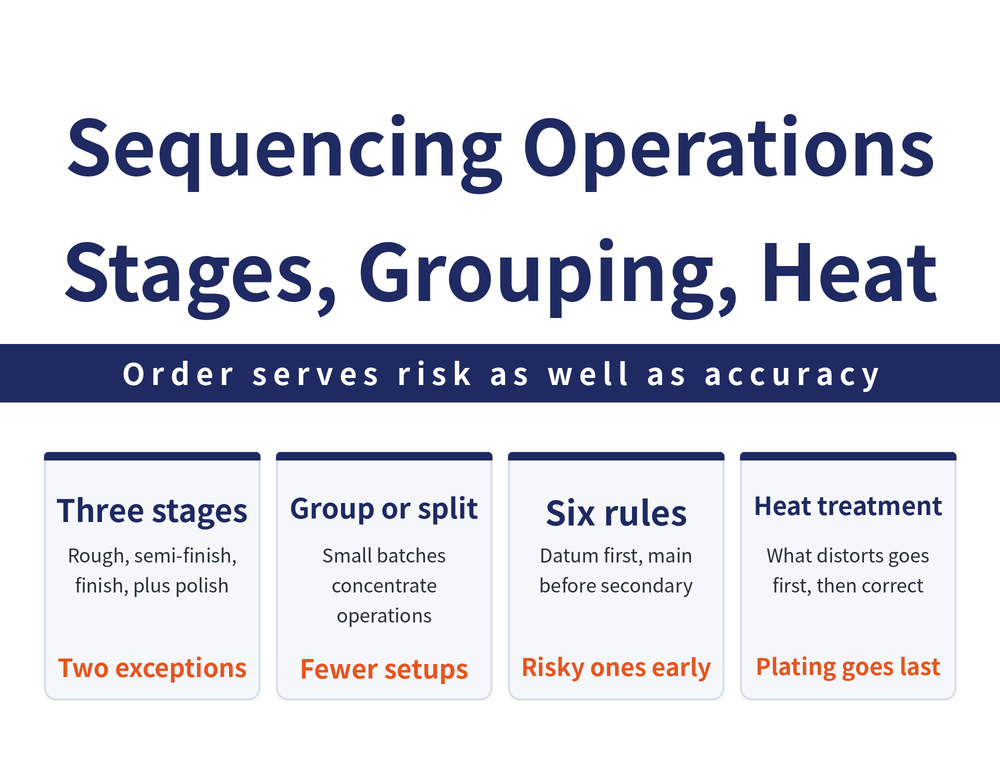
A process is generally divided into roughing, semi-finishing and finishing stages; for what each stage aims for and why they are split, see Planning the Cutting Sequence.
Two cases do not need splitting: parts of modest requirement, or parts of high requirement whose blanks are rigid and accurate; and large, heavy workpieces of moderate requirement machined complete in one setup on a machining centre. The reasoning for the second is that the repeat-setup error saved outweighs what splitting would buy.
2. Concentrate or divide the operations
| Divided | Concentrated | |
|---|---|---|
| Form | Many operations, little content each | Few operations, many steps each |
| Advantages | Simple tooling, easy to set; suits picking sensible cutting data; easy product changeover | Suits high-efficiency CNC; fewer setups and less idle time; easier to hold surface-to-surface position accuracy |
| Cost | More machines, more floor space | Heavy equipment and tooling investment, complex setup and maintenance, harder changeover |
The choice relates to batch size, but not as simply as "small concentrate, large divide": small batches usually concentrate operations on general machines (because each setup costs relatively more); large batches work either way — divided into a flow line, or concentrated on high-productivity equipment.
Note the advantage of concentration worth remembering: fewer setups makes surface-to-surface position accuracy easier to hold. That is the same reasoning as the unified datum principle — see choosing a locating datum.
3. Six rules for machining order
| # | Rule |
|---|---|
| 1 | For complex, large or widely varying blanks, lay out marking first to give the datum machining something to align to |
| 2 | Datum face before the rest — machine the finish datum first |
| 3 | Re-true the finish datum before machining important surfaces |
| 4 | Main before secondary, rough before finish |
| 5 | Secondary surfaces tied positionally to a main surface come after that main surface |
| 6 | Where scrap risk is high, finishing and polishing may be brought forward; normally the finishing of main surfaces goes last |
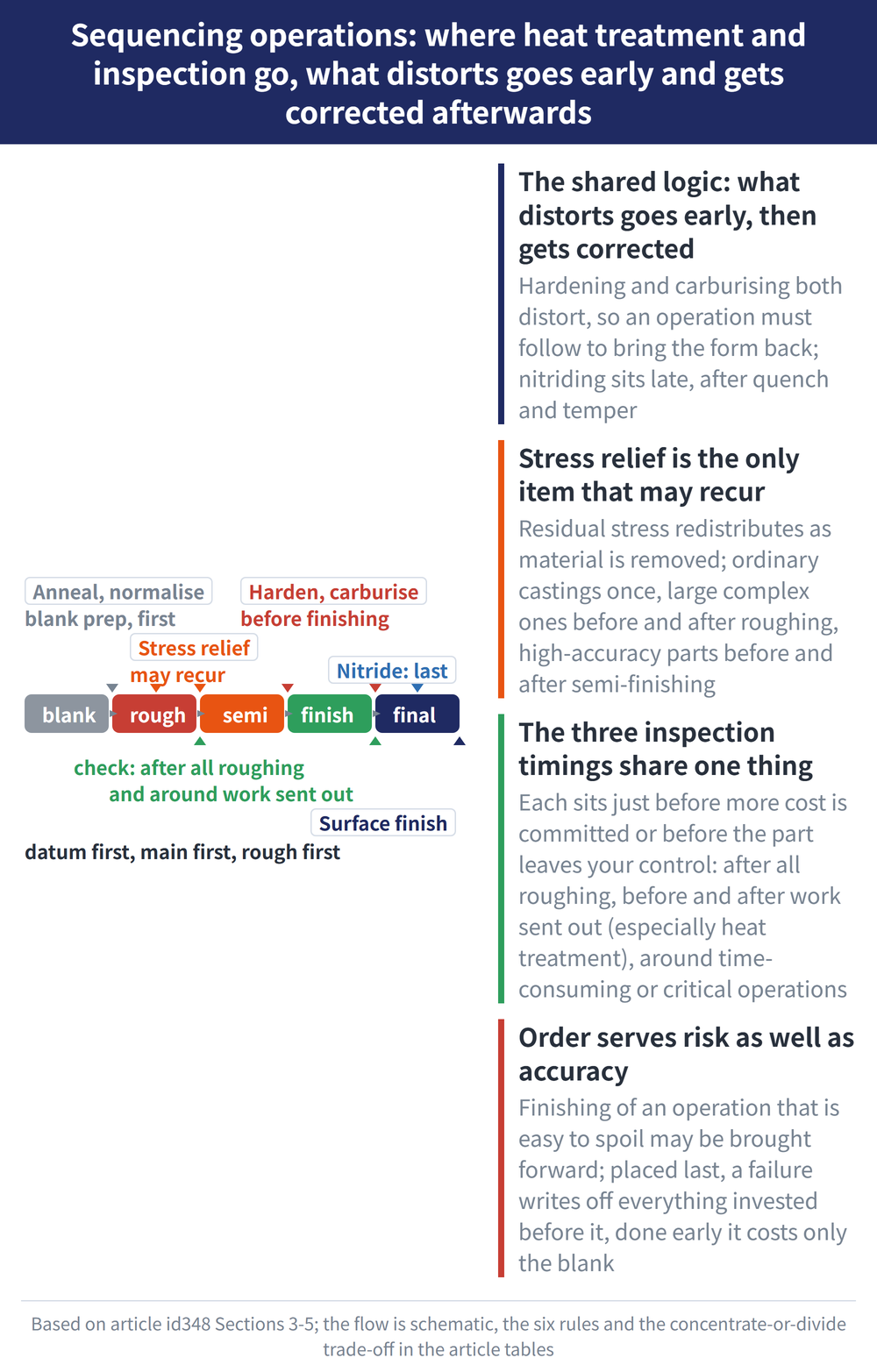
Rule 6 is the only conditionally reversible one, and it shows what sequencing is really about: order serves risk as well as accuracy. An operation that is easy to spoil, placed last, can write off everything invested before it; done early, a failure costs only the blank.
4. Which cut does heat treatment go before
| Treatment | Timing |
|---|---|
| Annealing, normalising | Preparatory treatment of the blank; before machining |
| Stress relief (ageing) | For residual stress. Ordinary castings once after casting or roughing; large complex ones before and after roughing; high-accuracy ones before and after semi-finishing; high-accuracy low-rigidity parts need more |
| Hardening | Raises hardness and distorts readily; before grinding in the finishing stage |
| Carburising | Distorts readily; before finishing. To control case depth, finishing must precede carburising |
| Nitriding | Late in the process, before final machining of that surface; the part should be quenched and tempered first |
The shared logic is "what distorts goes early, and gets corrected afterwards" — hardening and carburising both distort, so an operation must follow to bring the form back. Stress relief is the only item that may recur, because residual stress redistributes as material is removed.
5. Where inspection and surface treatment sit
| Item | Timing |
|---|---|
| In-process inspection | After all roughing and before finishing; before and after work sent out (especially heat treatment); before and after time-consuming or critical operations |
| Special inspection | Fluorescent and magnetic particle inspection for surface quality sit in the finishing stage; if used to check blanks for cracks, before machining |
| Surface treatment | Plating, coating, bluing, oxidising, anodising and similar go at the end |
The three inspection timings share one thing: each sits just before more cost is committed, or before the part leaves your control. That is cheaper than inspecting every nth operation. For which route each surface should take, see machining route selection.
Compiled from the process planning chapter of a metal cutting technical handbook as general process principles; adjust for part geometry, material and available equipment.
6. Frequently Asked Questions (FAQ)
Q: Machining complete in one setup — still split the stages?
Large heavy workpieces of moderate requirement often are not split, because the repeat-setup error saved outweighs the benefit. Parts of high accuracy, or with high internal stress in the blank, should still be split.
Q: Concentrate or divide for small batches?
Small batches usually concentrate operations on general machines, because each setup costs relatively more. Large batches work either way, depending on whether you build a flow line or use high-productivity equipment.
Q: Why bring risky operations forward?
Because order serves risk as well as accuracy. An operation that is easy to spoil, placed last, can write off everything invested before it; done early, a failure costs only the blank.
Q: Why might stress relief be needed several times?
Because residual stress redistributes as material is removed. Large complex castings need it before and after roughing, and high-accuracy low-rigidity parts may need it after rough turning, rough grinding and semi-finish grinding.
This article is part of Manufacturing Process: The Complete Guide - Set the Datum First, Then Sequence, Allowance and Dry Cutting; that guide shows how the whole topic fits together.