
Choosing a Locating Datum: Six Rough Rules, Four Finish Rules, Five Method Rules
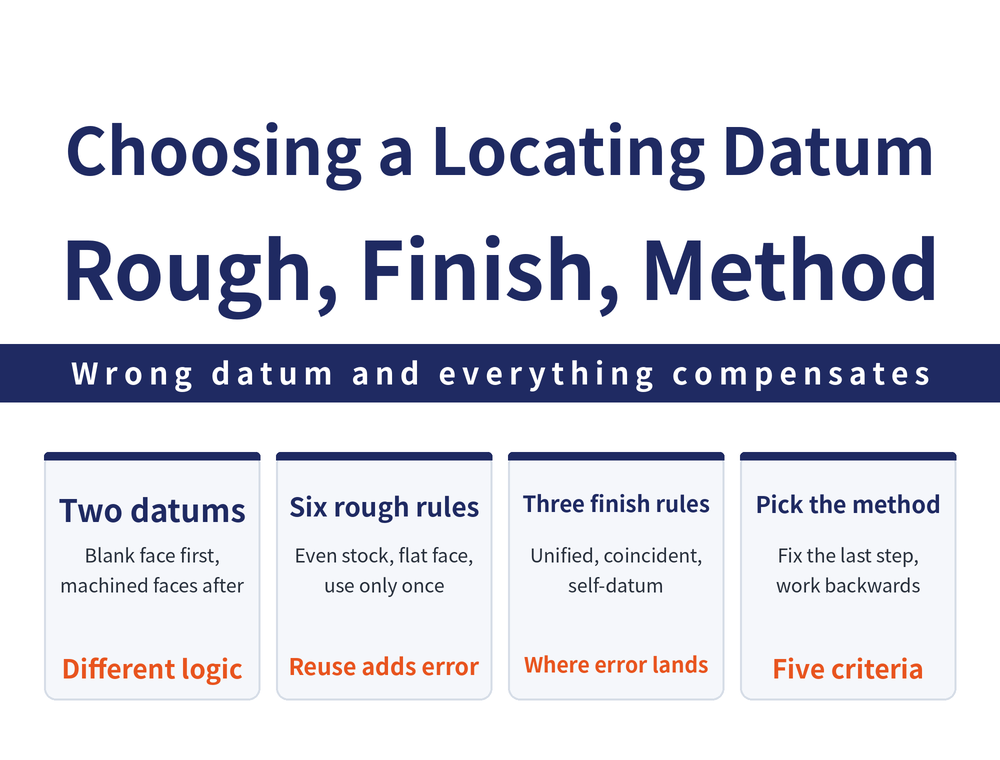
Give the same drawing and the same machine to two planners and the operation sequences can differ considerably — often because of which face the first cut is located from. Get the datum wrong and every later operation is compensating for it. This article covers six rules for rough datums, four for finish datums, and five criteria for choosing the machining method.
1. Rough and finish datums: has it been machined yet
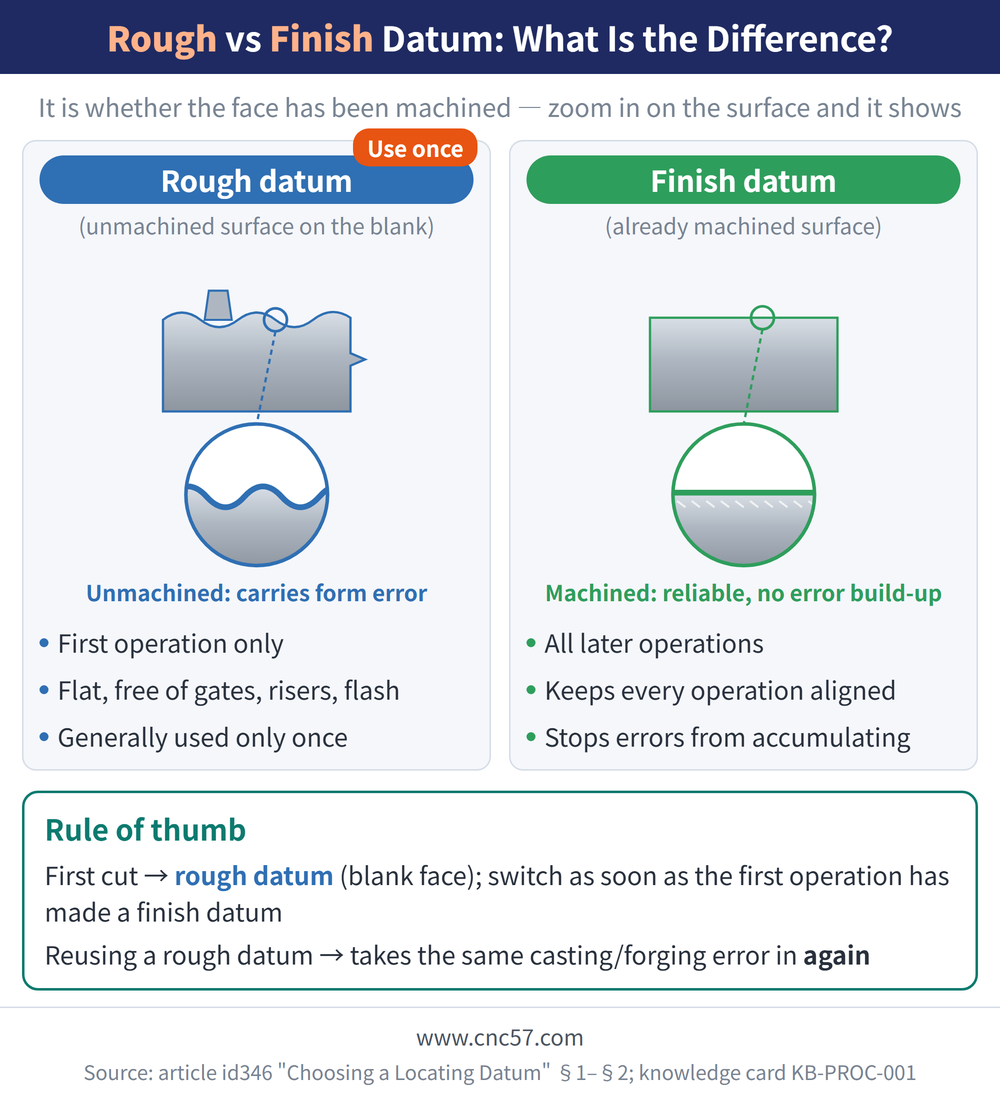
A locating datum is the surface used to establish the workpiece position relative to the machine and the tool. There are two kinds, and the line between them is simple:
| Type | Used in | What surface |
|---|---|---|
| Rough datum | The first operation | An unmachined surface on the blank |
| Finish datum | All later operations | An already machined surface |
The selection logic differs completely. The rough datum answers "how do I make the first cut", when no reliable machined surface exists yet. The finish datum answers "how does every later operation stay aligned", where the concern is stopping errors from accumulating.
2. Rough datum: six rules
| # | Rule |
|---|---|
| 1 | Make locating, clamping and machining convenient, and keep the fixture simple |
| 2 | If the position accuracy between a machined face and an unmachined face must be secured first, use that unmachined face as the rough datum |
| 3 | To keep the rough stock on one important surface small and even, use that surface as the rough datum |
| 4 | To even out stock across several surfaces, choose the blank face that best distributes the position error |
| 5 | The rough datum face must be flat and free of gates, risers or flash, or location will be unreliable |
| 6 | 🔴 A rough datum should generally be used only once (especially a primary one); reusing it introduces significant position error |
Rule 6 is the one most often ignored. A rough datum is an unmachined face and already carries casting or forging form error; locating from it a second time takes that same error in again. The correct move is to switch to the finish datum as soon as the first operation has produced one.
Rules 2, 3 and 4 look like three separate requirements but are three cases of one question — what are you protecting: a positional relationship, the stock on one surface, or stock distribution across several. They cannot all be optimised at once, so the priority has to be decided first.
3. Finish datum: three named principles
Beyond the shared requirement of convenient, sufficiently accurate location, three named principles apply:
| Principle | Method | What it solves |
|---|---|---|
| Unified datum | Use one set of datums across the operations for most surfaces | Fewer fixtures to design and build, no datum-transfer error, higher output |
| Coincident datum | On final finishing, locate from the design datum | Secures position accuracy |
| Self-datum | Locate from the surface being machined itself | When rough stock must be small and even |
They apply in order: use the unified datum by default (fewer fixtures, fewer errors); but where a surface cannot reach its position accuracy on the unified datum, that finishing operation must switch to the coincident datum — back to the datum shown on the drawing. Self-datum is the special case, used where stock evenness comes first, with position accuracy secured by the preceding operation.
Behind all three is one judgement: where the error is absorbed. A unified datum spreads it; a coincident datum concentrates accuracy on the dimension that matters most. For how tolerance is specified, see tolerance grades and fits. For how the workpiece is restrained, see How a Workpiece Is Located: Six Degrees of Freedom, Locating Pins and the Diamond Pin.
4. Choosing the machining method: work backwards
There is a firm rule of order here: fix the final machining method first, then select each preceding operation backwards. The reason is direct — the final method is set by the drawing, and every operation before it exists to make the next one possible. Sequencing forward from roughing tends to produce a chain that ends one grade short.
| Criterion | Must match |
|---|---|
| Economic machining accuracy | The accuracy and roughness called out on the drawing |
| Geometric and positional accuracy | Form accuracy and surface-to-surface position requirements |
| Machinability of the material | Hardened and heat-resistant steels take the grinding route |
| Production type | High volume warrants high-efficiency equipment; small batches use general machines |
| Shop conditions | Available equipment and operator skill level |
5. The two criteria most often underrated
"Economic machining accuracy" in the first row is the key term — every method has a band it can reach at sensible cost, and the full comparison by surface type is in machining route selection for external, hole and flat surfaces. The last two criteria are often treated as unwelcome compromises, but they are the two that bring a plan back from paper to the shop floor: however good the route, if the equipment cannot deliver it or the operators are unfamiliar with it, real yield will not follow.
The principles here are compiled from the process planning chapter of a metal cutting technical handbook and are general process principles; actual sequencing should be adjusted for part geometry, material and shop conditions.
6. Frequently Asked Questions (FAQ)
Q: Why should a rough datum be used only once?
Because it is an unmachined face carrying casting or forging form error. Locating from it again takes that error in a second time and produces significant position error. Switch to a finish datum as soon as one exists.
Q: Unified or coincident datum when they conflict?
Use the unified datum by default to reduce fixtures and transfer error. But where a surface cannot reach its position accuracy that way, that finishing operation must switch to the design datum.
Q: Why sequence backwards from the last operation?
Because the final method is set by the drawing and every earlier operation exists to make the next possible. Sequencing forward from roughing tends to produce a chain that ends one accuracy grade short.
Q: Can an unmachined face be used as a datum?
Yes, and sometimes it must be. Where position accuracy between a machined and an unmachined face has to be secured first, that unmachined face should be the rough datum — rule two of the six.
This article is part of Manufacturing Process: The Complete Guide - Set the Datum First, Then Sequence, Allowance and Dry Cutting; that guide shows how the whole topic fits together.
Published: 2026-08-26 | Last updated: 2026-10-25









