
How Metal Elements Affect Machinability: C, Cr, Ni
A metal's machinability is closely tied to its chemical composition. Elements such as carbon (C), chromium (Cr), nickel (Ni) and molybdenum (Mo) affect hardness, strength, wear and corrosion resistance, while sulfur (S) and lead (Pb) improve machinability. Understanding each element helps optimize cutting conditions, tool selection and material use—a foundation of machining and material selection. For material grouping, see ISO Workpiece Material Classification.
How Elements Affect Machinability
Alloying elements change hardness, strength/toughness, machinability and wear/corrosion resistance, in turn affecting tool life, cutting force and chip evacuation. Broadly, elements either harden/strengthen (harder to machine), improve machinability (easier to machine), or add toughness/corrosion resistance/light weight.

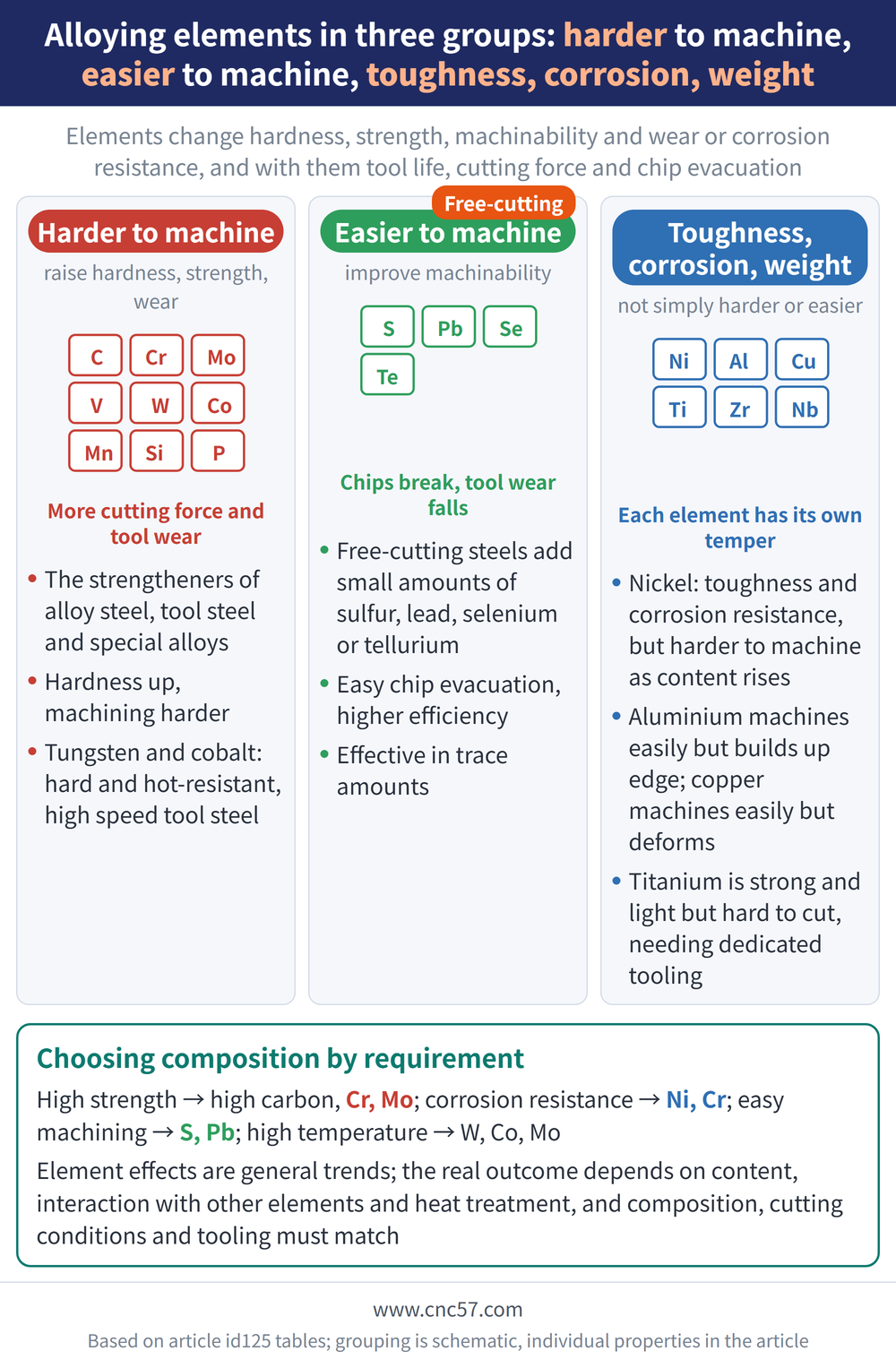
Elements That Raise Hardness, Strength and Wear (Harder to Machine)
These are the strengtheners of alloy steel, tool steel and special alloys; they boost performance but raise cutting force and tool wear.
| Element | Key effect | Effect on machining |
|---|---|---|
| Carbon C | Raises hardness and strength | More hardness → harder to machine; for high-strength materials |
| Chromium Cr | Raises hardness, adds corrosion resistance | Higher wear resistance, more cutting force |
| Molybdenum Mo | Raises hot strength and wear resistance | Higher tool-durability demand; for high-load cutting |
| Vanadium V | Refines grain, raises strength | Better wear resistance, more machining difficulty |
| Tungsten W | High hardness, heat resistance | For high-speed steel; hard to cut |
| Cobalt Co | Raises hot hardness | In a workpiece, cobalt usually means a cobalt-based superalloy, one of the hardest materials to machine; hard particles in the matrix wear tools fast |
| Manganese Mn | Raises strength, improves hardenability | More wear resistance, moderate machinability |
| Silicon Si / Boron B | Raises hardness and strength | More brittleness, lower machinability |
| Phosphorus P | Raises strength | More brittleness, lower toughness |
Elements That Improve Machinability (Easier to Machine)
Free-cutting steels deliberately add small amounts of sulfur, lead or selenium/tellurium to break chips and reduce tool wear.
| Element | Key effect | Effect on machining |
|---|---|---|
| Sulfur S | Improves machinability | Easy chip break, lower tool wear |
| Lead Pb | Excellent machinability | Easy to cut, higher efficiency |
| Selenium Se / Tellurium Te | Improves machinability | Better machining efficiency |
Elements Adding Toughness, Corrosion Resistance or Light Weight
| Element | Key effect | Effect on machining |
|---|---|---|
| Nickel Ni | Raises toughness, adds corrosion resistance | Common in stainless steel; high toughness means heavy chip deformation and high cutting temperature, and Cr-Ni steels get harder to machine as nickel content rises |
| Aluminum Al | Lightweight, good heat conduction | Easy to machine but prone to built-up edge |
| Copper Cu | High conductivity, good ductility | Easy to machine but prone to deformation |
| Titanium Ti | High strength, low density | Hard to cut; needs dedicated tools |
| Zirconium Zr / Tantalum Ta / Niobium Nb | Raise high-temp performance, add corrosion resistance | For special alloys; high machining difficulty |
| Oxygen O / Nitrogen N | Affect material purity | Excess lowers material performance |
Choosing Composition by Requirement
| Requirement | Key elements |
|---|---|
| High strength | High carbon, Cr, Mo |
| Corrosion resistance | Ni, Cr |
| Easy machining | S, Pb |
| High temperature | W, Co, Mo |
In engineering, composition, cutting conditions and tool matching work together to raise efficiency, extend tool life and optimize performance. For high-hardness materials, parameters must match the hardness state—see End Mill Cutting Conditions Guide.
※ Element effects are general trends; actual results depend on content, interactions with other elements and heat-treatment state.
FAQ
Which elements make a material harder to machine?
Carbon (C), chromium (Cr), molybdenum (Mo), vanadium (V), tungsten (W) and cobalt (Co) raise hardness, strength and wear resistance, increasing cutting force and tool wear—so machining gets harder.
Why is free-cutting steel easier to machine?
Free-cutting steel adds small amounts of sulfur (S), lead (Pb) or selenium/tellurium (Se/Te), which break chips and reduce tool wear—giving smooth chip evacuation and higher efficiency.
What roles do Cr and Ni play in stainless steel?
Chromium provides corrosion resistance and hardness (more cutting force); nickel adds toughness and corrosion resistance, but that toughness also means heavier chip deformation and higher cutting temperature, and Cr-Ni steels get harder to machine as nickel content rises. Both are key to austenitic stainless steels such as SUS304/316.
Why does aluminum tend to form built-up edge?
Aluminum (Al) is soft, ductile and highly conductive, so material tends to stick to the cutting edge and form a built-up edge. Sharp edges, higher cutting speeds and proper cooling help.
For the full reading guide on this topic, see Tool Life and Wear: A Complete Reading Guide.
This article is part of Workpiece Materials: The Complete Guide - Name the Metal First, Then Match the Tool; that guide shows how the whole topic fits together.
Published: 2026-03-25 | Last updated: 2026-10-21









