Metal Material Guide: Steel, Stainless & Aluminum Selection
Choosing a metal is a chain of trade-offs: it has to be strong enough and corrosion-resistant enough, and pushing either of those up usually means it cuts harder and dulls tools faster. This guide sets carbon steel, alloy steel, tool steel, stainless steel, aluminum, copper alloy, cast iron and special alloys against one set of criteria, so you can decide which family the part belongs to, which grade within it, and what that choice costs you downstream in machining. For each material's ISO workpiece group, see ISO Workpiece Material Classification.
Overview of Eight Metal Material Families
The table indexes the eight common families with representative grades, key properties, typical uses and ISO workpiece group.
| Family | Representative grades | Key properties | Typical use | ISO group |
|---|---|---|---|---|
| Carbon / structural steel | SS400, S25C, S45C | Low-medium strength, good machinability | Structures, machine parts | P |
| Alloy / engineering steel | SCM420, SNCM439, SCr420 | High strength, heat-treatable | Gears, shafts, auto parts | P |
| Tool / mold steel | SK4, SKH51, SKD11, SKD61 | High hardness (HRC50+), high wear resistance | Cutters, molds, high-load parts | P (annealed) / H (hardened) |
| Stainless steel | SUS304, SUS316, SUS420J2, SUS630 | Corrosion resistant, strong and tough | Food, medical, aerospace | M (austenitic) / P·H (martensitic/PH) |
| Aluminum alloy | A2014, A5052, A6063, A7075 | Lightweight, good machinability | Aerospace, building, precision parts | N |
| Copper alloy | C1100, C5191, C1720 | High conductivity, good ductility | Electronics, springs, contacts | N |
| Cast iron | FC250, FCD700 | Good castability, high compressive strength | Machine bases, industrial equipment | K |
| Special alloys | Nickel-based, titanium, superalloys | High-temperature strength, corrosion resistance | Aerospace, high-temp & chemical plant | S |
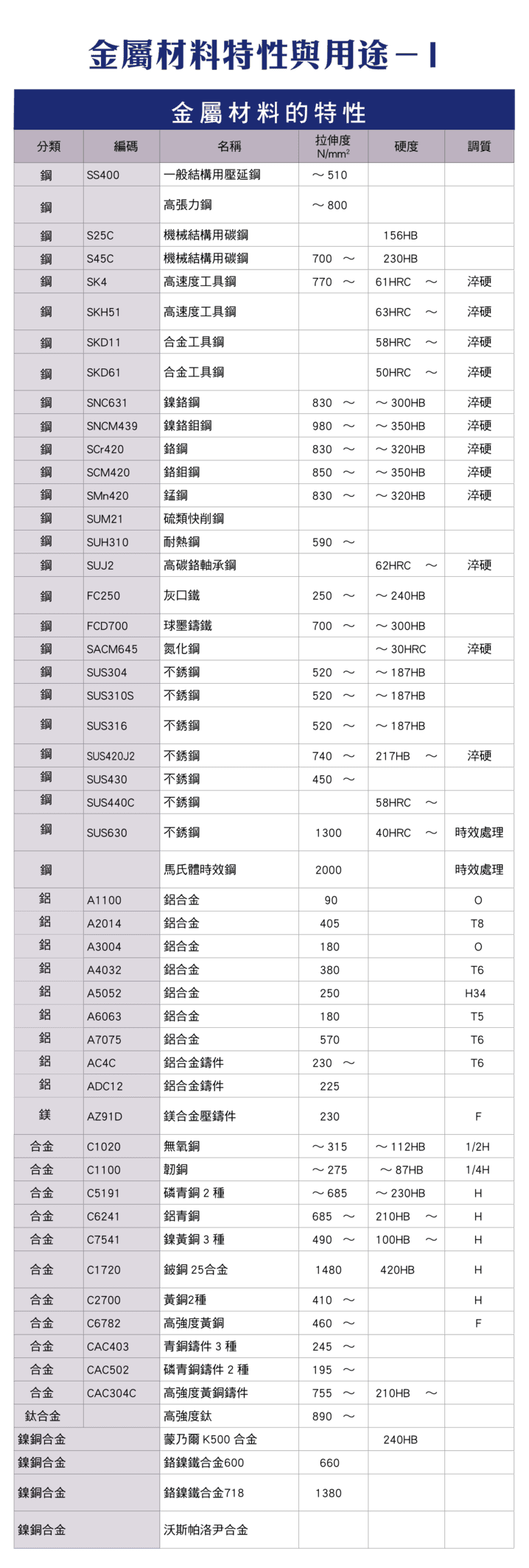
Carbon, Alloy and Tool Steels
Iron-based materials are the largest group; as carbon and alloying content rise, strength and hardness increase but so does machining difficulty.
| Class | Representative grades | Properties | Use |
|---|---|---|---|
| Carbon / structural | SS400, S25C, S45C | Low-medium strength, good machinability | Structures, machine parts |
| Alloy steel | SCM420, SNCM439, SCr420 | High strength, heat-treatable (carburize/Q&T) | Gears, shafts, auto parts |
| Tool / mold steel | SK4, SKH51, SKD11, SKD61 | High hardness (HRC50+), high wear resistance | Cutters, molds, high-load parts |
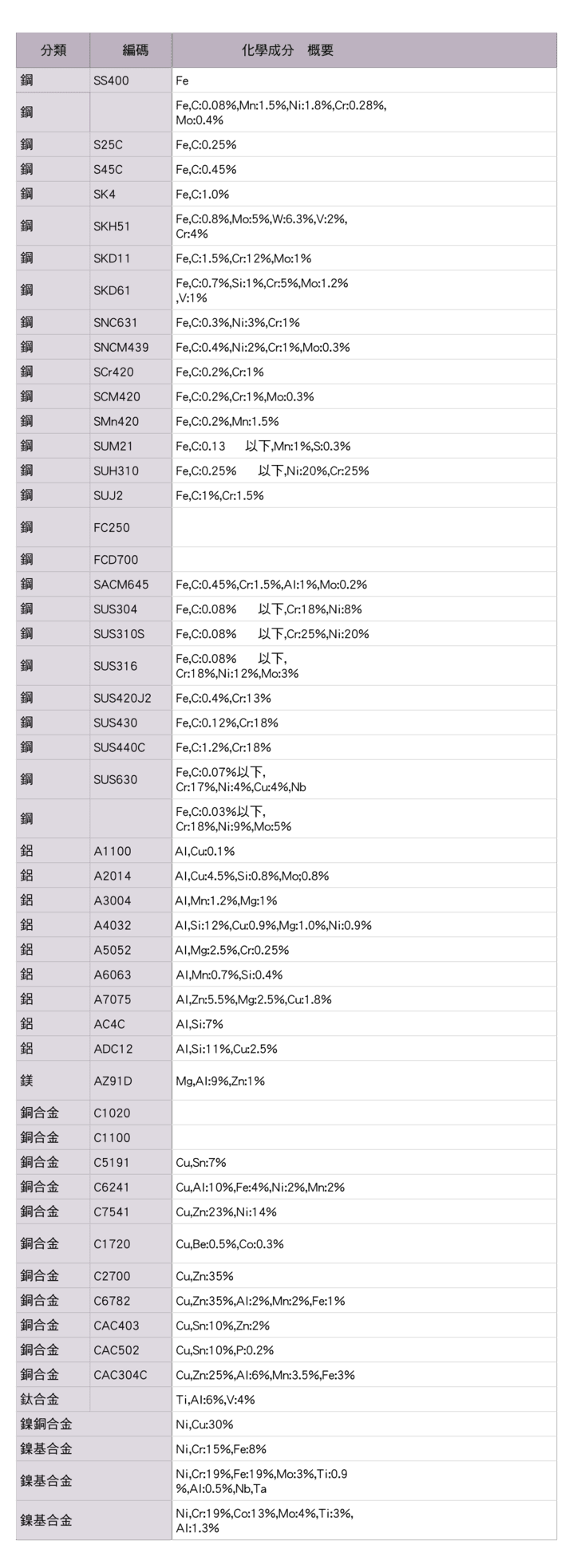
Stainless, Aluminum and Copper
Non-carbon-steel families emphasize corrosion resistance, light weight or conductivity, with differing machinability and tooling.
| Class | Representative grades | Properties | Use |
|---|---|---|---|
| Stainless steel | SUS304, SUS316, SUS420J2, SUS630 | Corrosion resistant, strong and tough | Food, medical, aerospace parts |
| Aluminum alloy | A2014, A5052, A6063, A7075 | Lightweight, good machinability | Aerospace, building, precision parts |
| Copper alloy | C1100, C5191, C1720 | High conductivity, good ductility | Electronics, springs, contacts |
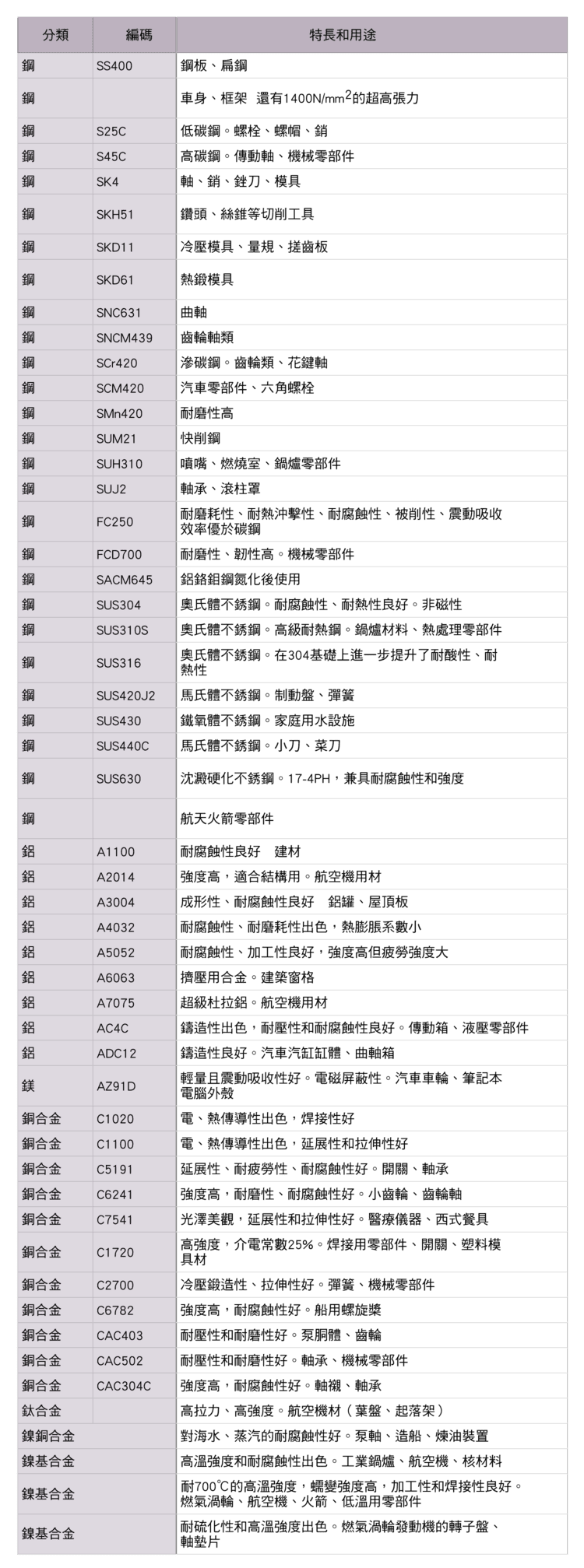
Cast Iron and Special Alloys
| Class | Representative grades | Properties | Use |
|---|---|---|---|
| Cast iron | FC250 (grey), FCD700 (ductile) | Good castability, high compressive strength | Machine bases, industrial equipment |
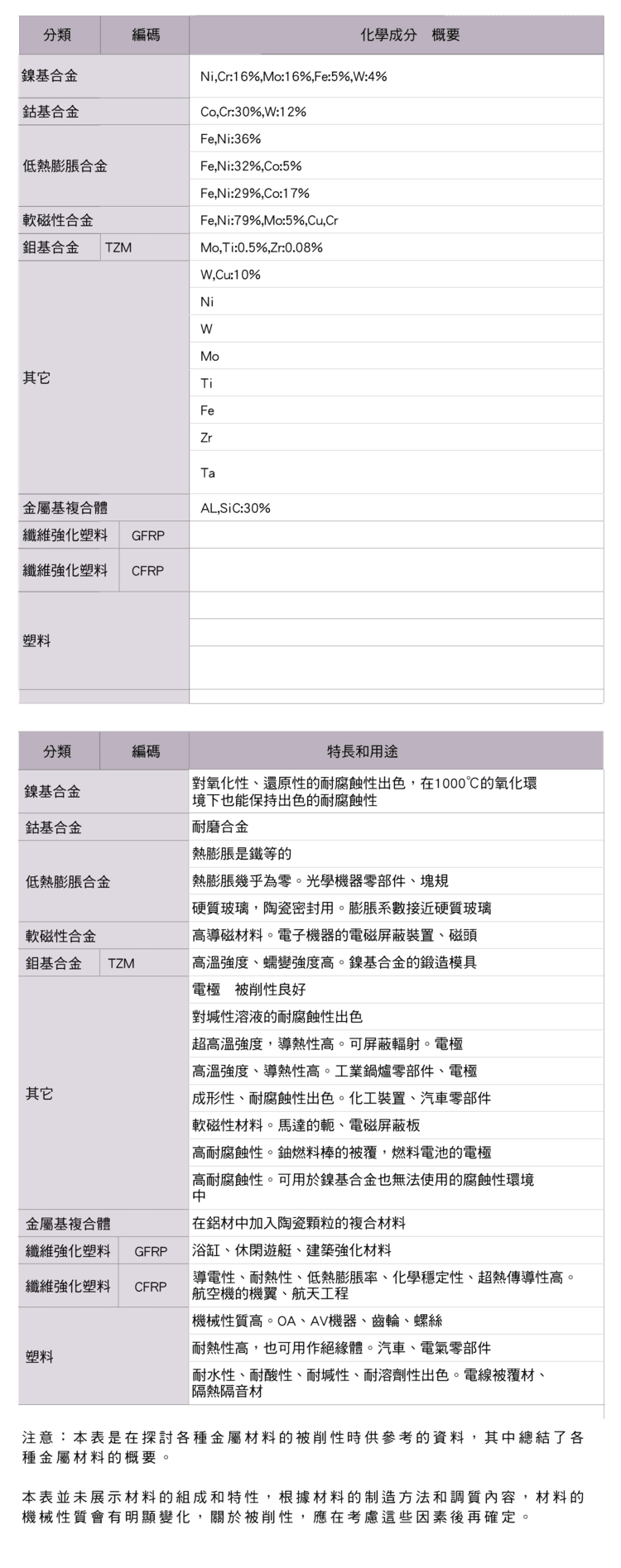
| Special alloys | Nickel-based, titanium, superalloys | High-temperature strength, corrosion resistance | Aerospace, high-temp & chemical plant |
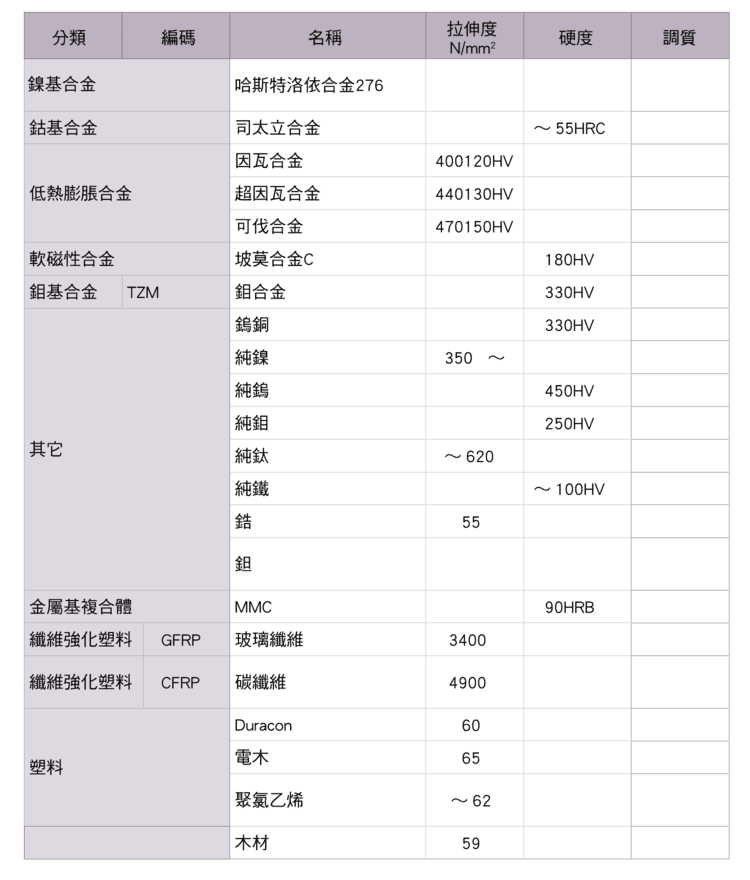
Strength, Hardness and Machinability
Generally, higher strength means higher hardness, and higher hardness means greater machining difficulty—directly affecting tool choice and cutting conditions. Actual parameters must match the material's hardness state; see End Mill Cutting Conditions Guide.
Material Selection Advice
Match the requirement to a suitable family to balance performance, machinability and cost.
| Requirement | Recommended materials |
|---|---|
| High strength | Alloy steel, tool steel |
| Corrosion resistance | Stainless steel, aluminum |
| Light weight | Aluminum alloy |
| High temperature | Nickel-based, superalloys |
| High conductivity | Copper alloy |
Engineering selection balances strength, machinability and cost; the right material improves performance, lowers manufacturing cost and raises reliability.
※ Grades listed are common representatives; hardness and strength are indicative. Verify actual properties against datasheets and heat-treatment state.
FAQ
What are the main families of metal materials?
Commonly eight: carbon/structural steel, alloy steel, tool/mold steel, stainless steel, aluminum, copper, cast iron and special alloys—each differing in strength, hardness, corrosion resistance and machinability.
Which material for corrosion-resistant parts?
Stainless steel (e.g. SUS304/316) is first choice; use aluminum where light weight also matters. Food and medical applications mostly use SUS304/316.
Why does higher hardness mean harder machining?
Higher hardness resists the cutting edge more, raising cutting forces and tool wear, so it needs more wear-resistant tool materials and more conservative cutting conditions—hence greater difficulty.
Which material for high-temperature parts?
High-temperature equipment, aerospace and chemical plant commonly use nickel-based and superalloys for high-temperature strength and corrosion resistance; these are hard to machine and belong to ISO group S.
This article is part of Workpiece Materials: The Complete Guide - Name the Metal First, Then Match the Tool; that guide shows how the whole topic fits together.
Published: 2026-03-25 | Last updated: 2026-08-08