Microscope Measurement: NA, Resolution & Depth of Field
Microscope measurement is a key technique for precision inspection and dimensional analysis; its core performance is set by numerical aperture (NA), resolution, depth of field and optical design. This guide covers NA and resolution formulas, working distance, depth of field, magnification and telecentric optics to raise accuracy and image quality.
1. What Microscope Measurement Is
Microscope measurement uses optical magnification for precise observation and measurement, common in micro-size measurement, surface-defect analysis, precision-machining inspection and electronic/semiconductor inspection.
2. Numerical Aperture (NA)
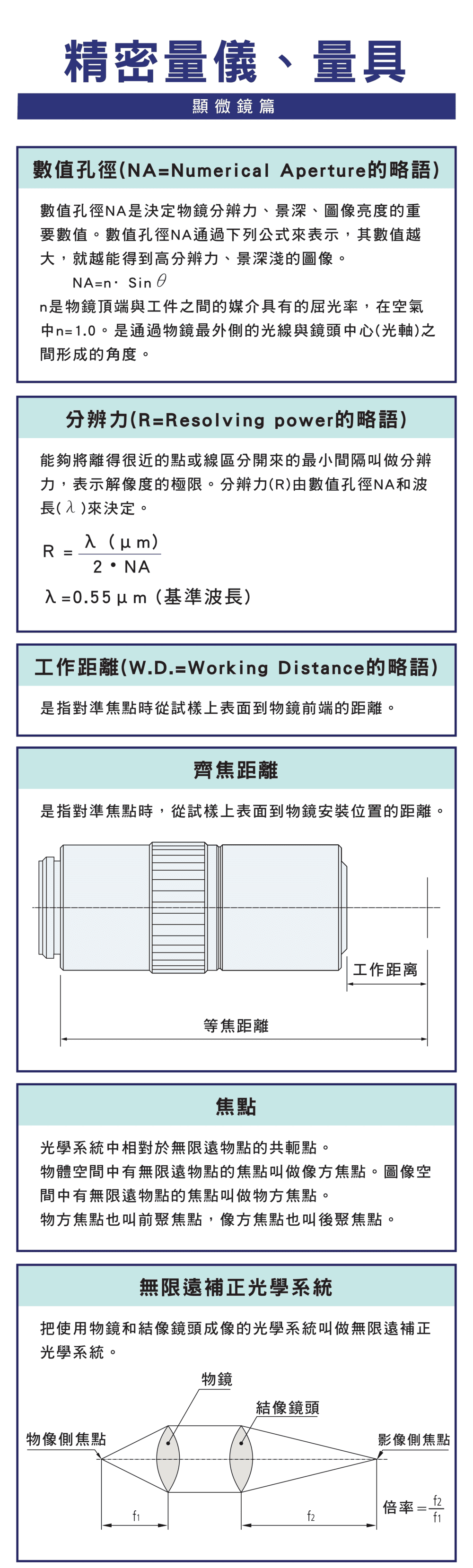
NA is the core parameter for microscope performance — it sets resolution, affects brightness and controls depth of field.
| Item | Content |
|---|---|
| Formula | NA = n × sinθ |
| n | Medium refractive index (air ≈ 1.0) |
| θ | Angle of light entering the lens |
| Trait | Higher NA → higher resolution, shallower depth |
3. Resolution
Resolution is the smallest distance between two distinguishable points: R = λ / (2 × NA). λ is the wavelength (commonly 0.55 μm); higher NA gives smaller R and greater clarity. It is the key index of resolving power.
4. Working and Parfocal Distance
Working distance is from the specimen surface to the objective front: short → high magnification; long → more operating space. Parfocal distance is from the specimen surface to the objective mounting, keeping focus consistent when switching objectives. Focus has an object-side (front) and image-side (back) point, forming the basis of imaging.
5. Infinity vs Finite Optical System
| System | Trait |
|---|---|
| Infinity-corrected | Objective + tube lens, stable imaging, for high-accuracy measurement |
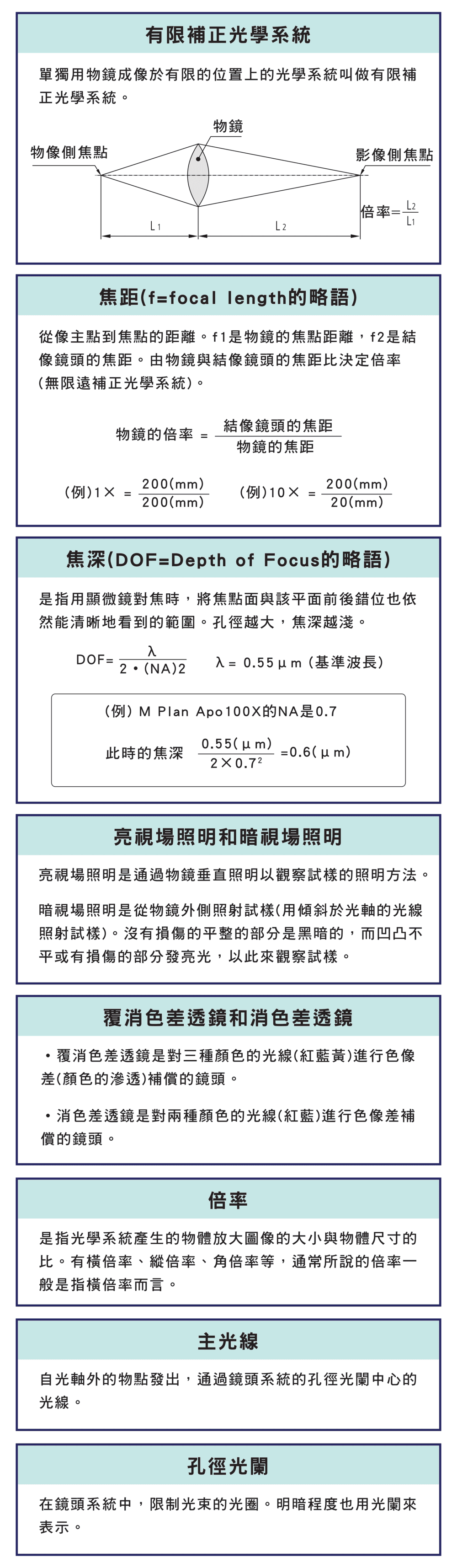
| Finite-corrected | Objective images directly, simpler structure |
6. Focal Length, Magnification and Depth
Magnification is set by the focal-length ratio: magnification = tube-lens focal length / objective focal length; longer focal length → higher magnification. Depth of field is the in-focus range: higher NA → shallower depth. High magnification and NA give clarity but a smaller measurable height range — a trade-off.
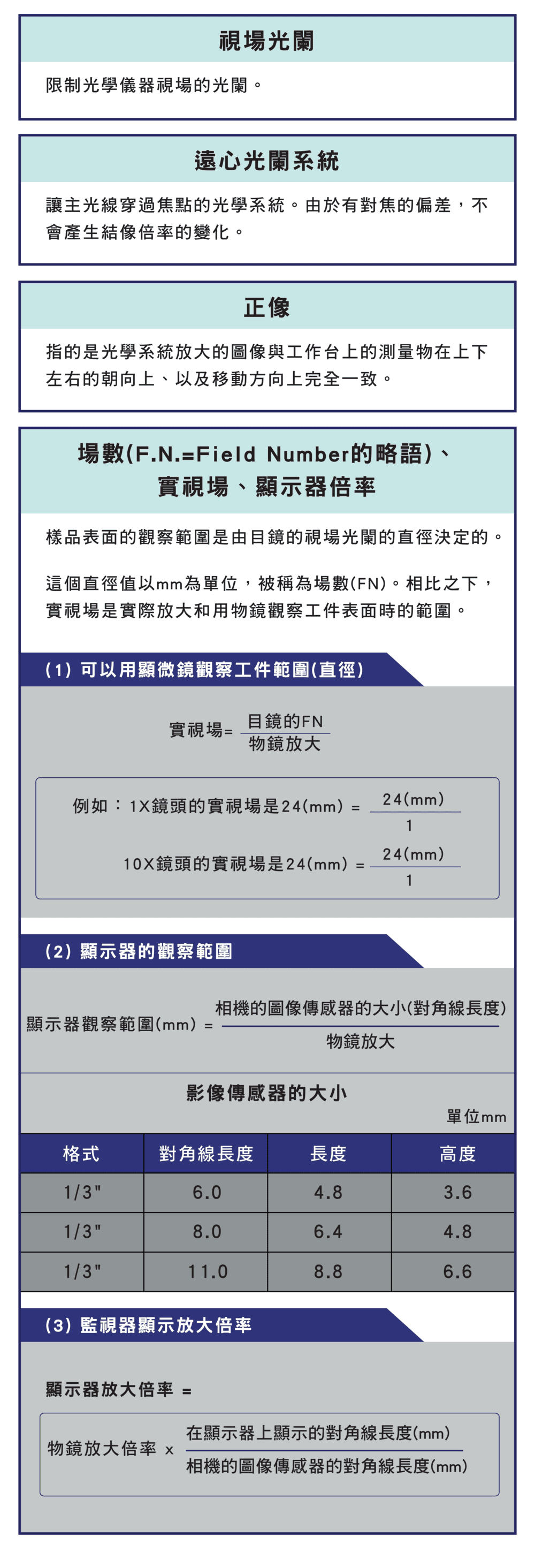
7. Telecentric Optics and FOV
Chromatic-corrected lenses raise clarity; a telecentric system keeps magnification unaffected by focus error, ideal for precision measurement. FOV and magnification: real field of view = FN / objective magnification; display magnification = display size / sensor size, affecting field size and measurement range. For non-contact imaging see the Vision Measuring System Guide.
FAQ
Q: Is higher NA always better?
Higher NA gives better resolution and a brighter image but shallower depth of field and usually shorter working distance. For parts with large relief or when you need more space, very high NA can be inconvenient — balance to the workpiece and task.
Q: Is resolution the same as magnification?
No. Magnification enlarges the image; resolution (R = λ/2NA) decides whether two close details can be separated. High magnification with insufficient NA is "empty magnification" — still blurred. For measurement, look at resolution.
Q: Why is telecentric optics good for measuring?
With ordinary lenses, magnification changes as the object defocuses, causing size error; telecentric optics keeps magnification independent of focus distance within a range, giving stable sizes — ideal for precision dimensions and parts with height variation.
Q: How is real FOV calculated?
Real FOV = field number (FN) / objective magnification. For example, FN 22 with a 10× objective gives about 2.2 mm. Higher magnification means a smaller field and narrower range, so trade off resolution against field of view.
This article is part of Precision Measurement Complete Guide: Ask What You Are Measuring First, Then Pick the Instrument; that guide shows how the whole topic fits together.
Published: 2026-03-23 | Last updated: 2026-07-25