
Grinding Monocrystalline Silicon: Four Characteristics, and the Direction It Always Cracks
Silicon has no ductility at room temperature, so grinding removes material by microcrack growth and brittle fracture, and it cracks along fixed crystal directions. This article covers the four grinding characteristics, why a softer wheel is the right choice, and the two problems that stop wafers being accepted: grinding marks and warp.
1. When you meet it
Silicon is the foundation material of the microelectronics and solar industries: more than 95% of semiconductor devices are made from it, and 85% of those are integrated circuits.
Machining meets it at two points: front end, where silicon is ground, lapped and polished into a wafer with high form accuracy to serve as substrate; and back end, where the wafer is back thinned to reduce back surface roughness and the damaged layer.
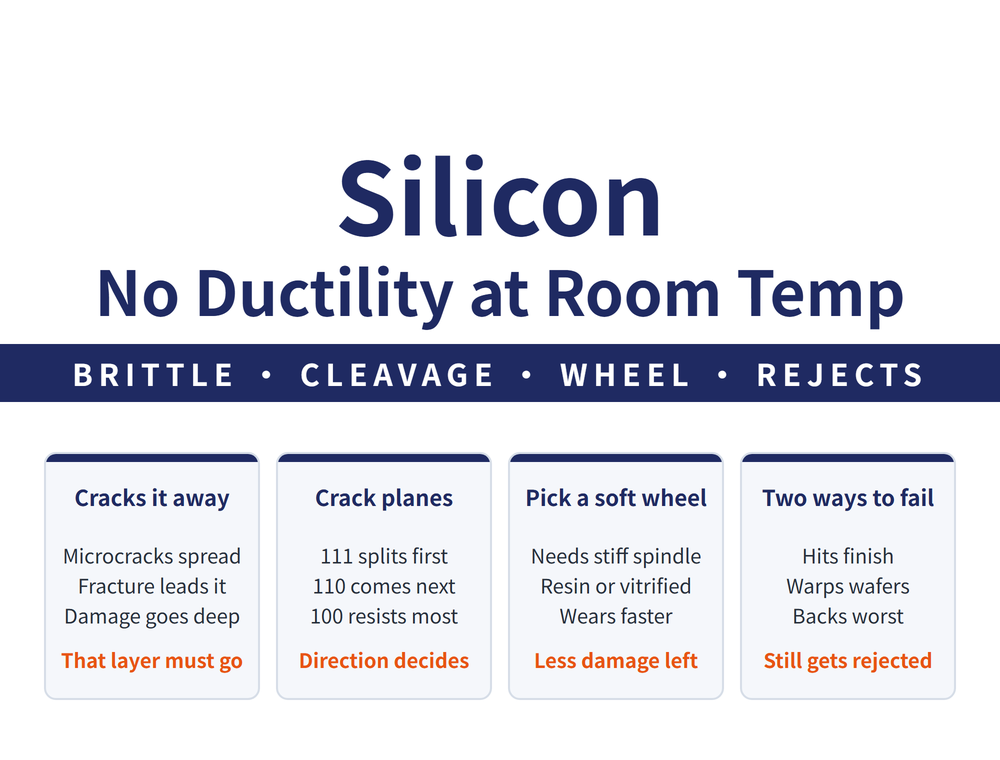
🔑 Both jobs share one condition: the material does not deform at room temperature, it only cracks. Everything below follows from that sentence.
2. No ductility at room temperature
Silicon is grey with a metallic lustre, but mechanically it behaves as a brittle material: no ductility at room temperature, hard and brittle.
| Property | Value |
|---|---|
| Hardness | Mohs 6.5–7.0 (Knoop 9.5–11.5 GPa) |
| Tensile strength | 113 MPa |
| Compressive strength | 120 MPa |
| Clear plasticity begins | above 700–800 °C |
📌 That last row is the contrast that matters. Plastic deformation needs 700 °C and above, and room temperature machining never reaches it — so at room temperature the material can only crack, never be pushed aside.
3. It cracks along fixed planes
Under load, silicon fails along crystal planes, and the planes are not equally easy to split:
| Plane | How readily it splits |
|---|---|
| (111) | Splits most readily: densest atom packing, largest plane spacing, lowest bond density and lowest fracture toughness |
| (110) | Next |
| (100) | Hardest to split |
🔴 The directions that fracture most readily are <111>, and <110> on the (100) plane. Two (111) planes also intersect along a ready cleavage direction.
⚠ Industry works mainly with (111) and (100) wafers: MOS integrated circuit substrates are usually (100), while bipolar substrates use (111) or (100). Confirm which plane the part is before deciding on workholding and feed direction.
4. Four grinding characteristics
| Characteristic | Content |
|---|---|
| Surface and subsurface damage | Material leaves mainly by microcrack growth and brittle fracture, with some plastic deformation |
| High force ratio, low G-ratio | The spindle needs high stiffness; the wheel wears faster and costs more to run |
| Surface quality is hard to hold | Accuracy is achievable, but visible grinding marks remain |
| Distortion and breakage | Tensile strength far exceeds shear strength, so parts break relatively easily in process |
🔑 The first is the nature of the material; the other three are its consequences. Diamond wheel grinding leaves scratches and microcracks on the surface, and microcracks, dislocations, amorphous and polycrystalline layers and residual stress below it — that damaged layer has to be removed by later ultra-precision work.
5. Why a softer wheel is the right choice
This is the counter-intuitive one. Instinct pairs a hard, brittle material with a hard wheel; silicon goes the other way:
🔴 To limit subsurface damage, the usual choice is a softer resin bond or vitrified bond diamond wheel.
⚠ Price the trade-off in first: a softer wheel means a lower G-ratio, faster wheel wear and higher running cost. It is not the place to economise — saving on the wheel thickens the damaged layer, and the back end spends longer removing it.
📌 Separately, the high force ratio means the spindle on an ultra-precision grinder must be stiff. For reading and matching the wheel itself, see Reading a Grinding Wheel Marking: Abrasive, Grit, Grade, Structure and Bond.
6. Marks and warp: two ways to fail inspection
Grinding marks: the process reaches high accuracy, but the visible marks it leaves affect wafer nano topography, roughness and strength — passing on dimension is not the same as passing.
Warp: residual stress in the subsurface warps and bows large diameter thin wafers.
🔴 Back thinned wafers suffer most: once warped they are hard to handle automatically and break easily — the problem shows up at the next station, not at yours.
📌 This belongs to the same family as distortion control on other hard, brittle materials; for the wider picture see Workpiece Materials: The Complete Guide - Name the Metal First, Then Match the Tool.
7. Frequently Asked Questions (FAQ)
Q: Why can silicon not be treated as just another hard material?
Because it has no ductility at room temperature. Plastic deformation needs 700 to 800 degrees Celsius, which room temperature machining never reaches, so material is removed by microcrack growth and brittle fracture rather than being pushed aside. That single fact drives the rest: damage on and below the surface, a high force ratio, visible grinding marks, and parts that break easily.
Q: Parts keep cracking from the same direction. Coincidence?
No, the crystal plane decides it. Silicon fails along crystal planes, and they differ: (111) has the densest packing and the weakest bonding between planes, so it splits most readily; (110) comes next; (100) resists most. The directions that fracture most readily are <111> and <110> on the (100) plane. Confirm the plane before setting workholding and feed direction.
Q: Why use a soft diamond wheel?
To limit subsurface damage, which is why softer resin bond and vitrified bond diamond wheels are usual. The cost is a lower G-ratio, faster wear and higher running cost. It is not an economy worth making: a cheaper wheel leaves a thicker damaged layer, and removing that layer by ultra-precision work costs more than was saved. The high force ratio also demands a stiff spindle.
Q: Everything is within tolerance, so why was it rejected?
Usually marks or warp. Grinding reaches high accuracy but leaves visible marks that affect nano topography, roughness and wafer strength. The other is warp: subsurface residual stress bows large diameter thin wafers, and back thinned wafers suffer most, becoming hard to handle automatically and prone to breaking. Neither appears in a dimensional tolerance, yet both decide acceptance.
Published: 2026-09-21 | Last updated: 2026-09-21









