
When to Use an Oversize Tap: Five Reasons and How Much to Add
When a tapped thread comes out small and the go gauge will not enter, the first instinct is to fit a new tap. In five situations a new tap will not help, because the standard class was never large enough to begin with. This article explains why taps often need to be larger than the standard class, how much to add, and when the quick rule must give way to a real calculation.
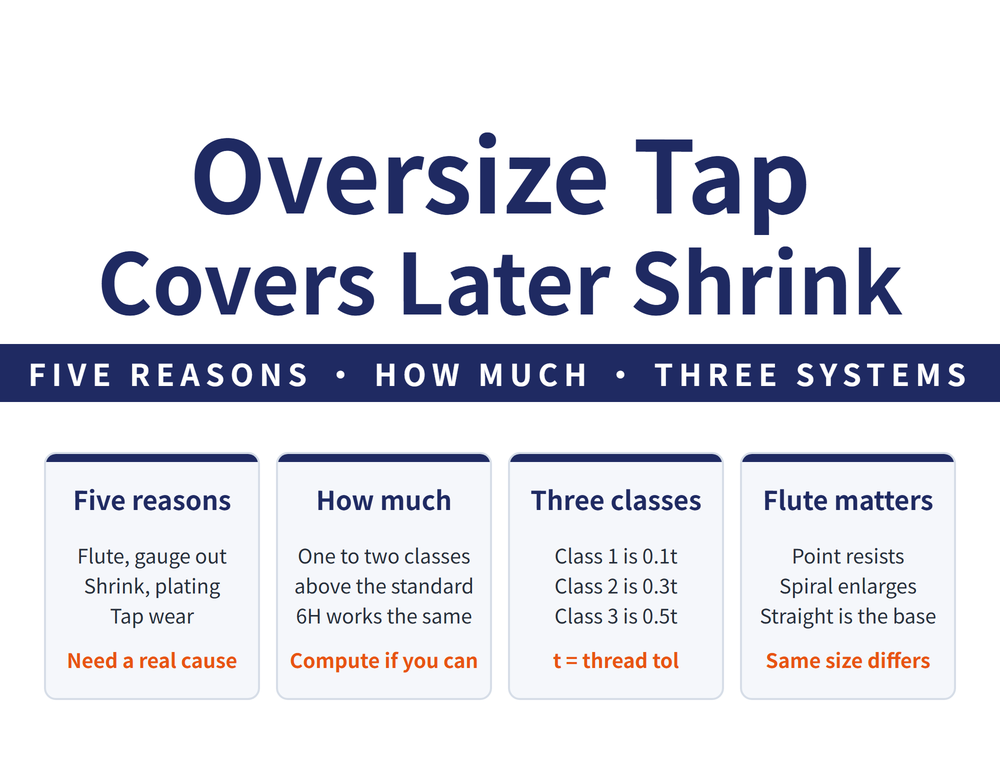
1. The standard class is a starting point, not the answer
A tap class was originally designed to match a specific internal thread class. Under the old system, a class 2 tap matched an old JIS class 2 internal thread, so picking it should have been the end of the story.
On the shop floor it often is not. Threads come out undersize, the go gauge will not enter, or the tap starts running out of tolerance far too soon. That is not necessarily a faulty tap. It usually means the starting size of the standard class did not account for what happens after cutting.
The five reasons below are exactly that: what happens afterwards.
2. Five reasons the standard class falls short
| Reason | What happens | Go oversize? |
|---|---|---|
| 1 Flute form | Different flute forms produce different axial thrust, so the thread drifts in different directions | Depends on the form, see section 6 |
| 2 Gauge out | Normal edge wear pushes the tap past the go gauge limit early, cutting tool life short | Yes |
| 3 Workpiece shrinkage | Material or shape causes the part to shrink after machining, so the thread closes up | Yes, allow for shrinkage |
| 4 Plating allowance | The thread is plated afterwards and the coating eats into the profile | Yes, by coating thickness |
| 5 Wear tendency | The material does not enlarge the thread, but the tap itself wears heavily | Yes, as large as the job allows |
The five split into two groups that are handled differently. Numbers 3 and 4 are predictable compensation: shrinkage and coating thickness can both be worked out, so there is a basis for how much to add. Numbers 2 and 5 are about tool life: the aim is not to make one thread pass, but to let the tap produce more parts before it drifts out of tolerance.
3. How much to add: one to two classes above standard
The general rule is simple. Go one or two classes above the standard class, and the usual recommendation sits inside that one to two class range.
This rule is not tied to any one maker's precision system. It applies equally to the 6H internal thread classes of JIS and ISO. Whether you are working with a maker's own precision grades or with JIS 5H and 6H, stepping up one or two classes holds.
⚠ Note what this is. It is a quick estimate, not a calculation. Section 7 covers when the estimate is not good enough.
4. First establish which system you are in
The most common source of confusion when choosing a tap class is that three tolerance systems exist side by side, and their wording looks alike.
| System | How tolerance is set | Class notation |
|---|---|---|
| JIS annex (old system) | A separate value for each size, like a lookup table | Grade 1, 2, 3 |
| JIS main body (current, per ISO2857) | One formula, fed with the internal thread tolerance | Class 1, 2, 3 |
| Maker precision grades | Also formula based, but the steps are defined by the maker | Varies by maker |
The main body system sits between the old system and maker grades. The old "grade" and the main body "Class" deliberately use different words to keep them apart. Grade 2 and Class 2 are not the same thing. For the internal thread side of this, see Tap Thread Tolerance Guide: P-Class, 6H/7H & Gauges.
5. How the three main body classes are calculated
The main body system does not state a tolerance value directly. It expresses tolerance as a percentage of the internal thread tolerance. So for a given size, the tolerance position stays the same across classes and only the width of the band changes.
| Class | Tolerance, relative to internal thread tolerance t | When t = 20 μm |
|---|---|---|
| Class 1 | 0.1 t (narrowest, most precise) | 2 μm |
| Class 2 | 0.3 t | 6 μm |
| Class 3 | 0.5 t | 10 μm |
Here t is the tolerance of the internal thread itself, not the tolerance band. For a 5H internal thread the pitch diameter band is 100 μm while its tolerance t is 20 μm, and feeding that in gives the three figures on the right. Change the internal thread class and t changes, so all three move with it. That is what being formula based means.
⚠ The tolerance band diagram in the reference data marks a fourth coefficient, 0.7t, alongside 0.1t, 0.3t and 0.5t. That line is the outer boundary of the Class 3 band relative to the zero line. It is a geometric annotation, not a fourth class; only three classes are defined. Seeing 0.7t is not grounds for inferring a "Class 4".
6. Different flute forms, different recommended classes
Reason 1 is the one most often overlooked. For the same nominal size, changing the flute form can change the recommended class.
| Flute form | Tendency from axial thrust |
|---|---|
| Straight flute hand tap (reference) | Used as the basis for comparison |
| Spiral point tap | Axially resists enlarging the cut |
| Spiral flute tap | Axially tends to enlarge the cut |
This is why a catalogue lists different recommended classes for the same size in different tap types. It is not a misprint. The flute form genuinely drives the thread in a different direction. Choose with the flute form in view, not the size alone. For how the two forms divide the work, see Tapping Troubleshooting Guide: Chipping, Breakage & Size Defects.
7. When the quick rule is not enough
One or two classes up is a rule of thumb, good for a fast estimate. One case calls for a real calculation instead: plating allowance.
Coating thickness is a measurable number. Converting it back into how much to leave before tapping often lands between whole classes rather than on one. In that situation the one to two class rule can leave you a class short, or a class too far.
The test is simple. If the compensation can be expressed as a number, use the number. Use the one to two class range only when it can only be estimated.
The opposite problem, where the thread comes out oversize rather than undersize, has entirely different causes and is not solved with an oversize tap. See Internal Thread Oversize Causes: Feed, Runout & Tap Selection.
8. Frequently Asked Questions
Q: Will an oversize tap make the thread too loose?
It will, if the reason for going oversize does not apply. Going oversize compensates for something that shrinks the thread later: shrinkage, plating or wear. If the compensation exceeds the actual reduction, the finished thread ends up loose. Oversize is therefore not a case of bigger being safer. It has to answer to a specific source of reduction. With no such source, choose the standard class.
Q: Are grade 2 and Class 2 the same thing?
No. Grade belongs to the JIS annex, the old system, where each size carries its own tolerance value. Class belongs to the JIS main body, the current system per ISO2857, where tolerance is expressed as a percentage of the internal thread tolerance. The two systems run in parallel and the different wording is deliberate. Check which one a specification is using before comparing numbers.
Q: Why do a spiral point tap and a spiral flute tap of the same size carry different recommended classes?
Because the flute form changes the axial thrust, and with it the direction the thread size drifts. Taking the straight flute hand tap as the basis, a spiral point tap resists enlarging the cut axially while a spiral flute tap tends to enlarge it. This is the first of the five reasons for going oversize, and it is why catalogues list different recommended classes for the same size in different tap types.
Q: Is the 0.7t line on the tolerance diagram a fourth class?
No. The JIS main body defines only Class 1, 2 and 3, corresponding to 0.1t, 0.3t and 0.5t. The 0.7t line marks the outer boundary of the Class 3 band relative to the zero line. It is a geometric annotation showing where the band sits on the diagram, not a class in its own right.
For the pilot hole size to pair with the tap, see Metric Tap Drill Size Chart: M1–M100 Pilot Holes. For the full picture of thread machining, see Thread Machining: A Complete Reading Guide.
Published: 2026-09-21|Last updated: 2026-10-31









