
Three Reaming Quality Problems: Rough Bores, Bell Mouths and Growing Diameters
When reaming goes wrong the shop floor says one of three things: the bore is rough, the mouth has belled out, or the diameter keeps growing. Those three point to three completely different investigations, and the one most often misread is the third - "oversize from the first part" and "growing as it runs" have opposite causes and opposite fixes. This article sets out the order of investigation for each, and explains what cutting fluid is actually solving: built-up edge.
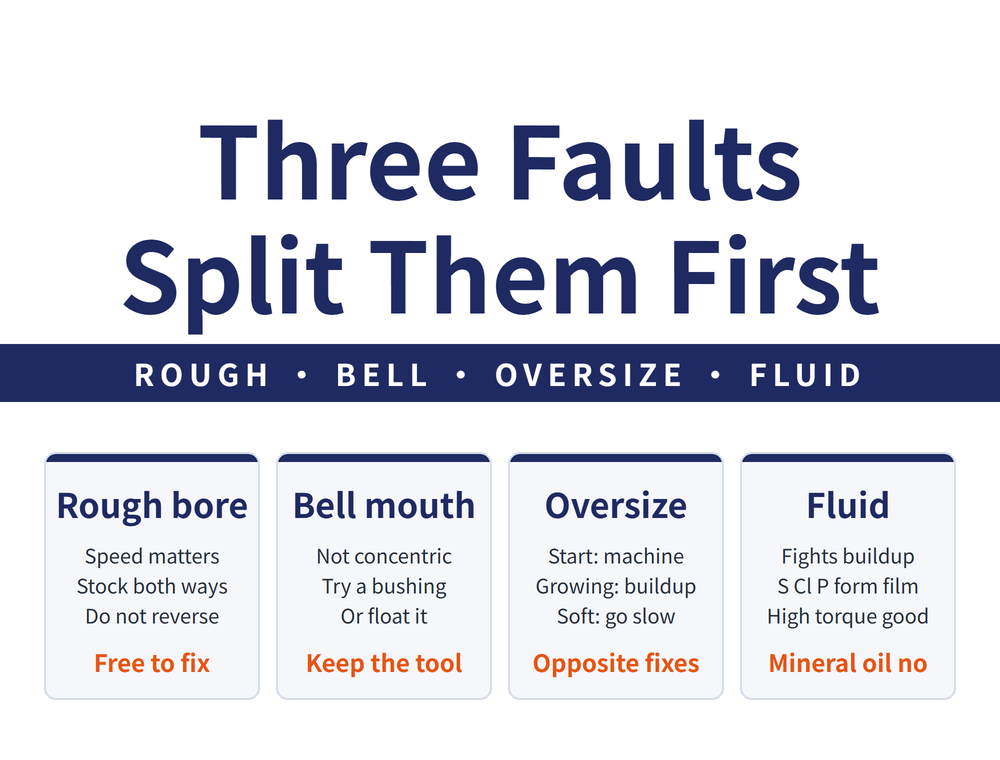
1. First decide which problem you have
| Symptom | First question to ask |
|---|---|
| Rough bore | HSS or carbide reamer, and at what speed |
| Bell mouth | Is a guide bushing or floating holder in use |
| Oversize bore | Oversize from the start, or growing as it runs |
🔴 That third row is the important one. "Oversize from the start" points at the machine and the setup; "growing as it runs" points at built-up edge and smearing - the fixes are completely different. Separate them in the first question or you spend a whole round looking the wrong way.
2. Rough bore: five causes
| Cause | What to do |
|---|---|
| Speed too high | Speed has the largest effect; HSS in steel builds an edge if run too fast |
| Allowance or feed wrong | Squeezed both ends: too much worsens finish, too little raises friction and chatter |
| Edge not sharp enough | Lap a new reamer; concentrate on the cutting-to-margin transition |
| No fluid, or the wrong fluid | Dry rubbing spoils the surface; the wrong fluid makes friction worse |
| Withdrawn the wrong way | Never reverse out; pull straight out along the feed direction |
The third row deserves its own note: the final size of the bore is formed at the transition between the cutting portion and the margin. However rough the tool is there, the bore wall will be. Lap it lightly with a stone until the transition is smooth.
3. Two things usually skipped: withdrawal direction and the numbers not printed
🔑 Withdrawal direction costs nothing: no tool change and no parameter change. Reversing out presses the edges against the wall and scores it. A reamer whose shank is larger than its working diameter must be withdrawn turning in the same direction as when cutting.
⚠ The speeds and feeds behind the previous section come from a single source of industry experience values, not from documented experimental data. This article deliberately does not print the numbers and keeps only the directional rules - speed has the largest effect, HSS runs far slower than carbide, cast iron can run faster than steel. Take actual parameters from the tool maker's catalogue and a trial cut.
4. Bell mouth: a guidance problem
The cause points one way: the cutting portion of the reamer is not concentric with the pre-drilled hole, or the feed direction does not line up with the part's axis of rotation. That gives two lines of attack:
| Countermeasure | How |
|---|---|
| Improve guidance (first) | Use a precision guide bushing; if not possible, hold in a floating holder |
| Shorten the margin | Keep 4~12 mm, relieve the rest on diameter or grind a larger back taper |
Ask about the bushing or the floating holder first - it is the most direct fix and it does not touch the tool body. Shortening the margin does. The two variants use the same margin length, differing only in whether the rest is relieved on diameter or back tapered; relieving on diameter guides better and is the one commonly used.
Hand reaming adds a cause machine reaming never has: uneven force from the two hands on the tap wrench, which reams the hole oval or bell mouthed. Without a bushing to guide it, that is the main failure mode of hand reaming.
5. Oversize bore: two situations, two investigations
| Situation | Cause | How to check |
|---|---|---|
| Oversize from the start | Machine, tool defect, wrong parameters | 1 concentricity and spindle or chuck run-out 2 then parameters 3 then fluid |
| Growing as it runs | Built-up edge or smearing on the margin | 1 surface treatment 2 EP oil 3 lower speed 4 unequal spacing |
The speed reduction in the second row follows a counter-intuitive rule: the softer the workpiece, the lower the reaming speed should be. Soft material sticks to the edge more readily, and higher speed only grows the built-up edge faster. Unequally spaced teeth attack it from the design side - they reduce smearing and also break up the regular tool marks on the bore wall.
6. What the fluid is really solving is built-up edge
Read the sections above together and one term keeps appearing: built-up edge. It is the key factor in reamed accuracy and finish, and the way it does damage is particular:
It adheres at the junction of the cutting edge and the margin, and its size and position keep changing with the material structure - and those changes print straight onto the bore wall, opening the diameter and spoiling the finish.
So the direction for better reaming is clear: reduce or eliminate built-up edge.
How does fluid do that? Besides carrying away heat and cooling the cutting zone, the key is chemical film formation: fluids containing sulphur, chlorine or phosphorus release those active elements under high temperature and pressure, and they react with the metal surface to form a film of very low shear strength. That film sits between edge and chip, so friction drops, cutting force and heat drop, tool life rises - and the conditions for built-up edge are destroyed.
7. A counter-intuitive indicator: high burnishing torque is good
The working state of the margin decides bore accuracy and finish. How do you know whether the margin is working properly? By the burnishing torque:
| Margin state | Torque | Why |
|---|---|---|
| Working normally | High | Multiple teeth burnishing at the same time |
| Not working properly | Low | Only a few teeth are engaged |
⚠ This runs against the instinct that low torque means a smooth cut. In the burnishing stage of reaming, low torque means only a few teeth are working - and that is exactly why the finish is poor.
8. Choosing a fluid: what the comparison showed
Twenty cutting fluids were compared under the same reaming conditions, measuring torque, hole expansion and surface result. The direction that comes out of it:
| Result | Fluid |
|---|---|
| Better: low steady torque, better surface, less expansion | Soya oil and its blends, sulphurised oil |
| Worse: no marked improvement | Mineral oils and their blends, unsuitable for finish reaming |
🔴 Another chlorinated solvent formulation performed best (a 1980s result), and this article omits it entirely. That family of solvents is now known to carry health and environmental hazards and is banned or tightly restricted industrially in most countries - it can be read as a historical result, not taken as current advice. The omission is deliberate.
Fluid classification and additive chemistry are a separate subject. Before choosing, settle the material: cast iron is generally reamed without fluid, steel is not.
9. Frequently Asked Questions (FAQ)
Q: The bore keeps growing. Is the tool worn?
First separate "oversize from the start" from "growing as it runs". Growth during the run typically comes from built-up edge or smearing on the margin; the fixes are surface treatment, an EP oil, a lower speed, or unequally spaced teeth. Oversize from the start means checking concentricity and spindle or chuck run-out instead. The two have completely different answers.
Q: Can I reverse the reamer out of the hole?
No. Reversing presses the edges against the wall and scores it. Pull the reamer straight out along the feed direction. A reamer whose shank is larger than its working diameter must be withdrawn turning the same way as when cutting. This costs nothing to fix - no tool change, no parameter change.
Q: The mouth has belled out. Do I need a new reamer?
Not yet. Belling comes mainly from the reamer not being concentric with the pre-drilled hole, so the first countermeasure is guidance: a precision guide bushing, or a floating holder if a bushing is not possible. Only if neither works do you shorten the margin, and that does touch the tool body. For hand reaming, also check for uneven force on the wrench.
Q: Why does softer material call for a lower speed?
Because soft material adheres to the edge more readily and forms built-up edge, whose size and position keep changing and print onto the bore wall, opening the diameter and spoiling the finish. Higher speed grows it faster. This runs against the usual instinct that soft material can be run faster, and it matters especially in a finishing operation like reaming.
For expansion, shrinkage and how the allowance limits are set, see Why a Reamed Hole Is Never the Reamer Size: Expansion, Shrinkage and the Allowance Squeeze; for choosing the tool, see Choosing a Reamer: Seven Classification Axes, 15 Types, Flutes and Angles.
Published: 2026-09-19|Last updated: 2026-09-19









