
Choosing a Reamer: Seven Classification Axes, 15 Types, Flutes and Angles
Before asking which reamer to buy there are seven things to settle: hand or machine, cylindrical or tapered bore, solid or shell, adjustable diameter or not, tool material, cutting edge or burnishing, straight or helical flute. Those seven axes decide the type, and the type decides flute count and angles. This article lays out the seven axes, 15 common types with their diameter ranges, the flute count tables and the four angles that matter, so you know what you are asking for before you request a quote.
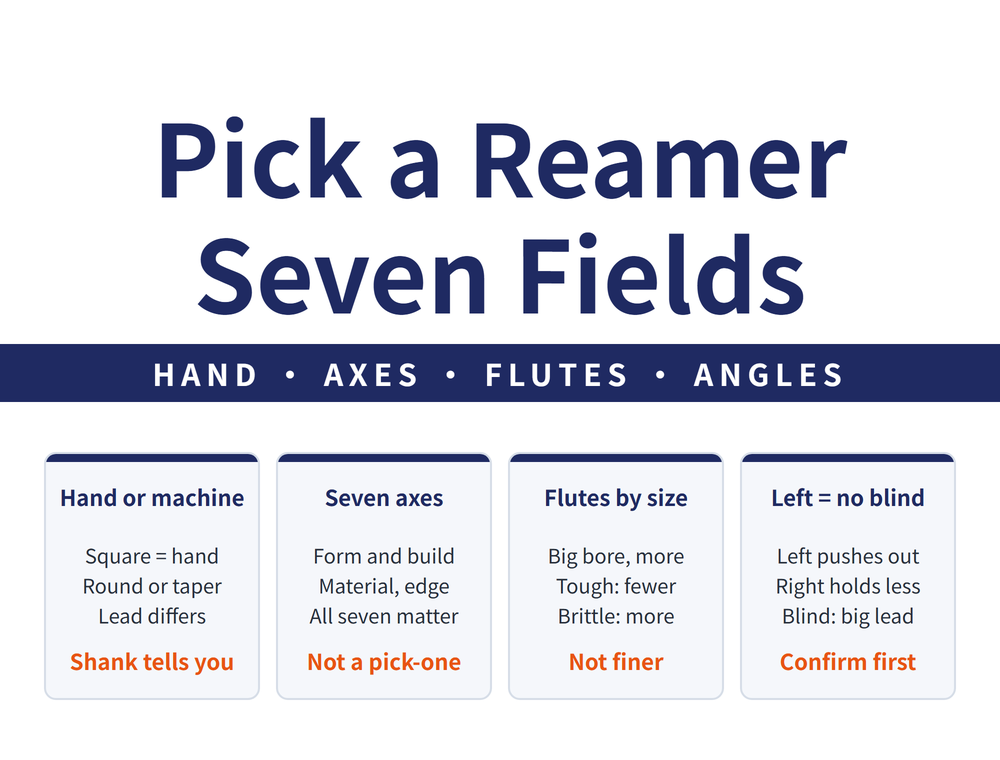
1. First decide: hand or machine
This is the first of the seven axes because it sets the shank, the angles and the accuracy you can reach all at once.
| Item | Hand reamer | Machine reamer |
|---|---|---|
| Shank (tells them apart) | Square drive | Parallel or Morse taper |
| Cutting edge length | Longer | Shorter |
| Lead angle | Smaller, low axial force, enters easily | Larger |
The shank is the quickest identifier: a square drive means hand reamer. Its lead angle is deliberately small so a person can turn it and so the tool finds the bore.
2. The seven classification axes
| Axis | Options |
|---|---|
| 1 How it is driven | Hand, machine |
| 2 Bore form | Cylindrical, tapered, stepped |
| 3 Construction | Solid (small and medium), assembled (inserted blade, shell; larger bores) |
| 4 Adjustable diameter | Adjustable (including expanding), fixed |
| 5 Tool material | Carbon tool steel, alloy steel, HSS, carbide |
| 6 Cutting edge | Cutting, burnishing (edgeless) |
| 7 Flute form | Straight, helical |
These are not seven alternatives, they are seven fields that all have to be filled in. Fill them in when you request a quote and nobody has to come back and ask - this is also why one diameter comes back with several prices. For how to write an RFQ for other cutting tools, see How to Write a Cutting Tool RFQ (Request for Quotation): Part Number, Specs, Work Material, Quantity and Lead Time in One Go.
3. Fifteen common types: diameter decides your shortlist
| Type | Range |
|---|---|
| Hand / machine cylindrical, small | D = 1~3 mm |
| Hand cylindrical | D = 3~50 mm |
| Machine cylindrical | D = 3~15 mm |
| Hand / machine end cutting | D = 3~15 mm |
| Taper shank machine | D = 10~30 mm |
| Machine reamer through a bushing | D = 2.5~12 mm; holds pitch and size |
| Rear piloted | D = 13~32 mm; pitch and size held by the bushing |
| Machine reamer with end radius | D = 10~30 mm; radius at the bore face |
| Hand shell reamer | D = 20~40 mm, Z = 12~20 |
| Machine shell reamer | D = 25~80 mm, Z = 10~16 |
| Machine shell with end radius | D = 25~80 mm |
| Inserted blade machine | D = 32~150 mm; saves body material |
| Helical push reamer | Stable size and finish, harder to make and regrind |
| Taper reamer (1:30, 1:50) | Tapered bores; toolroom and maintenance work |
| Morse taper reamer | Morse taper bores |
Read this table by finding your diameter band first, then checking for a special need: holding pitch, an end radius, or saving material. Above 80 mm the inserted blade type is essentially the only route left.
4. Flute count: diameter decides, material trims
More flutes is not better. Two rules: larger bore, more flutes; fewer flutes in tough materials, more in brittle ones.
| HSS machine D mm | 1~3.5 | 4~13 | 14~28 | 30~48 | 50~55 |
|---|---|---|---|---|---|
| Flutes z | 4 | 6 | 8 | 10 | 12 |
| Carbide machine D mm | <6 | 6~18 | 19~34 | 35~40 | >40 |
|---|---|---|---|---|---|
| Flutes z | ≤3 | 4 | 6 | 8 | ≥10 |
These two tables come from a different source than the type table above, so the same diameter is not guaranteed to agree between them. Buy against the maker's specification and the drawing.
5. Straight or helical: a left hand helix cannot ream a blind hole
| Flute | Strength | Where |
|---|---|---|
| Straight | Easy to make, regrind and inspect | The common choice |
| Helical | Smooth cut, clears chips, longer life | Deep and interrupted bores (keyway, oil groove) |
🔴 A left hand helix pushes chips forward, so it cannot ream a blind hole.
Right and left hand feed forces act in opposite directions, so a right hand reamer is less securely held than a left hand one, and its parameters must be kept lower. Those two sentences are the pair most often missed when choosing a helical reamer.
Helix angle B follows the material: grey iron and hard steel take 7~8 deg; malleable iron and general steel 12~20 deg; aluminium and light alloys 35 deg.
6. Four angles: ask about the lead angle first
| Angle | How it is chosen |
|---|---|
| Lead angle | Hand 1~1.5 deg; machine, steel through bore 12~15 deg; blind 45 deg; brittle 3~5 deg |
| Rake angle | Usually 0 deg; HSS finishing 5~10 deg; carbide 0~5 deg |
| Clearance angle | Kept relatively large, 6~14 deg |
| Inclination angle | 15 deg ground on a straight flute so chips go forward; for through bores |
Ask about the lead angle first, because it follows the form of the bore: 12~15 degrees for a through bore, but 45 degrees for a blind one - a large jump. Rake is usually 0 degrees because the reaming allowance is small to begin with (typically 0.06~0.30 mm), so the chip is thin and only touches near the edge; rake has no marked effect on deformation, and 0 degrees is simply easier to make and regrind. Clearance is kept large because reaming takes a thin chip and wears the flank noticeably, and a larger angle makes the diameter change more slowly as it wears.
For regrinding the reamer itself see Regrinding a Reamer: Rake Face, Flank and How Fine the Ground Surface Must Be; for carbide and special structures see Regrinding Carbide and Special Reamers: Tilt Angle, Transition Edge Position and Three Structures.
7. Frequently Asked Questions (FAQ)
Q: Why do quotes for the same diameter differ so much?
Usually because the specification is not the same. A reamer has seven axes to fill in at once: hand or machine, cylindrical or tapered bore, solid or shell, adjustable or fixed, tool material, cutting or burnishing, straight or helical. One diameter in different combinations is a completely different tool. Fill in all seven when you ask and nobody has to come back.
Q: Can I ream a blind hole with a left hand helical reamer?
No. A left hand helix pushes chips forward, and in a blind hole they are driven to the bottom with nowhere to go. The lead angle also changes: a machine reamer in a steel through bore normally takes 12~15 degrees, while a blind hole jumps to 45 degrees. Confirm both before ordering.
Q: Do more flutes mean better accuracy?
No. Flute count is set mainly by diameter, with material as a trim. Larger bores take more flutes, smaller take fewer; tough materials take fewer, brittle materials can take more. The HSS and carbide tables differ, so the same diameter is not guaranteed to agree between them - buy against the maker's specification.
Q: Why is reamer rake usually zero?
Because the reaming allowance is small to begin with, typically 0.06~0.30 mm, so the chip is thin and only contacts near the edge. Rake has no marked effect on deformation there, and 0 degrees is easier to make and regrind. HSS reamers for finishing can go to 5~10 degrees and carbide is usually 0~5 degrees.
Once the reamer is chosen, for what tolerance the bore can reach and how the drill-ream-bore route is planned, see How to Improve Hole Accuracy: IT Tolerances and the Drill / Ream / Bore Route; for the holder, see Tool Holders for Reaming: Floating Is a Tapping Answer.
Published: 2026-09-19|Last updated: 2026-10-28









