
Repairing a Stripped Thread: Drill, Tap STI, Install a Wire Thread Insert and Break Off the Tang
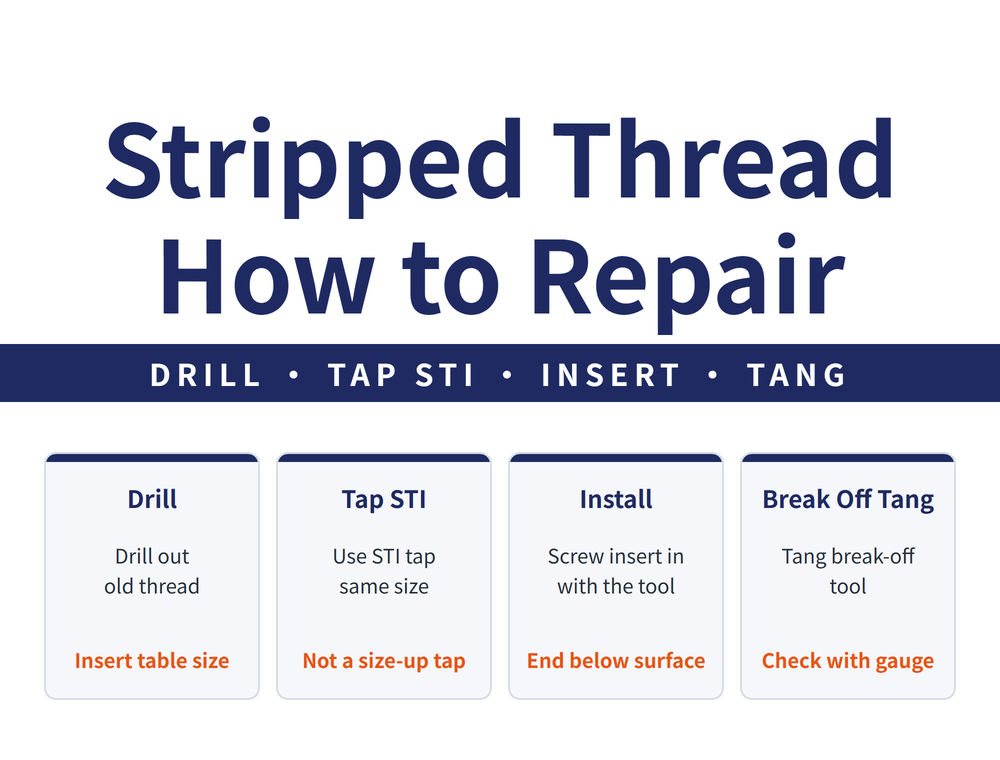
A stripped threaded hole does not mean scrapping the part. Drill out the old thread, cut an oversize STI thread with an STI tap and screw in a wire thread insert, and the hole is back to its original size (an M6 hole repaired this way still takes an M6 screw). The job is four steps: drill, tap STI, install the insert, break off the tang. Drill size and drilling and tapping depths can be read from the DIN 8140 table, but go by the data of the insert brand you actually use.
Why a Thread Insert Can Fix a Stripped Hole
A common wire thread insert is stainless steel wire wound into a helical internal thread. The repair enlarges the hole, cuts an STI thread made for the insert (Screw Thread Insert: an internal thread one step oversize), and screws the insert in; the inside of the insert is the original thread.
So after the repair the screw size does not change. Soft materials such as aluminium and magnesium strip easily, and inserts are often fitted from the start to reinforce them; for thread length of engagement, see Thread Engagement Guide.
1. The Four Steps at a Glance
| Step | What to do | Watch out for |
|---|---|---|
| 1 Drill | Drill out the old thread with the drill for that insert size | Take size and depth from the insert table, not a normal tap drill chart |
| 2 Tap STI | Tap with the STI tap of the same size | Check with an insert thread gauge if needed |
| 3 Install | Screw the insert in with the installation tool | Its end goes below the workpiece surface |
| 4 Break off tang | For tanged inserts, snap the tang with a tang break-off tool | Check the finished thread with a gauge |
2. Drill Size, Drilling Depth and Tapping Depth
The table follows the DIN 8140 insert size table for common coarse threads; depths are for an insert 1.5 times the thread diameter long (all in mm).
| Size | Drill | STI tap major dia. | Insert length | Drilling depth | Tapping depth |
|---|---|---|---|---|---|
| M3×0.5 | 3.20 | 3.65 | 4.50 | 6.75 | 6.25 |
| M4×0.7 | 4.20 | 4.91 | 6.00 | 9.15 | 8.45 |
| M5×0.8 | 5.20 | 6.04 | 7.50 | 11.10 | 10.30 |
| M6×1.0 | 6.30 | 7.30 | 9.00 | 13.50 | 12.50 |
| M8×1.25 | 8.30 | 9.62 | 12.00 | 17.62 | 16.37 |
| M10×1.5 | 10.40 | 11.95 | 15.00 | 21.75 | 20.25 |
| M12×1.75 | 12.40 | 14.27 | 18.00 | 25.87 | 24.12 |
Tapping depth is always one pitch less than drilling depth, and a blind hole must allow at least the drilling depth. The same size can have different drill sizes from different makers: another maker gives 8.40 for M8 and 12.60 for M12, so take the drill size from the brand of insert you buy and do not mix two makers' tables. For STI tap drill sizes in other thread systems, see Special Tap Drill Chart.
3. An STI Tap Is Not a Standard Tap One Size Up
An STI thread is sized for the insert; it is not simply the next standard thread size. For M6×1.0 the STI tap major diameter is 7.30 mm, while a standard M7×1.0 is 7 mm. They do not match, and a thread cut with the wrong tap will not hold the insert properly.
For ductile materials such as aluminium, STI form taps are also available, with their own tap drill sizes; see section 5 of Form Tap (Roll Tap) Drill Size Chart.
4. Installing the Insert and Breaking Off the Tang
Screw the insert in until its end sits below the workpiece surface, with no coil left sticking out at the mouth. On a tanged insert, snap the tang off with a tang break-off tool once the insert is in place; tangless inserts skip this step.
Finish by checking the thread with a gauge. For tapping holders and related details, see Tool Holders for Tapping.
Frequently Asked Questions (FAQ)
Q: Can a stripped threaded hole be repaired with a thread insert?
Yes. Drill out the old thread, tap it with an STI tap and screw in the insert; the hole keeps its original thread size, so an M6 hole still takes an M6 screw.
Q: Can I use a standard tap one size up instead of an STI tap?
No. For M6×1.0 the STI tap major diameter is 7.30 mm while a standard M7×1.0 is 7 mm; the sizes differ and the thread will not hold the insert properly.
Q: What drill size and depth do I need for an M6 insert?
Per the DIN 8140 size table, for an M6 insert 1.5 times the diameter long: drill 6.30 mm, drilling depth 13.5 mm and tapping depth 12.5 mm. Go by the data of the insert brand you actually use.
Q: How deep should the insert go, and what about the tang?
Screw it in until its end sits below the workpiece surface; on a tanged insert, snap the tang off with a tang break-off tool, then check the thread with a gauge.
Sources: insert dimensions per the DIN 8140 size table; installation steps per Bossard thread insert assembly instructions (Traditional Chinese web page).
This article is part of Thread Machining: A Complete Reading Guide; that guide shows how the whole topic fits together.
Last updated: 2026-10-31









