
Tool Holders for Tapping: Rigid, Synchronised and Floating
A tapping holder solves one problem: what to do with the synchronisation error between feed and spindle rotation. A rigid holder leaves no compensation, a synchronised holder leaves a very small axial float, and a floating holder leaves a larger amount of travel. This guide compares the three in one table, then gives three decision criteria plus the supporting choices on tap drill size, chip evacuation and coolant.
1. What Makes Tapping Hard: Feed Must Match Rotation Exactly
In tapping the tap must advance by exactly one pitch (the axial distance between two adjacent threads) per revolution. Any lead or lag pulls on the thread form through axial force.
Once the error accumulates, the thread deforms, the thread gauge no longer passes, and in the worst case the tap breaks off inside the hole. The hole is already at its last operation by then, so scrap costs the most here.
The holder has exactly one job here: to absorb or eliminate that synchronisation error. The three holder types are three different ways of handling it.
2. How the Three Holder Types Work, and What They Cost
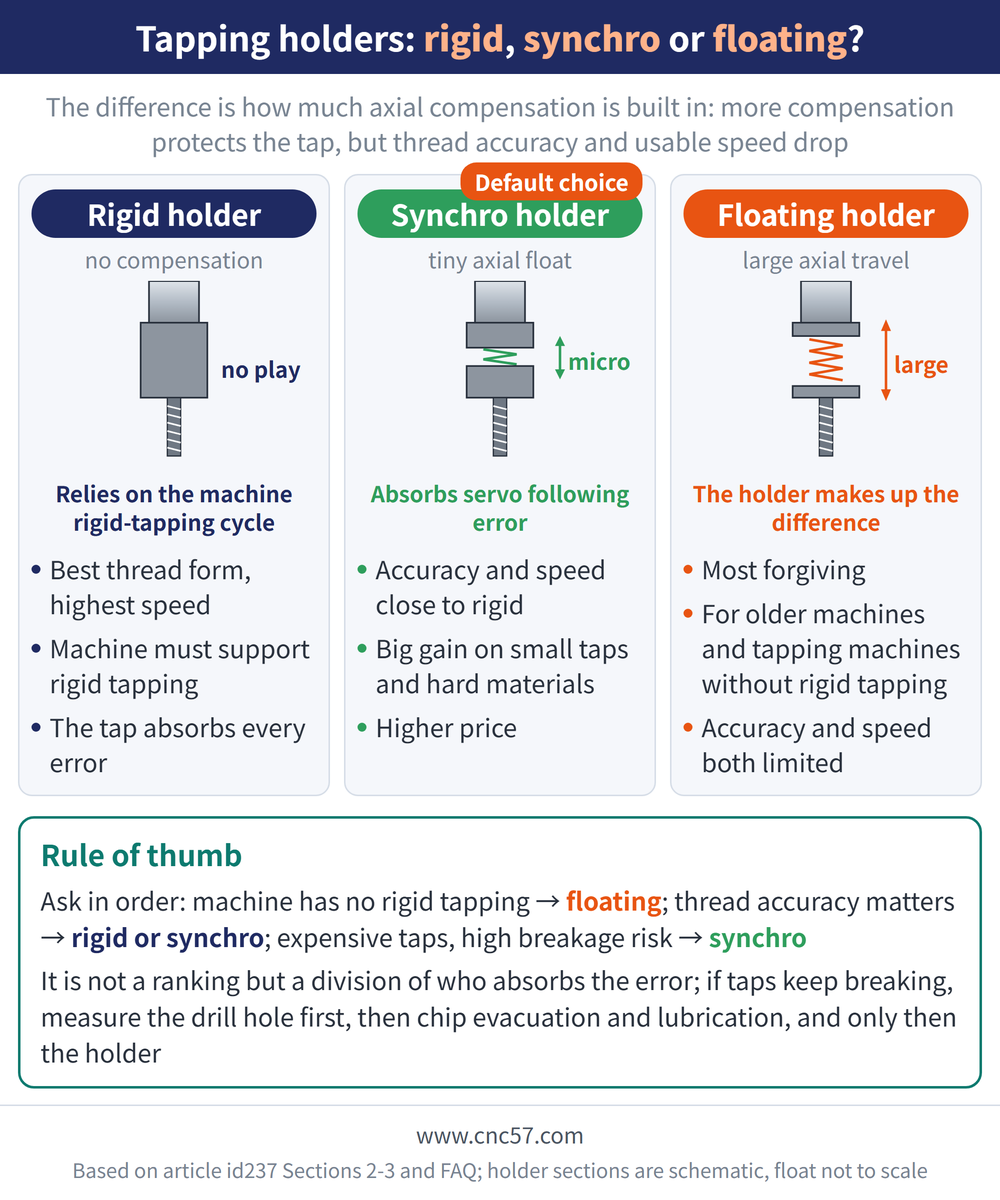
The difference is whether axial compensation is provided at all, and how much. The more compensation there is, the safer the tap; thread accuracy and usable speed both fall in return.
| Holder type | Compensation | Thread accuracy and speed | Where it fits, and what it costs |
|---|---|---|---|
| Rigid tap holder | None; it relies on the rigid tapping function of the machine | The most accurate thread form, and the highest usable speed | Requires a machine that supports it; the whole error lands on the tap |
| Synchronised tap holder | A very small axial float that absorbs the following error | Accuracy and speed both close to a rigid holder | The mainstream choice on machining centres; higher unit price |
| Floating tap holder | A large amount of axial extension and retraction, so the holder makes up the mismatch | Both accuracy and usable speed are limited | For older machines or tapping machines; the most forgiving option |
The table gives general direction only; follow the catalogue or the relevant standard — not measurements taken by this site. Actual compensation travel in mm varies widely by model, so check the catalogue.
Rigid tapping in the table above is the control function that makes spindle rotation and Z axis feed follow each other, so that no external compensation is needed. The three are not ranked best to worst; they differ in who absorbs the error. If the machine can absorb it, move toward rigid; if it cannot, move toward floating. How the machine feeds and how tap back clearance should be matched are covered in Tapping Setup Guide.
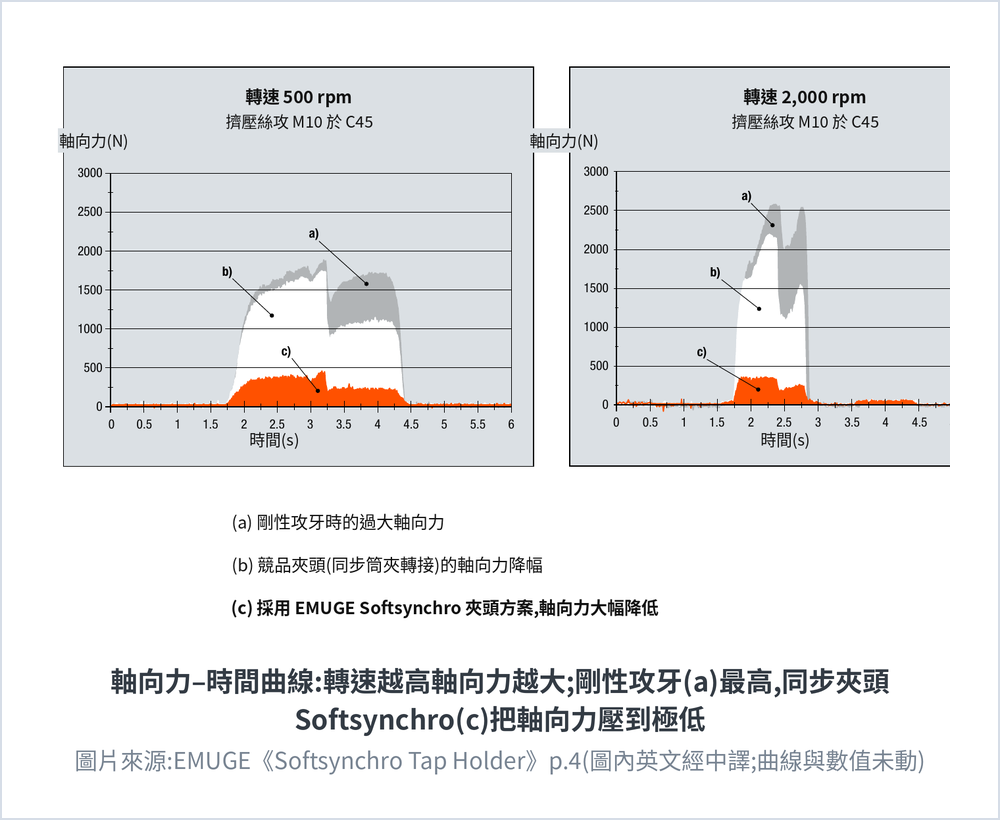
Manufacturer comparison: for the same M10 forming tap in C45, rigid tapping (a) produces the highest axial force, while the manufacturer's own synchronised holder (c) pushes axial force down to a very low level, as shown below.
3. How to Choose: Three Decision Criteria
Work through the three criteria below in order and the answer usually appears quickly. The first one is a gate: fail it and the later choices do not exist.
| Criterion | Which way it points | Notes |
|---|---|---|
| 1. Does the machine support rigid tapping? | No → floating holder | When spindle and Z axis cannot follow each other, only the holder can absorb the error |
| 2. How tight is the thread accuracy requirement? | Tight → rigid or synchronised holder | The more float there is, the less consistent thread start and thread depth become |
| 3. Tap cost and breakage risk | High risk → synchronised holder | For small-diameter taps, difficult-to-cut materials and deep threads, protecting the tap beats saving on the holder |
The table gives general direction only; follow the catalogue or the relevant standard — not measurements taken by this site.
On most machining centres the safe default is the synchronised holder: almost no loss in thread accuracy, with a layer of insurance kept. Move to a rigid holder only when the last of the cycle time matters. For how a tap holder differs from the other clamping styles, see Tool Holder Clamping Methods Comparison.
4. Tap Drill Size and Tap Style: The Top Two Causes of Broken Taps
Taps still break with the right holder, because most causes do not sit in the holder. Settle the two items below first.
| Supporting item | Direction | Notes |
|---|---|---|
| Tap drill size | Look it up first; do not judge it by feel | An undersized hole is the leading cause of broken taps, because torque climbs steeply |
| Tap style and chip direction | Decided by through hole or blind hole | Straight-flute and spiral-point taps push chips ahead; spiral-flute taps pull chips back out, which suits blind holes |
The table gives general direction only; follow the catalogue or the relevant standard — not measurements taken by this site.
Always look the tap drill size up in a table; for the value of each thread size see the Tap Drill Size Chart, and for the drilling-to-tapping sequence see the Drill and Tap Process Guide. On ductile materials you can switch to a forming tap (a tap that raises the thread by plastic deformation instead of cutting), which produces no chips at all.
5. Coolant, Overhang and Change-over Efficiency
The remaining three items decide stability and shop floor efficiency, and only make sense read together with the holder type.
| Supporting item | Direction | Notes |
|---|---|---|
| Coolant | Tapping demands lubrication more than other operations | Neat cutting oil or tapping fluid usually beats a water-soluble emulsion |
| Overhang and concentricity | Keep the overhang as short as the job allows | Poor concentricity pushes the first thread off line, and runout and vibration follow |
| Change-over efficiency | Many thread sizes call for a quick-change holder | The tap is swapped without removing the whole holder, which saves time in mixed low-volume work |
The table gives general direction only; follow the catalogue or the relevant standard — not measurements taken by this site.
Tapping relies almost entirely on lubrication to cut friction torque; for deep and blind holes move to coolant through the tool, see the Coolant-Through Tool Holder Guide; for what runout does, see Tool Runout: Effects and Control; for the trade-offs of quick-change systems, see the Quick-Change and Modular Tool Holder Guide.
In practice, settle the tap drill size and the tap style first, then discuss the holder type. For the same question in other operations see Choosing a Tool Holder for Drilling and Choosing a Tool Holder for Milling.
Last updated: 2026-10-22
6. Frequently Asked Questions (FAQ)
Q: My machine already has rigid tapping — do I still need a synchronised holder?
Usually yes. Servo following error never drops to zero, and fine compensation moves that error off the tap, which is most noticeable on small-diameter taps.
Q: What separates a synchronised holder from a floating one?
The amount of compensation and what it is for. A synchronised holder absorbs only the small error and keeps thread accuracy close to rigid; a floating holder carries far more travel and exists for machines without rigid tapping.
Q: Taps keep breaking — will a different holder fix it?
Measure the tap drill hole first, since an undersized hole is the most common cause; confirm it against the Tap Drill Size Chart. Then check chip evacuation and lubrication, and only then the holder type.
Q: Can I just hold a tap in an ordinary collet chuck?
It will hold, but there is no axial compensation and no torque protection, so keep it to low-risk tapping on a machine that supports rigid tapping. For how the clamping styles differ see Tool Holder Clamping Methods Comparison.
For the full reading guide on this topic, see Hole Accuracy: A Complete Reading Guide.
This article is part of Tool Holders: The Complete Guide - One End Meets the Spindle, the Other Holds the Cutter; that guide shows how the whole topic fits together.









