
Thread Grinding: Single-Rib or Multi-Rib Wheels, and the Machine Points That Decide the Result
The thread form on a precision tap, a thread gauge or a lead screw is ground, not cut. Thread grinding splits into two routes, single-rib for accuracy and multi-rib for output. This article covers how each works, what each suits, and the machine points on a thread grinder that are easiest to skip and most expensive to skip.
1. What is ground rather than cut
Thread grinding is a finishing process, used for thread surfaces that must be accurate, hard, or both.
Typical parts: lead screws, worms, taps, thread gauges, thread milling cutters, thread chasers, and threads on already hardened parts.
🔑 Note that last one. Once a part is hardened it can no longer be tapped or turned, and grinding is the only process left that can correct the form. That is why precision taps and gauges take this route instead of stopping at the cutting operation.
2. Single-rib wheel: the accuracy route
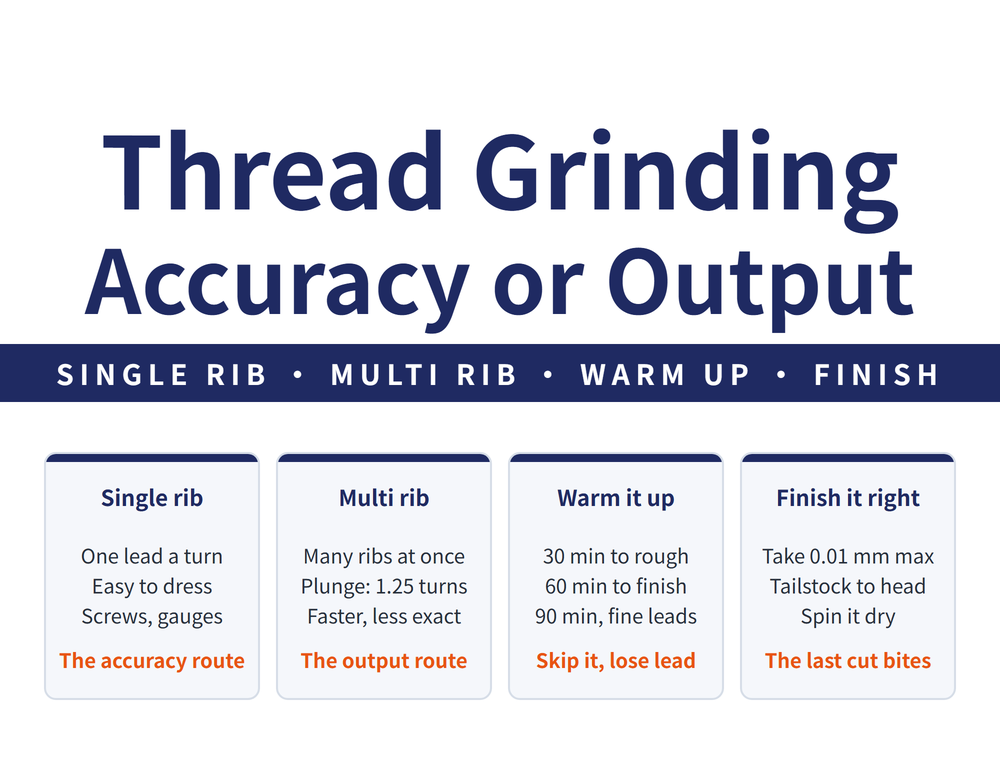
The principle is simple: for every revolution of the work, the machine drive train advances the wheel along the axis by exactly one lead, evenly.
The form comes from one rib on the wheel; the lead comes from the drive train. Two separate jobs, two separate sources of error.
| Item | Single-rib grinding |
|---|---|
| Pitch accuracy | Grade 5–6 |
| Surface roughness | Ra 0.08–1.25 µm |
| Suits | Precision lead screws, thread gauges, worms, small-batch threaded parts, relief grinding of precision hobs |
| Wheel dressing | Straightforward |
⚠ The pitch accuracy grade above is not tied to an ISO or CNS grade system and must not be converted directly. When agreeing accuracy with a customer, work from a standard both sides accept and from gauge measurement.
3. Multi-rib wheel: the output route
A multi-rib wheel carries several thread forms and engages several turns at once. It runs two ways:
| Method | Condition | How it runs |
|---|---|---|
| Longitudinal | Wheel narrower than the thread length | One or several traverse passes bring it to final size |
| Plunge | Wheel wider than the thread length | Wheel feeds in radially; about 1.25 turns of the work completes it |
📌 Those 1.25 turns are the whole argument for plunge grinding. It suits relief grinding of taps in larger batches and general fastener threads. The price is slightly lower accuracy (no comparison basis or grade figure is given; setting it against single-rib is a practical inference), and markedly harder wheel dressing — every rib lives on the wheel, so one dressing operation has to true them all.
4. Choosing between the two
| Aspect | Single-rib | Multi-rib |
|---|---|---|
| Accuracy | Higher | Slightly lower (inferred) |
| Output | Lower | Higher |
| Wheel dressing | Easier | Complex |
| Batch size | Small batches | Larger batches |
🔑 In one line: thread form accuracy sends you to single-rib, volume sends you to multi-rib. There is no middle option, because dressing effort pushes you back to the same decision. For reading the wheel itself, see Reading a Grinding Wheel Marking: Abrasive, Grit, Grade, Structure and Bond.
5. Warm the machine to thermal equilibrium
A thread grinder is run up to thermal equilibrium before work, to stop the wheel spindle growing axially as it heats. However much the spindle grows, the lead moves with it.
| Situation | Idle running time |
|---|---|
| Before roughing | 30 minutes or more |
| Before finishing | 60 minutes or more |
| High accuracy trapezoidal lead screws | 90 minutes or more |
🔴 This is a scheduling decision, not an operating one. Treat it as a five-minute warm-up and the thread simply will not hold accuracy — and the symptom looks like a worn machine or the wrong wheel, which sends the investigation the wrong way.
6. Mounting, dressing and balancing the wheel
When the wheel goes on the flange: the clearance between the bore and the flange locating face must be evenly distributed, the contact faces must be packed with thick soft paper, and the screws tightened gradually and symmetrically so the wheel is not loaded unevenly and damaged.
Balance it more than once: static balance, then mount on the spindle and dress the form and face, then remove and static balance a second time before fine dressing, with a third round if needed. Lubrication oil pressure on the guideways under the table should also be set correctly.
📌 Once it is on, leave it on. A wheel mounted on its flange should run to its wear limit, which saves abrasive and diamond and avoids repeated mounting and rebalancing.
⚠ A plain wheel used for thread grinding should be formed on a lathe first, then mounted on the thread grinder spindle and finish dressed with a diamond.
7. The finish is where parts are lost
| Stage | Point |
|---|---|
| Near final size | Infeed is generally 0.005–0.01 mm; more than that and size accuracy is not held |
| Finishing direction | Grind from the tailstock towards the headstock where possible, to reduce pitch error from thermal distortion |
| Tailstock pressure | Higher for short thick parts; lower for long slender ones |
| Grinding fluid | Ample and aimed at the grinding zone, to cool the part and flush loose grit, preventing burn and distortion |
| Before shutdown | Turn the fluid off and run the wheel for 5 minutes so centrifugal force throws fluid out of the pores |
⚠ With a multi-rib wheel, both fluid flow and pressure need to be higher, and the tank has to cope with the extra cooling load and settle the swarf. For looking after the machine as a whole, see Grinding Wheels and Machines: The Complete Guide - Reading the Wheel, Mounting It, Dressing It, and Tracing Defects.
8. When the thread comes out wrong: which group to check first
When a ground thread fails, first be clear which problem it is. Each of the four common problems has its own group of things to check first; check the wrong group and the settings only get further off:
| Problem | Check this group first | Typical causes |
|---|---|---|
| Pitch error | Drive train and heat | Table stick-slip, lead screw accuracy and wear, drive train error, poor centre holes, room temperature swings, poor part cooling |
| Pitch diameter error | Work holding and infeed | Centre runout or looseness, centre hole distortion, wrong tailstock pressure, fast wheel wear |
| Thread form error | Wheel dressing | Diamond dresser loose or blunt, uneven dressing stroke, inconsistent dressing passes, wheel wear |
| Surface burn | Wheel and grinding data | Too much stock on one flank, grit too fine or grade too hard, feed and speed too high, dull wheel |
🔑 The centre hole appears in both the pitch and the pitch diameter groups: headstock centre runout no more than 0.002 mm, and at least 80% contact between the centre hole and the centre. On precision lead screws and ball screws, centre hole quality matters even more.
9. Countermeasures: adjusting, choosing and dressing the wheel
⚠ Fine pitches (P ≤ 1 mm) readily show thread form error from wheel wear: move to a harder grade and separate roughing from finishing. For burn, go coarser and softer and dress in time. If the pitch diameter wanders, do not let the finishing pass reach the root of the thread; dress the wheel wider instead.
📌 Wheel choice follows the pitch too: fine pitches and taps take a fine grit, while coarse pitches and ball screw threads have a large contact area and take a coarser grit to limit heat and avoid burn. Dress the wheel in one direction only, from the outside in, so the tip of the form stays correct.
10. Frequently Asked Questions (FAQ)
Q: Threads are tapped, so why grind them?
Cutting and grinding serve different accuracy levels. Thread grinding is a finishing process for threads that must be accurate or hard: lead screws, worms, taps themselves, thread gauges, thread milling cutters and chasers. The decisive case is a hardened part — once the hardness is there it can no longer be tapped or turned, and grinding is the only process that can still correct the form. Precision taps and gauges are made this way.
Q: Single-rib or multi-rib wheel?
Accuracy points to single-rib, volume points to multi-rib. A single rib relies on the drive train to advance one lead per revolution, giving high pitch accuracy and easy dressing, which suits precision lead screws, gauges, worms and small batches. A multi-rib wheel grinds several turns at once and a plunge cycle finishes in about 1.25 turns of the work, so output is high — at the cost of considerably harder dressing, with accuracy generally taken to be slightly lower (an inference; no grade figure is given).
Q: Does the machine really need that long a warm-up?
Yes, because what it prevents is axial growth of the wheel spindle as it heats, and the lead follows that growth. Run 30 minutes or more before roughing, 60 minutes or more before finishing, and 90 minutes or more for high accuracy trapezoidal lead screws. Cut it short and the accuracy simply is not there, while the symptom resembles a worn machine or a wrong wheel choice — which leads the troubleshooting astray.
Q: What matters most as the thread approaches size?
Three things. Bring the infeed down to the 0.005–0.01 mm range, because more than that will not hold size accuracy. Take the finishing passes from the tailstock towards the headstock where possible, to limit pitch error from thermal distortion. Keep grinding fluid ample and aimed at the grinding zone, then switch it off before shutdown and run the wheel for five minutes to spin the fluid out of the pores.
Published: 2026-09-21 | Last updated: 2026-10-22









