
Thread Rolling Die Blank Diameter Chart (Rolling Type)
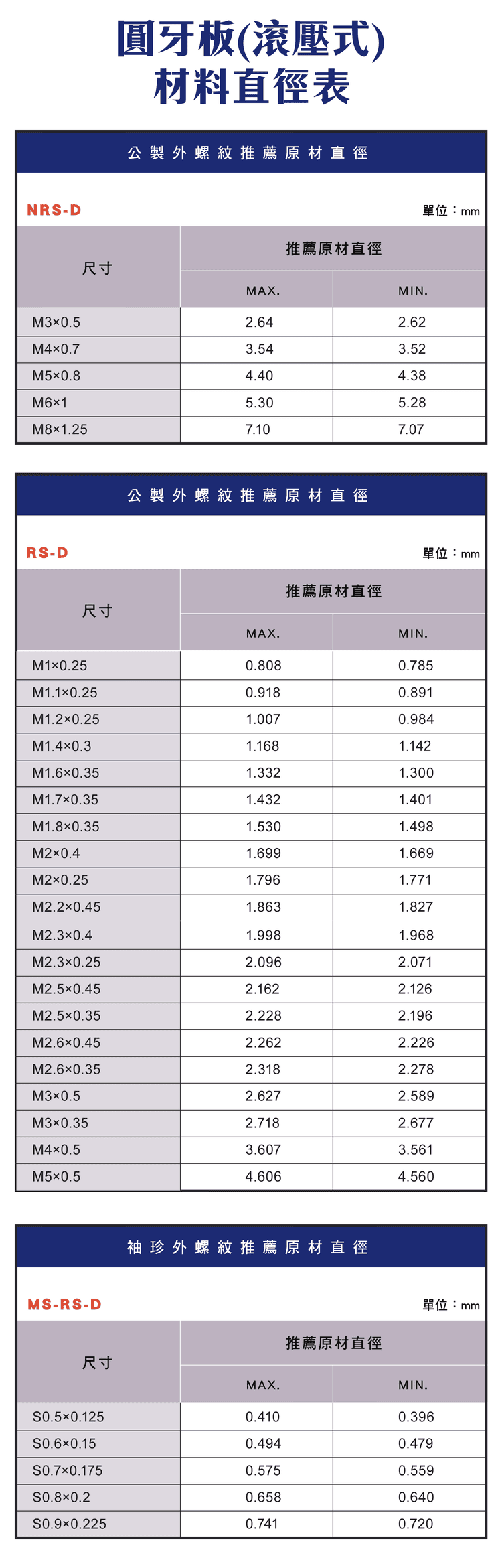
This guide gives blank (stock) diameter selection for rolling-type external thread dies, covering the NRS-D, RS-D and micro-thread MS-RS-D series. Keeping the stock diameter within the recommended MAX/MIN range ensures full plastic flow during rolling, improving thread strength, surface finish and accuracy while lowering incomplete-form and instability risk — a key basis for efficient chipless threading.
1. Rolling-Type Forming Principle
Thread rolling is a chipless forming method that squeezes material by plastic deformation into the thread form. Its core traits are no cutting and no chips, a work-densified surface for higher strength, and high throughput — suited to volume production, high-strength threads and precision external threads.
| Item | Content |
|---|---|
| Method | Chipless forming; plastic deformation into the form |
| Core traits | No chips, densified surface, high throughput |
| Suited to | Volume production, high-strength threads, precision external threads |
2. Blank Diameter vs Rolling Quality
The stock diameter is the key parameter for successful rolling. Too large raises the rolling load, distorting the form or overloading the machine; too small leaves insufficient fill and thread height. The best strategy is to stay within the chart's MIN–MAX and fine-tune by material and machine.
| Stock diameter | Effect |
|---|---|
| Too large | High rolling load, form distortion or machine overload |
| Too small | Insufficient fill, low thread height |
| Moderate | Within MIN–MAX, fine-tuned by material and machine |
3. Common Rolling Die Series
By thread size and accuracy need, common rolling die series are:
| Series | Range | Traits and advice |
|---|---|---|
| NRS-D (standard) | Medium-large M3–M8 | High stability, general steel; use mid-value for stable volume runs |
| RS-D (precision) | Small M1–M5 | High accuracy, diameter-sensitive; use upper-mid value for full form |
| MS-RS-D (micro) | Micro S0.5–S0.9 | Very high accuracy, hard material flow control; tight tolerance, precision machine |
4. Rolling Advantages (vs Cutting)
Versus cutting, rolling gives higher thread strength (continuous grain flow), better surface roughness, longer tool life and faster machining; but it doesn't suit high-hardness materials and has higher initial equipment cost.
| Aspect | Content |
|---|---|
| Advantages | Higher strength (continuous grain flow), better finish, longer tool life, faster |
| Limits | Not for high-hardness materials; higher initial equipment cost |
5. Practical Advice
For material, low-carbon steel rolls best, stainless needs more lubrication, and aluminum needs deformation control; adjust diameter by goal.
| Goal / material | Advice |
|---|---|
| Low-carbon steel | Best rolling result |
| Stainless | More lubrication |
| Aluminum | Watch deformation |
| High-speed production | Smaller diameter |
| High accuracy | Mid-value diameter |
| High strength | Larger diameter |
For cutting-type die blank diameter, see the Threading Die Blank Diameter Guide (Cutting Type); for external-thread cutting parameters, see the External Thread Machining Guide.
FAQ
Q: How does rolling differ from cutting?
Rolling is chipless plastic forming — no chips, a densified surface for higher strength, continuous grain flow and fast machining; cutting removes material with a tool. Rolling suits volume production and high strength but not high-hardness materials.
Q: How do I set the rolling blank diameter?
Keep the stock diameter within the die chart's MIN and MAX. Too large overloads the roll and distorts the form; too small underfills and leaves low thread height. Standard runs take the mid-value, precision parts the upper-mid value.
Q: How do I choose NRS-D, RS-D or MS-RS-D?
NRS-D is standard rolling for medium-large threads (M3–M8) in general production; RS-D is precision rolling for small sizes (M1–M5), sensitive to diameter; MS-RS-D is for micro threads (S0.5–S0.9), needing tight tolerance and a precision machine.
Q: Which materials suit rolling?
Low-carbon steel is ductile and rolls best; stainless can be rolled with more lubrication; aluminum needs deformation control. High-hardness materials lack the ductility and generally aren't suited to rolling — use cutting-type instead.
For the full reading guide on this topic, see Thread Machining: A Complete Reading Guide.
Published: 2026-03-24 | Last updated: 2026-07-25









