
Way Grinding: Four Methods, Why the Data Is Only a Starting Point, and Five Ways to Stop Distortion
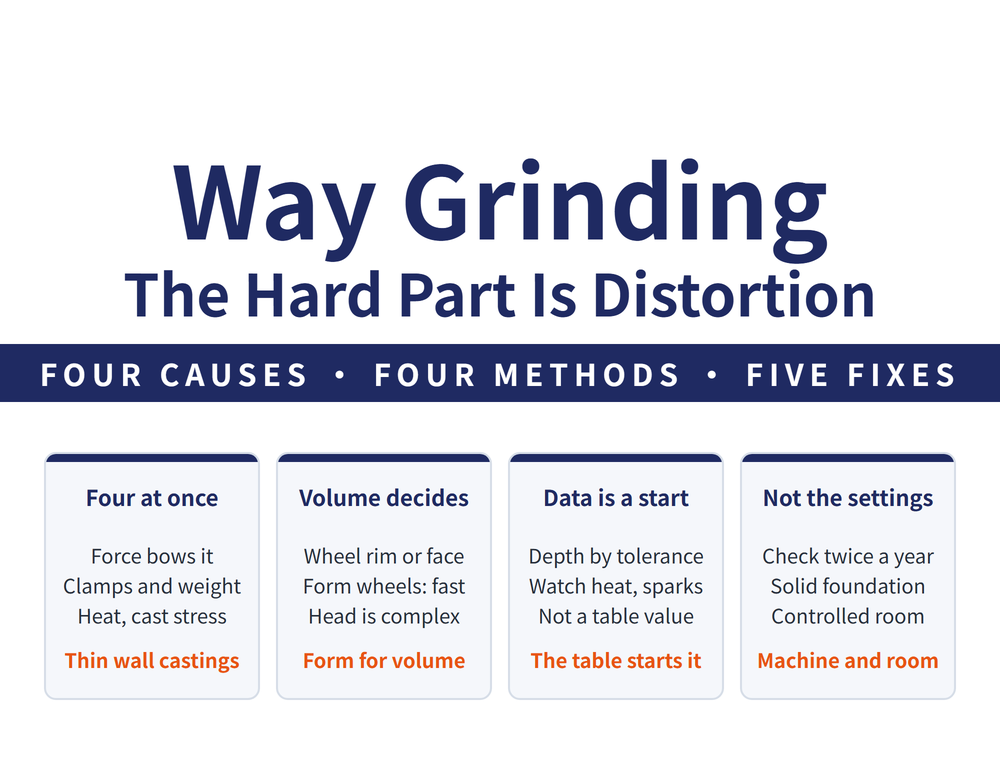
A machine tool gets its accuracy from its ways, and way grinding is the most demanding form of surface grinding there is: grinding force, self weight, grinding heat and casting residual stress all distort the part at once. This article covers the four grinding methods, why the data table is only a starting point, and why three of the five countermeasures are not about grinding at all.
1. What makes way grinding hard
A machine tool takes its accuracy from its ways — whether the table travels straight is decided here.
The difficulty is the part itself: ways are usually hollow, thin-walled castings of complex section. Put one on a grinder and four kinds of distortion appear together.
| Source | Result |
|---|---|
| Grinding force | Bowing, bending or twisting |
| Poor clamping, or self weight | Also produces significant distortion |
| Grinding heat and temperature gradients | Thermal distortion |
| Casting residual stress | Stress relief distortion |
🔑 Note self weight and residual stress in particular. Ordinary surface grinding assumes a plate small enough to sit on a magnetic chuck, where both are negligible. A way is not: its own weight is enough to deform it.
2. How tight the tolerances are: one bed as an example
The figures below come from one particular machine bed, not a general specification — they vary widely by machine type and accuracy class, so work from the drawing:
| Item | Tolerance |
|---|---|
| Flat way straightness (horizontal plane) | 0.008 mm / 1000 mm |
| Flat way straightness (vertical plane) | 0.009 mm / 1000 mm |
| V-way straightness | 0.006 mm / 750 mm |
| Flat way parallel to V-way | 0.01 mm / 750 mm |
| Way surface roughness | Ra 0.4 µm |
⚠ Straightness is in the thousandths of a millimetre per metre, and any one of the four distortions in section 1 exceeds that on its own. Which is why way grinding is a distortion problem before it is a grinding problem.
3. Choosing among the four methods
Way surfaces are mostly combinations of flats and angled faces, and four approaches handle them:
| Method | Character | Suits |
|---|---|---|
| Wheel periphery | General purpose | Any |
| Wheel face | General purpose | Any |
| Several form wheels plus an auxiliary head | Very efficient, but the head is complex | Volume production |
| Combined form wheel, one pass | As above | Volume production |
📌 The form wheel options are a volume decision, not an accuracy one. They buy throughput and pay in head complexity and dressing effort. For one-offs and small batches, periphery or face grinding is enough.
⚠ When rough grinding a way flat by the wheel face method, the wheel axis can be tilted by 3–5 degrees to reduce the contact area and improve heat dissipation. Separately, on plunge work the wheel diameter should not be too small — generally 1.3 to 1.5 times the width of the way surface.
4. The data table is a starting point, not a setting
| Form | Longitudinal feed rate | Depth of cut (per double stroke) |
|---|---|---|
| Wheel face | Rough 8–10 / semi-finish 4–6 / finish 1–2 m/min | 0.003–0.05 mm |
| Wheel periphery | 20–40 m/min | 0.001–0.10 mm |
🔴 The table carries a note that matters more than the table: depth of cut, and how many consecutive passes at it, should be set from the part tolerance, the rigidity of the wheel spindle and machine, how hot the part is running, and the character of the grinding sparks.
⚠ In other words, way grinding depth is not a value looked up in a table. The table starts you off; heat and sparks finish the decision.
On the wheel side, face grinding uses GC36H~JV or WA36H~JV, structure 7–8: green silicon carbide (GC) or white aluminium oxide (WA) at grit 36, grade H to J, bond V; peripheral grinding uses essentially the same wheel. For how each field of the code reads, see Reading a Grinding Wheel Marking: Abrasive, Grit, Grade, Structure and Bond.
5. Five countermeasures against distortion
| Cause | Countermeasure |
|---|---|
| The way grinder's own ways out of tolerance | Check and adjust every six months per the machine manual |
| Grinder foundation movement | Build the machine foundation properly at installation to prevent settlement |
| Too much grinding stock | More stock means more thermal and stress distortion; choose the stock accordingly |
| Too little time between rough and finish | After roughing, release the clamps and allow time for residual stress to redistribute, then reclamp with lower clamping force for finishing |
| Ambient temperature swings | Install precision way grinders in a temperature controlled room; in winter and summer, let the part stand 8 hours in that room before grinding |
6. Three of the five are not about grinding
Look at the list again: the first, second and fifth are not grinding parameters at all. They are about the machine and its environment.
🔑 That is the real difference from ordinary surface grinding: when a normal part comes out wrong you check the wheel first; when a way comes out wrong you check the foundation and the room temperature first. Check in the wrong order and the settings get changed beyond recognition while the problem stays.
📌 The fourth is the general rule for stress-bearing castings: let it move first, then grind it. Release the clamps after roughing so the part takes up its new shape, then hold it lightly to finish. Clamping it hard instead only postpones the distortion until after it comes off the machine.
For distortion control on other parts and for tracing grinding defects, see Grinding Wheels and Machines: The Complete Guide - Reading the Wheel, Mounting It, Dressing It, and Tracing Defects.
7. Frequently Asked Questions (FAQ)
Q: How does way grinding differ from ordinary surface grinding?
The part and its distortion sources. Ordinary surface grinding assumes a plate that fits on a magnetic chuck, while a way is a hollow thin-walled casting of complex section, where grinding force, clamping and self weight, grinding heat and casting residual stress all act at once. Required straightness sits in the thousandths of a millimetre per metre, and every one of those distortions exceeds that alone, so the work is about preventing distortion rather than about grinding.
Q: When are form wheels worth it?
At volume. Several form wheels with an auxiliary head, or a combined form wheel that grinds the way surface in one pass, are very efficient, but the head is complex and dressing is demanding, so they suit volume production. One-offs and small batches are better served by periphery or face grinding. It is a throughput decision rather than an accuracy one.
Q: Can the depth of cut just be taken from the table?
No, the table is only a starting point. Depth of cut and the number of consecutive passes at it should be set from the part tolerance, the rigidity of the wheel spindle and machine, how hot the part is running, and the character of the sparks. The decision is finished on the machine, not in the table, so treating the listed value as a setting ignores the actual state of that machine and that part.
Q: Straightness will not come right. What should be checked first?
The machine and the environment, before any setting is touched. Three of the five countermeasures are not parameters: the grinder's own ways need checking and adjusting every six months, the machine foundation must be built to resist settlement, and a precision machine belongs in a temperature controlled room with the part standing 8 hours before grinding in winter and summer. Beyond that, release the clamps between roughing and finishing so residual stress redistributes, then finish with lower clamping force.
Published: 2026-09-21 | Last updated: 2026-10-22









