
Why Threads Loosen: How a 30° Wedge Ramp Fixes It, and BT vs TT
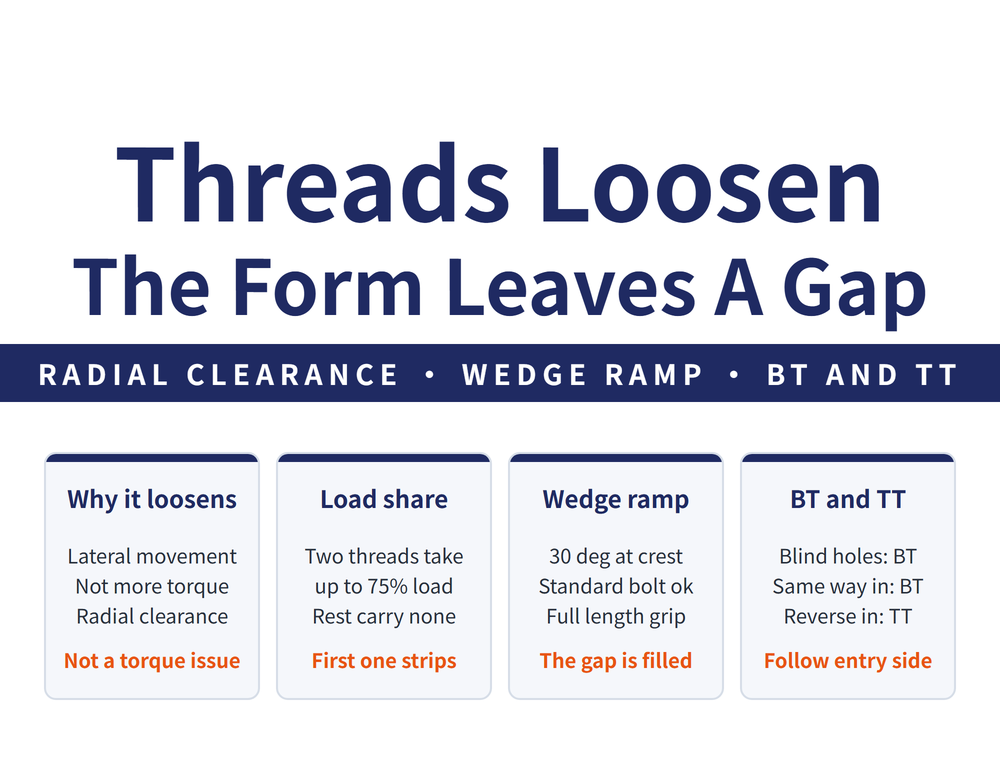
A bolt torqued to spec still backs out, and the cause is usually not the torque. The standard 60° thread form leaves a radial clearance. This article covers the mechanics behind thread loosening, what each traditional locking method gives up, and why adding a 30° wedge ramp to the internal thread crest solves lateral movement and load concentration at the same time.
1. A thread that loosens is not a defective thread
Threaded fasteners are meant to come apart. If a joint truly never had to separate, welding it shut would be the honest answer — no need to leave room for service or replacement.
"Removable" and "never loosens" are two sides of the same physical property. Locking is therefore not a repair for a defect; it is an extra mechanism added on top of a joint that must stay removable. That framing explains why every method below gives something up.
2. The cause is vibration, not insufficient torque
The instinct on the floor is to pull it tighter. The mechanics say otherwise: even when torque is applied correctly, vibration and dynamic loading tend to loosen even the most tightly torqued screw.
The root cause is small lateral movement, not a shortage of axial clamp load. No amount of axial force removes that one degree of freedom.
⚠ Raising the torque spec is therefore not a universal answer, and overshooting pushes the bolt into its plastic range.
3. The root: radial clearance left by the 60° form
A standard thread leaves a radial clearance between the bolt major diameter and the tapped hole. It exists so the bolt can be driven in, but it also provides room for lateral movement — and under vibration the bolt walks out through that gap.
The same form has a second side effect: load concentration. In a traditional tapped hole the first two threads may carry up to 75% of the load, while the rest carry almost none. That makes the first thread the likeliest place to strip, and it fatigues soft-metal bolts.
For how thread forms compare, see Thread Profile Guide: 60° V, 55° Whitworth, Trapezoidal & Round.
4. What each traditional locking method gives up
| Method | Limitation |
|---|---|
| Lock washers | Helpful, but not foolproof |
| Liquid adhesives | Effective, but costly, hard to remove, slow to clean |
| Serrated flange | No safer than a washer, and it damages the surface |
| Double nuts | Hard to torque both nuts correctly at once |
| Nylon washers | Absorb vibration, but cannot take high torque |
All five attack the same problem, and each gives up something different — cost, removability, surface integrity, load capacity. None of them is a complete answer, which is the reason to look at the thread form itself.
5. How the 30° wedge ramp solves it
The approach keeps the standard 60° flank angle and adds a 30° wedge ramp at the crest of the internal thread. The external thread stays standard: 2A in inch, 6g in metric.
As the bolt is tightened, the ramp meets the bolt thread crest and forms continuous contact along the whole thread length. The radial clearance is taken up, and the lateral degree of freedom is gone.
| Thread form | How the load is shared |
|---|---|
| Standard 60° | First two threads up to 75%; the far end carries almost none |
| With 30° wedge ramp | First thread about 17%, last about 12.5%, spread full length |
🔑 One change to the form fixes two problems: closing the gap stops lateral movement, and spreading the load relieves the first thread. Four side benefits follow — no adhesive or extra part, temperature does not affect the lock, it can be reused without losing hold, and a standard bolt still fits.
6. BT and TT: the ramp must face the entry direction
The wedge ramp is directional. It only works when it slopes toward the entry (load) direction, so one thread size comes in two versions.
| Code | Ramp faces | Where it is used |
|---|---|---|
| BT (Back Taper) | Backward | Blind holes; or through holes entered in the same direction as tapping |
| TT (Top Taper) | Forward | Through holes entered in the opposite direction to tapping |
📌 The test is not the hole type; it is how entry direction relates to tapping direction. A blind hole has only one way in, so it is always BT. For a through hole, ask which end the bolt goes in from.
In the designation, this profile is marked LK ahead of the thread size, with BT or TT appended after it.
7. Gaging: this thread has no common standard
This is the step most often missed on selection: the wedge ramp locking thread has no common standard such as DIN, so limit sizes can differ between makers.
Two brands represent the market, both tracing back to the same 1979 patent, which has since expired. They are identical in form and function yet not interchangeable — the difference lies in small dimensional tolerances.
So always gage with the matching brand's dedicated gages, using a two-piece GO / NO-GO set. If the thread was produced by single-point turning or thread milling, add an HRPG gage — it reads the angle at the base of the ramp, which a plain GO / NO-GO plug cannot detect.
8. FAQ
Q: If I just torque it harder, will it stop loosening?
No. Loosening is driven by small lateral movement under vibration, not by a shortage of axial clamp load. Even correctly torqued joints tend to loosen under vibration and dynamic loading. The radial clearance is what actually has to be addressed.
Q: Does a wedge ramp thread need a special bolt?
No. The ramp is on the internal thread side, so the external thread stays standard: 2A in inch, 6g in metric. That is part of why it is more practical than an adhesive. Nothing extra has to be stocked, and temperature does not change the holding effect, whereas adhesives cure or soften with heat.
Q: For a through hole, do I choose BT or TT?
Compare the bolt's entry rotation with the original tapping direction: same direction takes BT, opposite takes TT. A blind hole can only be entered from one end, so entry always matches tapping and it is always BT. The test is the direction relationship, not the hole type.
Q: Can I inspect it with another brand's gages?
Not advisable. There is no common standard here, limit sizes can differ between makers, and the two representative brands are not interchangeable despite identical form and function. Use the matching brand's gages in a two-piece GO / NO-GO set, and add an HRPG gage for turned or milled threads to check the ramp base angle.
For how thread types and standards are divided, see Thread Types Guide: Internal/External, Profiles & Standards. For another case of a form change solving a mechanical problem, see What Is a Buttress Thread: One-Way Power Transmission, and Why Metric and American Are Two Systems. The full entry point for thread machining is Thread Machining: A Complete Reading Guide.
Published: 2026-09-21 | Last updated: 2026-09-21









