
How Deep Can an End Mill Go: Depth Limits for Slotting and Shouldering
Two end mills of the same diameter can differ fourfold in how deep they cut. A standard type slots at 0.5 times diameter; a variable pitch type reaches 2 times. And depth can be bought with feed: halve the feed per tooth and the standard type's 0.5D becomes 1D. The reason behind that exchange rate is not tool rigidity, it is chip evacuation. This article sets out the depth limits for slotting and shouldering, the gap between tool types, and why cast iron allows double.
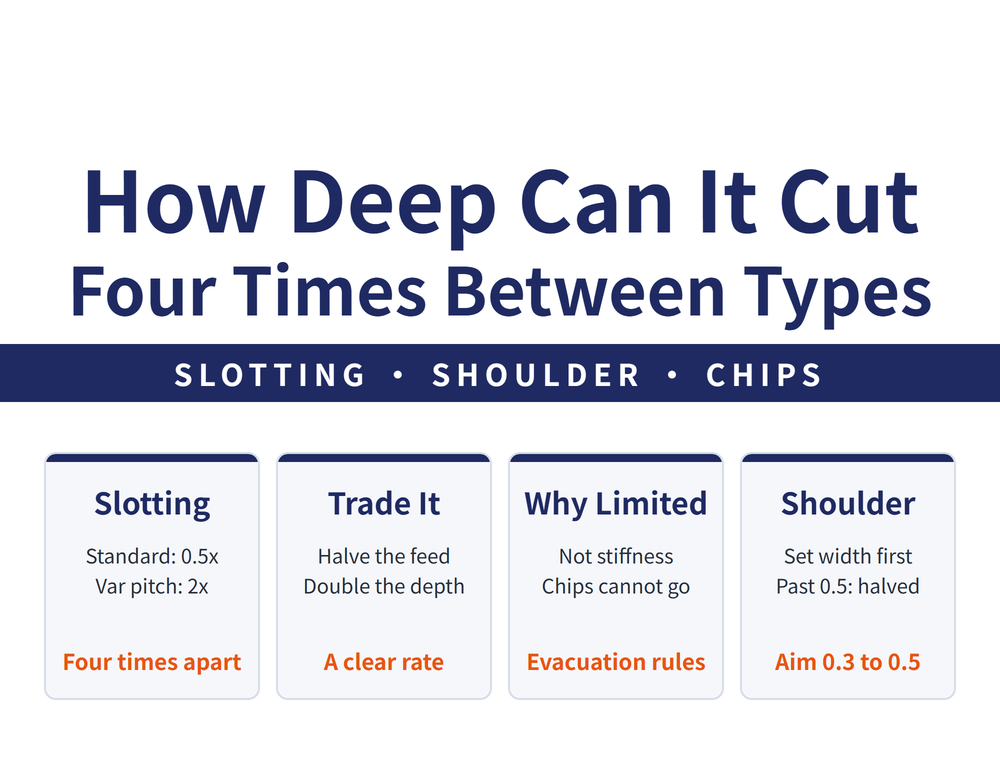
1. Slotting: Tool Type Sets the Limit, and the Spread Reaches Fourfold
Full slot milling is the hardest duty a cutter faces. All three sides are cutting and the chips have nowhere to go. Maximum axial depth ap is expressed as a multiple of diameter D:
| Diameter D | Standard | Wave form roughing | Variable pitch |
|---|---|---|---|
| 4 mm and under | 0.3 D | 0.4 D | 0.9 D |
| 4 to 5 mm | 0.4 D | 0.6 D | 1 D |
| 6 to 8 mm | 0.4 D (1 D at reduced fz) | 0.7 D (1.2 D at reduced fz) | 1.2 D |
| 10 to 25 mm | 0.5 D (1 D at reduced fz) | 0.9 D (1.5 D at reduced fz) | 2 D |
Look at the 10 to 25 mm row: 0.5 D for the standard type against 2 D for the variable pitch type, a factor of four. That is the most direct quantified argument for buying the more expensive cutter. It is not a little better, it is in a different class of what can be done at all.
2. Depth Can Be Bought With Feed, at a Stated Rate
The bracketed figures above are the same cutter used a different way:
| Tool type | Price in feed per tooth | Depth obtained |
|---|---|---|
| Standard | Reduce 50% | 0.5 D to 1 D |
| Wave form roughing | Reduce 30% | 0.9 D to 1.5 D |
| Variable pitch, D 16 mm and up | Reduce 20% | Reaches 2 D |
🔑 This is a stated exchange rate, not a vague instruction to go slower. With no variable pitch cutter to hand, a standard type at half the feed per tooth still slots to 1D deep, and the price is a number you can work out.
3. 🔑 What Limits Depth Is Not Only Rigidity, It Is Chip Evacuation
This point matters, because it explains why the exchange rate above exists at all.
Maximum depth in full slot milling depends not only on the strength and rigidity of the cutter but also on its ability to clear chips. In many cases, milling a deep slot requires a large reduction in feed per tooth to keep the chips moving.
So reducing fz is not about protecting tool rigidity, it is about letting the chips get out. That also explains why tool types with better chip handling, wave form roughing and variable pitch, can go deeper: they break the chip smaller and make it easier to move.
🔴 Cast iron allows double. The values above apply to steel; for cast iron they should be doubled, because cast iron chips break up on their own and evacuation was never the bottleneck.
4. Shoulder Milling: Fix the Width Before You Know the Depth
Shoulder milling follows a different logic: the radial width ae sets the ceiling on axial depth ap.
| Width ae | ap limit, D 16 mm and under | ap limit, D over 16 mm |
|---|---|---|
| Under 0.3 D | 2 D | 1.8 D |
| 🟢 0.3 to 0.5 D, recommended mode | 2 D | 1.8 D |
| 0.5 D to 0.75 D | 1.25 D | 0.8 D |
| 0.75 D and over | Treat as slotting and use the table in section 1 | |
Two things are worth noticing:
First, a width under 0.3D and a width between 0.3 and 0.5D give the same depth limit. Since the ceiling is identical, cutting thinner than that only throws away metal removal rate, which is why 0.3 to 0.5D is the recommended operating mode.
Second, once the width passes 0.5D the depth limit is cut roughly in half, from 2D down to 1.25D, and down to 0.8D on larger cutters. That is a cliff, not a slope.
5. How to Use These Two Tables
| Situation | How to look it up |
|---|---|
| Slotting | Identify the tool type, read section 1, then trade feed for depth if short |
| Shoulder milling | Fix the width first, read section 4, and keep the width in 0.3 to 0.5D |
| Machining cast iron | Double the slotting values |
| Depth still not enough | Cut in layers, or switch to a variable pitch cutter |
For converting to speed and feed, see [End Mill Cutting Conditions Guide]; for how tool shapes map to applications, see [End Mill Types and Features Explained].
6. Frequently Asked Questions (FAQ)
Q: A variable pitch cutter costs much more, is it worth it?
It depends on the job. At the same diameter it reaches four times the depth of the standard type, which removes several passes. If the part depth happens to sit where the standard type cannot reach, that is a difference in what can be done, not in how fast.
Q: Why does depth halve once width passes 0.5D?
A wider cut raises both the radial force on the cutter and the engagement arc, and at the same time makes the chips harder to clear. The two effects stack, so the axial depth that can be sustained falls sharply.
Q: Trading feed for depth, does overall efficiency get worse?
Work out the metal removal rate. With depth doubled and feed halved the volume per unit time is roughly level, but there are fewer layer changes and retracts. In practice it is usually worthwhile, though it should be calculated case by case.
Q: Do these multiples apply to every material?
The tabulated values are for steel, and cast iron allows double. Other materials such as stainless, titanium and aluminium behave differently in chip formation and cutting force, so follow the data published by the tool manufacturer.
The tabulated multiples are general recommended ceilings; usable values vary with tool specification, machine rigidity, clamping and workpiece material, so validate against your own conditions and consult the tool manufacturer's data before applying them.
Last updated: 2026-09-14









