
In-house Regrinding vs. Outsourced Grinding vs. Buying New — Which Is Cheapest?
When a carbide end mill goes dull, a shop usually has three roads: buy a new tool, send it out for grinding, or regrind it in-house. On the surface all three work; the difference only shows once you lay cost against time. This guide helps you decide which road is yours: start from your usage, then from how much lead time and downtime you can absorb, then from where the hidden costs land — and if buying a machine to grind in-house is on the table, when that becomes worth it.
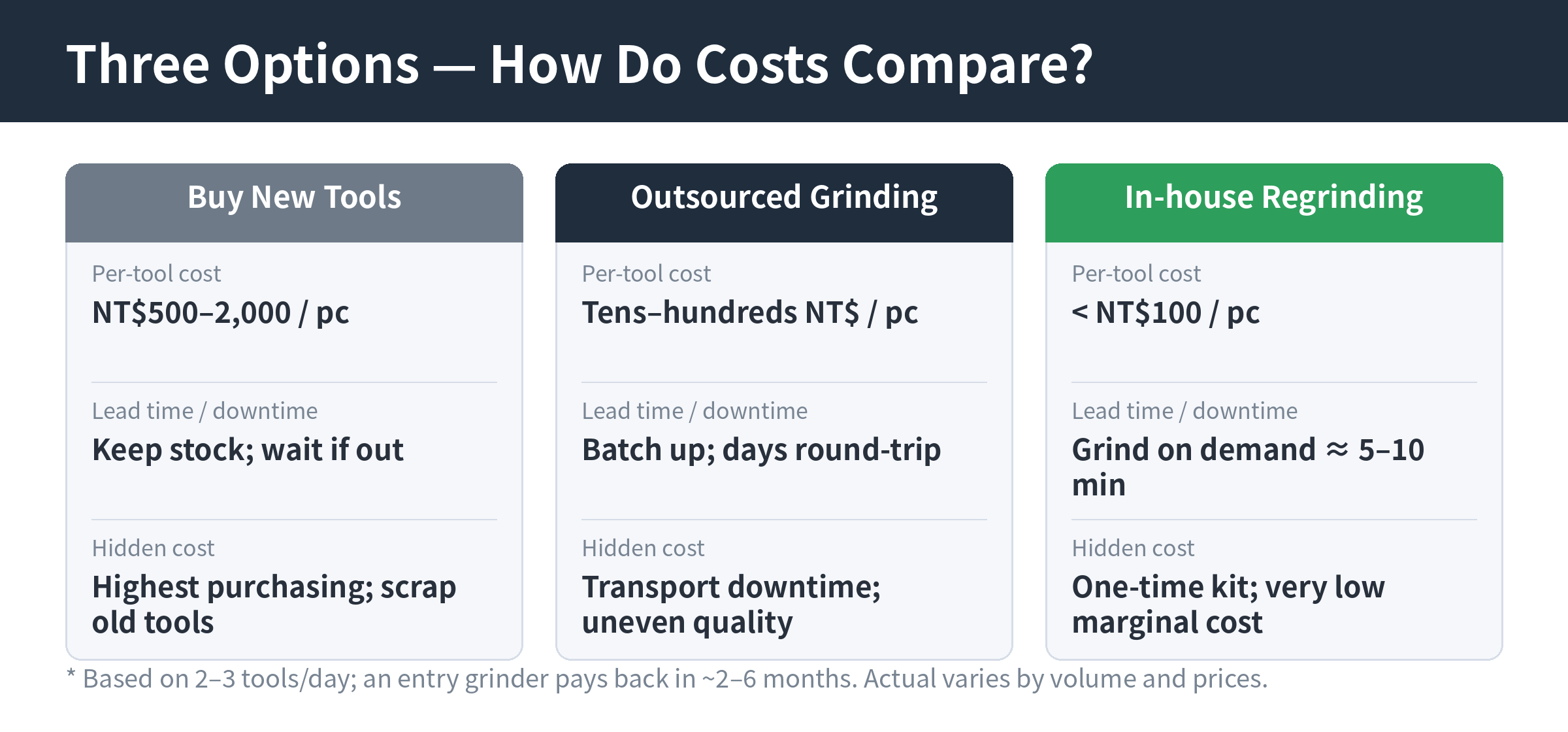
Three options, each with its own cost structure
| Option | Per-tool cost | Lead time / downtime | Hidden cost |
|---|---|---|---|
| Buy new | About NT$500–2,000 / tool | Need stock on hand; wait if out of stock | Highest purchasing cost; old tool scrapped |
| Outsourced grinding | About tens to a hundred-plus NT$ / tool (varies by diameter and vendor) | Need to batch up and ship back and forth; often tens of days | Shipping round-trips, downtime waiting, inconsistent quality |
| In-house regrinding | Consumables under NT$100 / tool | Grind and run immediately, about 5–10 min / tool | One-time equipment investment; very low marginal cost thereafter |
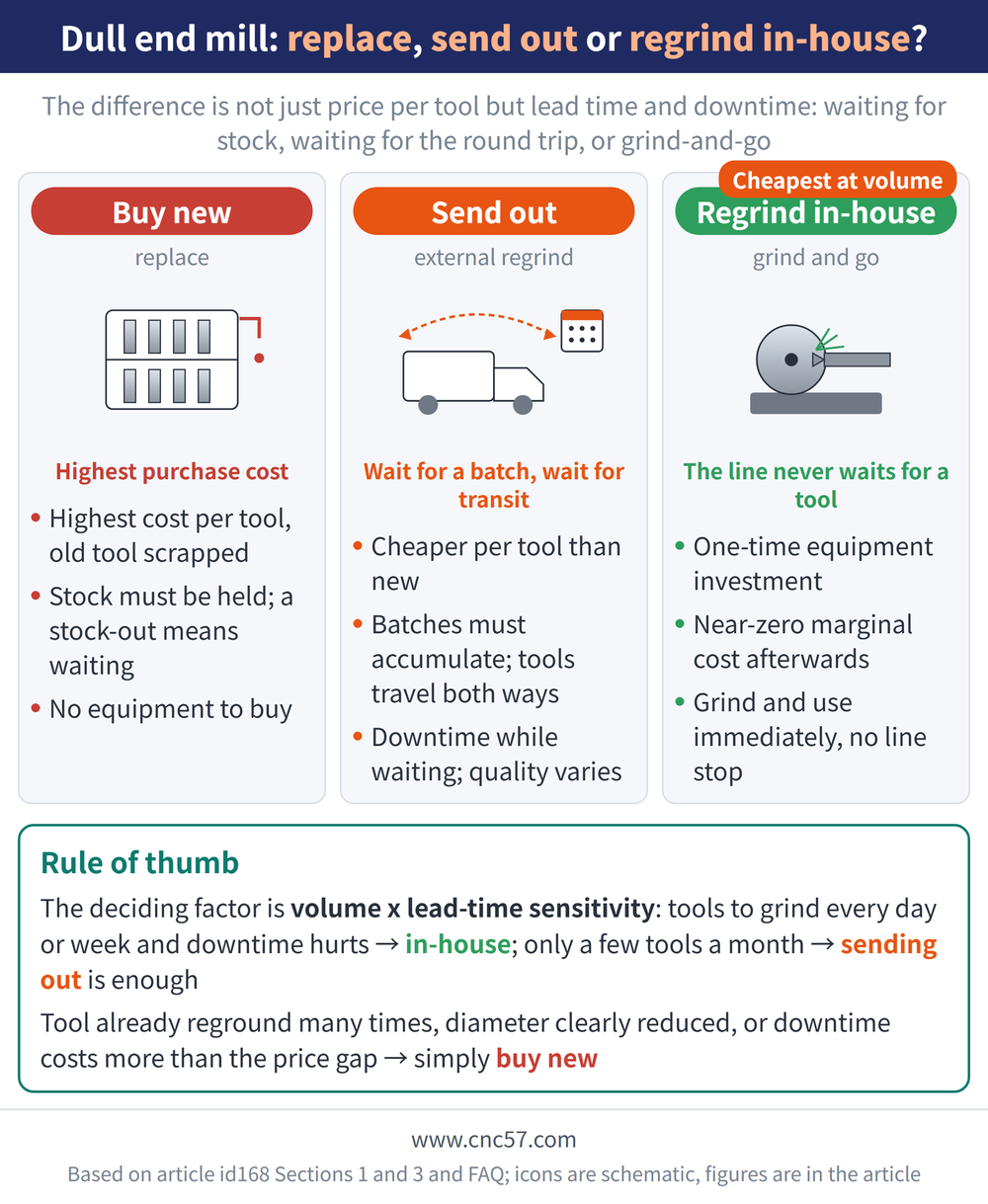
The key difference isn't just "how much per tool," but lead time and downtime. Buying new requires holding stock; outsourced grinding requires waiting for batches and logistics — these hidden costs are often overlooked. In-house regrinding is grind-and-run, so the line doesn't have to stop and wait for tools.
A calculation using a typical usage
Assume a shop needs to regrind 2–3 carbide end mills per day:
| Item | Description |
|---|---|
| If all are replaced new | at about NT$500–2,000 each, with 2–3 tools a day over ~22 working days, new-tool purchasing alone is a significant monthly outlay. |
| If reground in-house | at about NT$100 per regrind — and each tool can be reground many times — monthly consumables run only a few thousand NT$ at the same volume. |
| Switching from "buy new" to "regrind" saves several hundred to over a thousand NT$ per tool; against a one-time entry-level machine at NT$37,000, most shops recover the cost in about 2–6 months, with nearly pure savings after that (the higher the volume and the pricier the tool, the faster the payback). | |
Outsourced grinding is cheaper than buying new, but once you add lead-time waiting and batch requirements, its flexibility and long-term cost still lag in-house regrinding for shops that "use tools every day."
When should you consider buying a machine to regrind yourself?
| Item |
|---|
| You regularly have end mills to regrind every day/week, with steady volume. |
| You care a lot about lead time and can't accept tens of days of downtime from outsourcing. |
| You run many tool types (carbide, HSS, parting tools) and want one machine to handle them all. |
Conversely, if usage is sporadic and you grind only a few tools a month, outsourced grinding may be enough. The deciding factor is "volume × lead-time sensitivity" — the higher the volume and the more downtime hurts, the more worthwhile in-house regrinding becomes. (Not sure whether a tool should be reground? See "When to Regrind an End Mill? 5 Signs and the Correct Process.")
* The figures above are reasonable estimates; actual results vary with tool spec, unit price, usage, number of regrinds, and outsourcing rates.
FAQ
How long until in-house regrinding pays back?
It depends on usage. Estimating 2–3 tools per day, switching from buying new to regrinding saves several hundred to over a thousand NT$ per tool, so most shops recover an entry-level machine (NT$37,000) in about 2–6 months, mostly net savings after that; the higher the volume and tool unit price, the faster the payback.
What's the difference between outsourced grinding and in-house regrinding?
Outsourcing is cheaper per tool but requires batching and round-trip shipping, often tens of days, with inconsistent quality. In-house is grind-and-run, about 5–10 minutes per tool, so the line doesn't stop to wait. For high-volume, downtime-sensitive shops, in-house is cheaper long term.
Is buying a grinder worth it if usage is low?
If you grind only a few tools a month, outsourcing may be enough. Buying a machine pays off clearly when you regularly have tools to grind every day/week and you care about lead time.
When is simply buying a new tool the most economical?
When a tool has already been reground several times with noticeable diameter or length loss, or when precision demands and downtime costs outweigh the price gap, buying new often beats regrinding; low-cost, high-consumption standard tools are also usually replaced rather than reground.
For the full reading guide on this topic, see Tool Life and Wear: A Complete Reading Guide.
This article is part of Tool Regrinding: The Complete Guide — Decide Whether to Grind, Then Look Up How, With What, and How to Check; that guide shows how the whole topic fits together.
This article is part of End Mills: The Complete Guide - Know the Cutter, Choose It, Set the Conditions; Toolpaths Are Another Line; that guide shows how the whole topic fits together.
Further reading
| Item |
|---|
| When to Regrind an End Mill? 5 Signs and the Correct Process |
| End Mill Wear Analysis | A Complete Guide to Normal and Abnormal Wear |
Want to assess the right model for you? Take a look at the End Mill Grinder (Made in Taiwan · 1-year warranty · 2 on-site training sessions) — fits Φ3–20mm, with a "milling + parting" combo model also available. Send an online inquiry and we'll help estimate your usage and payback period.
Published: 2026-04-05 | Last updated: 2026-08-08









