
When to Regrind an End Mill? 5 Signs It's Dull and the Correct Regrinding Process
An end mill is a "consumable" in CNC machining — yet many shops do not replace tools when they are worn out, but throw them away while they could still be reground, effectively tossing money into the recycling bin. The hard part is catching the moment: edge dulling is gradual and not always visible, and the problem often only shows once the workpiece goes bad. This guide helps you decide when a cutter should go out for regrinding — with 5 signs you can spot on the floor, where carbide and HSS have to be judged differently, the steps a regrind should follow, and the mistakes most often made.
What does a dull end mill cause?
During high-speed cutting, an end mill is subjected to frictional heat and mechanical wear, and the cutting edge passes through three stages: "initial wear → steady wear → final wear." Once it enters final wear, flank wear (VB) expands rapidly and cutting performance drops sharply. If you keep pushing a dull tool, it leads to:
| Item | Description |
|---|---|
| Lower accuracy and surface quality | dimensional drift and higher surface roughness, raising the defect rate. |
| Higher cutting force and temperature | greater load on the machine and spindle, affecting machine accuracy over time. |
| Chipping and breakage risk | forcing a dull tool can cause sudden fracture, damaging the workpiece, fixtures, and even raising safety concerns. |
In other words, the cost of a dull tool is far more than the price of that one tool — it drags in scrap, downtime, and machine wear as well.
5 signs it's "time to regrind"
| Sign | What to look for on the floor |
|---|---|
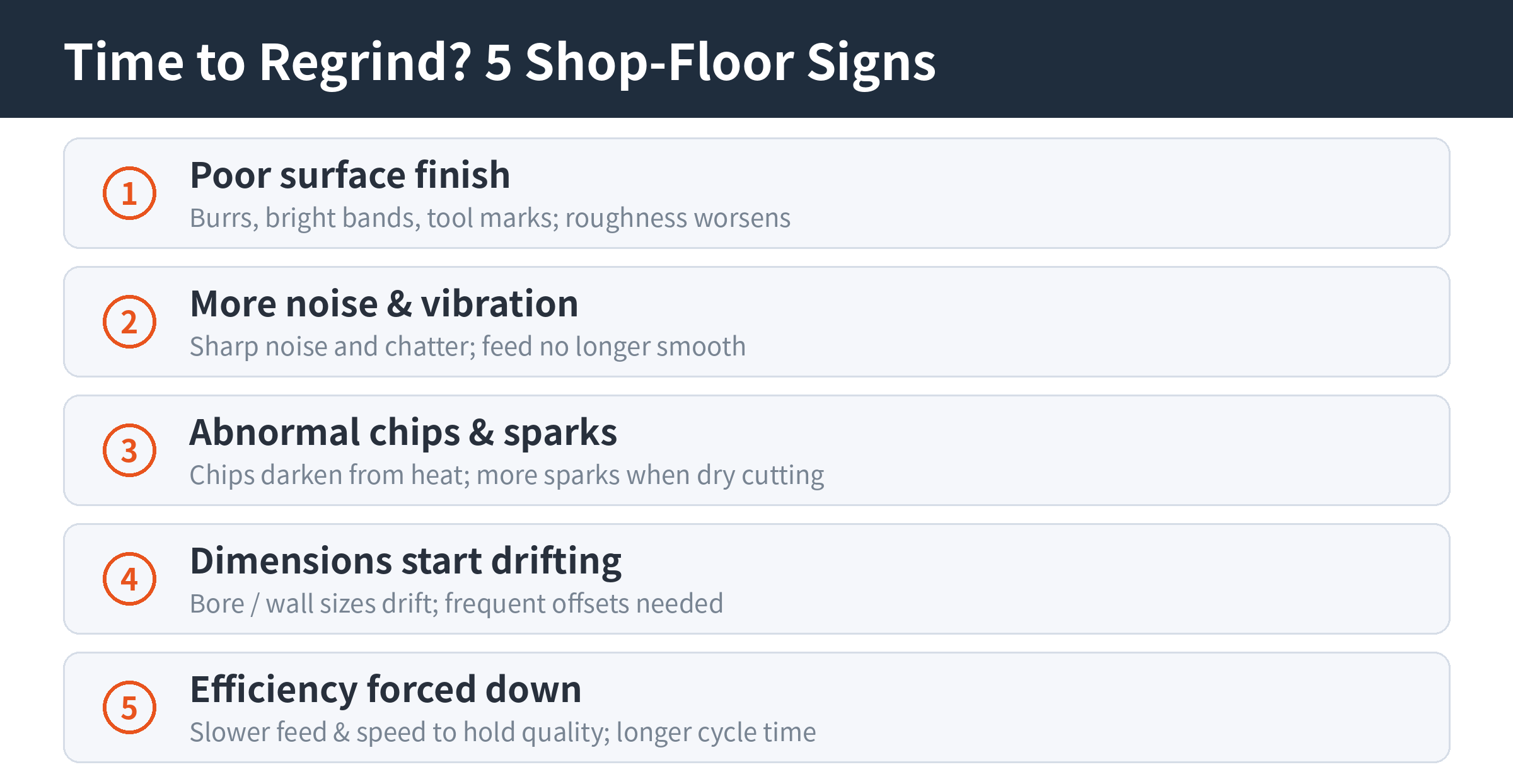
| ① Worse surface finish | Burrs, bright bands or tool marks on the workpiece; noticeably rougher surface |
| ② More noise and vibration | Sharp abnormal noise and chatter during cutting; it no longer "feels smooth" |
| ③ Abnormal chips / sparks | Chips turn darker (overheating) and curl abnormally; more sparks in dry cutting |
| ④ Dimensions start to drift | With the same program, bore/sidewall dimensions gradually shift and need frequent offset correction |
| ⑤ Efficiency is forced down | You slow feed and speed just to hold quality, lengthening cycle time per part |
If 2–3 of these appear, the edge most likely needs regrinding. Rather than waiting until a tool is completely unusable, regular regrinding keeps quality stable and lets a single tool be reused many times. (For the detailed mechanism of normal vs. abnormal wear, see "End Mill Wear Analysis.")
Carbide vs. HSS end mills — how is regrinding different?
Both materials can be reground, but the wheel and precautions differ; getting it wrong can ruin the tool:
| Item | Description |
|---|---|
| Carbide end mills | high hardness and wear resistance but more brittle; grind with a diamond (SDC) wheel. The main risks are overheating and chipping — use light feed and avoid removing too much at once to prevent micro-cracks at the edge. |
| HSS (high-speed steel) end mills | tough and impact-resistant; a CBN wheel is sufficient. The main risk is burning/annealing — excessive grinding heat tempers and softens the edge, lowering hardness so it dulls again quickly, so control grinding temperature and avoid dry burning. |
Either way, rake angle, clearance angle and helix angle must match the original tool spec; off angles directly hurt cutting performance.
These are not the only wheels: a white aluminium oxide (WA) wheel can grind HSS and a green silicon carbide (GC) wheel can grind carbide—which abrasive suits which tool is covered in Wheels for Tool Grinding: Abrasive, Shape and the Two Height Offsets. But when carbide must be finish-ground so every flute sits at the same height, the GC wheel’s own wear turns into error, so finish grinding is still done mainly with diamond.
The correct regrinding process (4 steps)
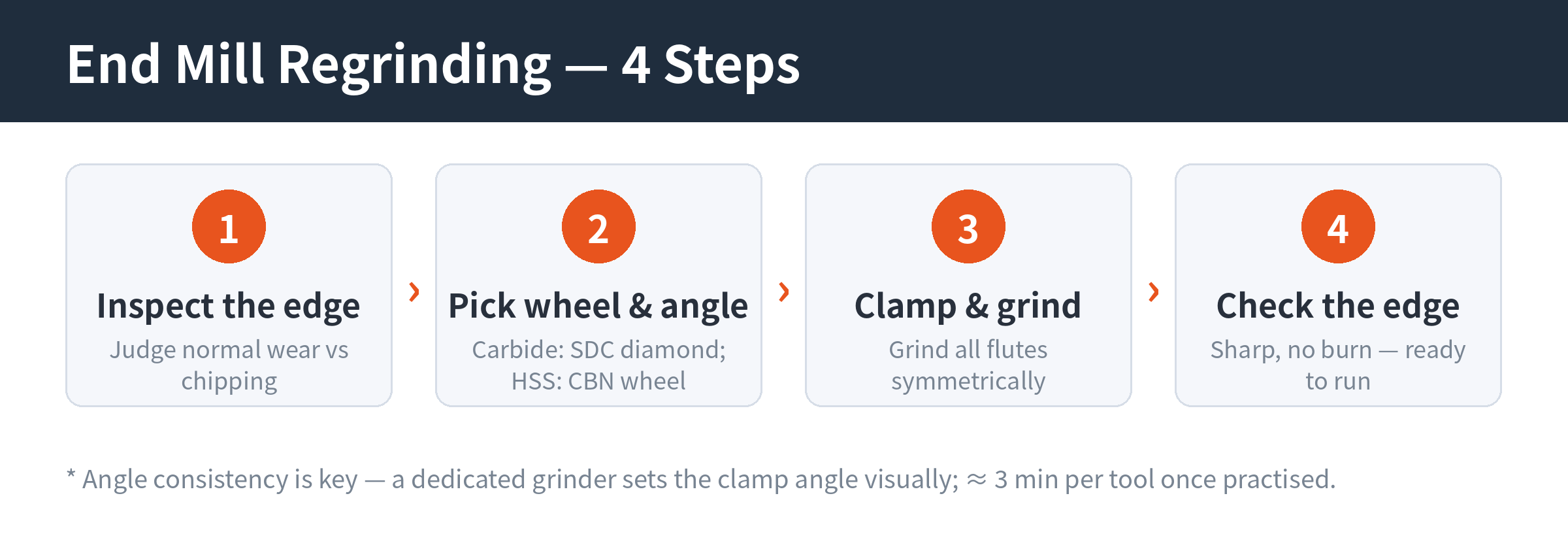
- Inspect the edge condition: determine whether it is normal wear or severe chipping, which sets how much to remove; for severe chipping, first dress it back to a notch-free edge.
- Choose the right wheel and angles: SDC diamond wheel for carbide, CBN wheel for HSS; set rake, clearance and helix angles to the original tool.
- Locate, clamp and grind the flanks: hold the end mill at the correct angle and grind the end and peripheral edges flute by flute, keeping all flutes symmetrical and at equal height.
- Inspect the edge: confirm a sharp edge with no burn discoloration and equal flute heights; if needed, apply a slight edge hone (R) to reduce chipping, then trial-cut on the machine.
The key is angle and flute-to-flute consistency — which is exactly why a dedicated end mill grinder is more stable than hand grinding: the clamping angle can be checked visually with high repeatability, and once practiced the whole job takes about 5–10 minutes.
The 5 most common regrinding mistakes
| Item | Description |
|---|---|
| Wrong clearance/rake angle | too small a clearance raises cutting resistance; too large weakens the edge and invites chipping. |
| Uneven flute heights | it becomes single-flute cutting — uneven load, more vibration, shorter life, poorer finish. |
| Removing too much at once | wastes flute length, reduces the number of possible regrinds, and raises the overheating risk. |
| Overheating / burning | HSS softens from annealing, carbide develops micro-cracks; the edge fails again quickly. |
| No edge hone | an edge that is too sharp without an R is prone to micro-chipping when machining hard materials. |
How often should you regrind?
There is no fixed number of hours — it depends on material, cutting conditions and tool material. In practice, judgment is based on flank wear (VB) or machining quality: regrind when VB approaches the life limit or when the 5 signs above appear. For frequently used tools, it is best to set regrinding standards and inspection intervals to avoid both "over-grinding" (wasting flute length) and "waiting too long" (making defective parts).
Is regrinding in-house worth it?
Taking a new carbide end mill at about NT$500–2,000 and a regrind cost of under NT$100, a single tool can be reground many times, so the cost per edge is greatly amortized. For CNC and mold shops that change tools every day, bringing regrinding back in-house — grind and run immediately — saves both tool purchasing costs and the downtime spent waiting for tools. (For a full cost comparison of in-house regrinding vs. outsourced grinding vs. buying new, see "In-house Regrinding vs. Outsourced Grinding vs. Buying New — Which Is Cheapest?")
* Figures here are general estimates; actual results vary with tool spec, unit price, usage and number of regrinds.
FAQ
How many signs mean it's time to regrind?
When 2–3 of the 5 signs appear — poorer finish, abnormal noise/vibration, overheated chips, dimensional drift, and reduced efficiency — the edge is usually dull and should be reground. Set up periodic inspection and regrinding standards rather than waiting until the tool is unusable.
Do carbide and HSS end mills use the same grinding wheel?
No. Carbide end mills are finish-ground mainly with a diamond (SDC) wheel; HSS end mills use a CBN wheel, or a WA wheel. The wrong wheel either won't cut or will burn the edge. Carbide fears overheating and chipping, HSS fears burn/annealing, so control temperature when grinding either.
How many times can an end mill be reground?
It depends on flute length, wear severity and how much is removed each time — generally many times. As long as enough flute length remains and there is no severe fracture, regrinding restores cutting performance. Removing a little each time and avoiding overheating extends the number of possible regrinds.
Where do people most often go wrong when regrinding?
The most common issues are uneven flute heights (turning it into single-flute cutting), a wrong clearance angle, and overheating/burning. Using a dedicated grinder with a visually verifiable clamping angle, controlling grinding temperature, and keeping flutes symmetrical avoids most problems.
For the full reading guide on this topic, see Tool Life and Wear: A Complete Reading Guide.
This article is part of Tool Regrinding: The Complete Guide — Decide Whether to Grind, Then Look Up How, With What, and How to Check; that guide shows how the whole topic fits together.
This article is part of End Mills: The Complete Guide - Know the Cutter, Choose It, Set the Conditions; Toolpaths Are Another Line; that guide shows how the whole topic fits together.
Further reading
Looking to buy: want to know which model fits your tool diameter and usage? Take a look at the End Mill Grinder (Made in Taiwan · 1-year warranty · 2 on-site training sessions) — fits Φ3–20mm, regrinds carbide / HSS / parting tools. Online inquiries welcome.
Published: 2026-04-06 | Last updated: 2026-10-19









