
What Honing Can and Cannot Do: How Five Finishing Processes Divide the Work
Honing is low speed abrasive machining: a set of fine grit stones is expanded against the bore wall while the head both rotates and strokes up and down. Its value concentrates on one thing, removing the roundness, cylindricity and waviness left by the previous operation while leaving a cross hatch pattern that holds an oil film. It also has one hard limit, because the positional accuracy of the bore does not improve through honing. Once you know what it corrects and what it does not, and compare it against lapping, polishing, superfinishing and super finish lapping, the decision becomes straightforward.
1. What it does: stones expand, the head rotates and strokes
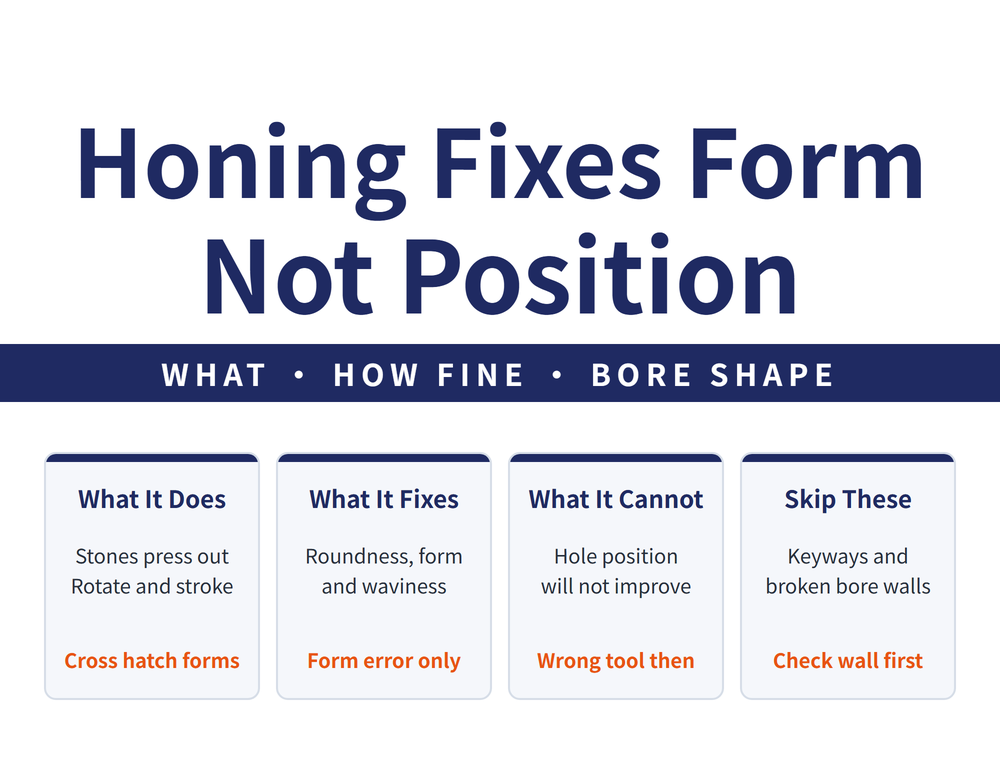
A honing head carries several fine grit stones around its circumference, and an expanding mechanism pushes them radially outward against the bore wall. The head then performs two motions at once, rotation and a linear reciprocating stroke, and the combination produces low speed abrasive machining of the bore.
Because the two motions overlap, each grit traces a path across the wall that crosses over itself without repeating, and that is where the cross hatch comes from. Radial pressure is the feed for the stones, so more pressure means more feed, which is the most direct adjustment available on the shop floor.
2. What it corrects: form error and surface
Honing removes the light form errors left by the previous operation in a relatively short time, covering roundness, cylindricity and surface waviness. Dimensional accuracy reaches IT6 to IT7. On bores under 50 mm, cylindricity reaches 0.5 μm and axis straightness 1 μm; on bores 300 to 400 mm long, cylindricity error can stay under 10 μm.
Surface roughness typically reaches Ra 0.8 to 0.2 μm, and under good conditions can go below Ra 0.025 μm. Honing also generates little heat, so the machined surface is largely free of thermal damage, altered layers, embedded grit and work hardening, and instead carries residual compressive stress, which helps service life.
The cross hatch is not a by-product but part of the purpose: it stores lubricant and maintains the oil film, so the part carries higher loads and wears better. That is the main reason cylinder liners are honed.
3. 🔑 What it cannot correct: position
Honing does not improve the positional accuracy of a bore.
This deserves its own section because it is where honing is most often misapplied. If the bore is tilted, the hole spacing is wrong, or the bore is not square to the datum face, that belongs to the earlier operation and to the locating datum. The honing head and the machine are connected in a floating arrangement, so the tool follows the bore that already exists; it makes the wall round and smooth, but it does not move the bore back to where it should be.
How to decide: ask whether what failed inspection is form or position. Roundness, cylindricity or roughness out of tolerance means honing is the right tool. Position, concentricity or perpendicularity out of tolerance means going back to the drilling or boring setup, and adding a honing operation only adds cost.
4. Which bores not to hone
Honing suits precision mating parts with high relative motion accuracy, but it does not suit interrupted surfaces, the most common being a bore with a keyway. Support breaks as the stone crosses the slot, the slot edges are easily damaged, and the cross hatch cannot run continuously.
Otherwise the range is wide. Through bores, blind bores, stepped bores and tapered bores are all workable, and so are flat faces, external cylinders and spherical surfaces. Materials run from hardened and unhardened steel, cast iron, bronze and hard aluminium through to carbide, glass, ceramics and sintered materials.
The barrier to entry is lower than people expect. Because the head floats relative to the machine, the machine itself does not need high accuracy, so a lathe, drilling machine or boring machine can be converted. For parts lacking rigidity, thin walled bores or harder surfaces, honing avoids complex and expensive tooling.
5. How the five finishing processes divide the work
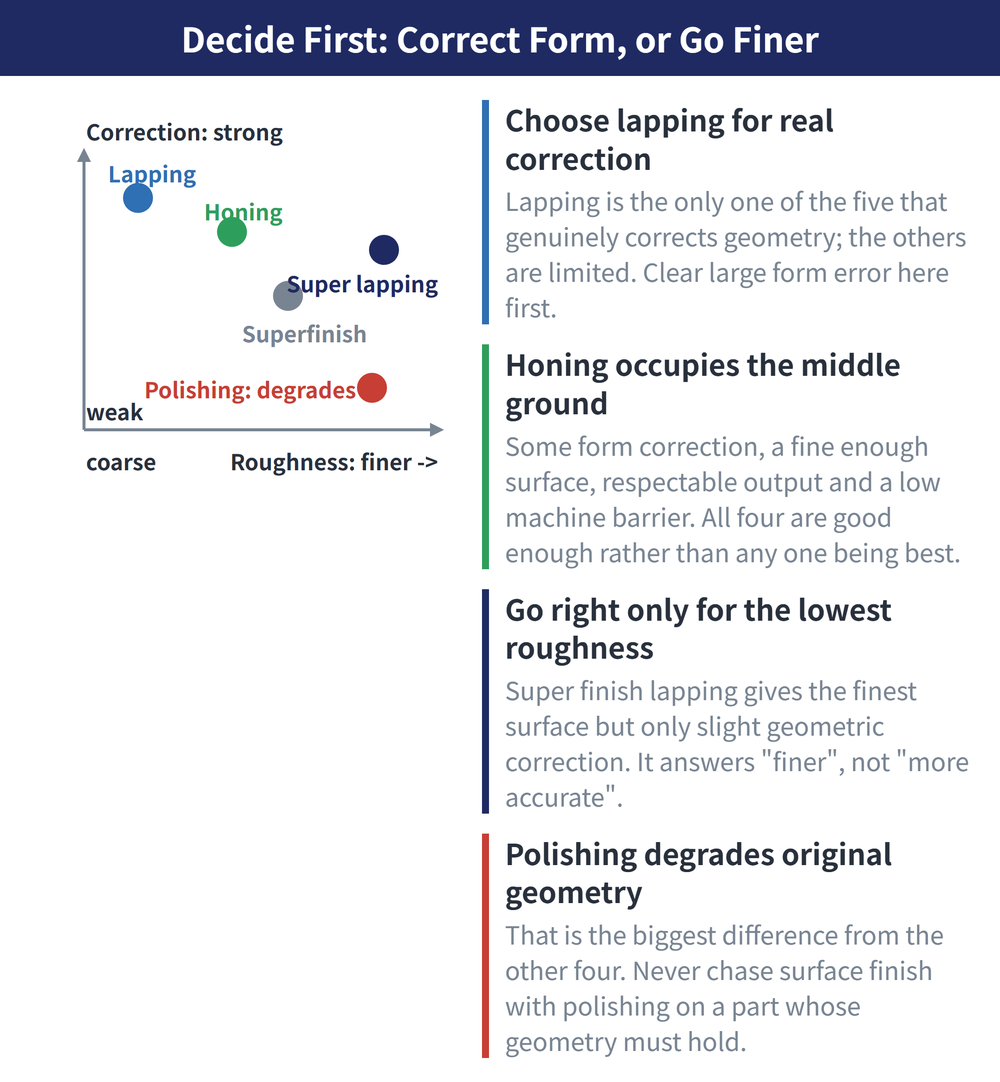
Honing is not the only option after fine grinding. Setting the five side by side makes selection much quicker:
| Comparison | Lapping | Polishing | Superfinishing | Honing | Super finish lapping |
|---|---|---|---|---|---|
| Abrasive bonding | Loose grit | Semi bonded | Bonded | Bonded | Loose grit |
| Roughness Ra(μm) | 0.125-0.010 | 0.032-0.125 | 0.01-0.160 | 0.016-0.32 | 0.008 |
| Geometry correction | Corrects | Degrades | Partial | Partial | Slight |
| Productivity | Low | High | High | Fairly high | High |
Three rules cover most cases:
① Real correction of geometric error means lapping. The other four are limited here.
② The lowest roughness with only slight correction means super finish lapping, which has both the finest surface of the five and high productivity.
③ 🔴 Never polish a part whose original geometric accuracy must be preserved, because polishing degrades it. That is the single biggest difference from the other four.
Honing sits in the middle: some form correction, a fine enough surface, respectable productivity and a low machine barrier. High volume cylinder liners, connecting rods, hydraulic valve bodies, fuel pump and injector parts and bushings use it, not because any one column is best, but because all four are good enough.
6. Superfinishing versus super finish lapping
The two names sit close together, but the real difference is whether the grit is fixed, not which one runs faster.
Superfinishing uses stones with fixed grit oscillating at 500 to 2000 cycles per minute, which often introduces slight chatter and prevents the cutting edges of each grain from being fully used. Super finish lapping runs in fluid with loose grit, oscillating at only 60 to 300 cycles per minute, so the motion is actually steadier and the loose grains cut with all their edges as they roll. That, rather than higher speed, is why it reaches a lower roughness.
Fluid and abrasive selection is covered separately in 〔Choosing a Grinding Fluid: Oil or Water Based, Five Types and EP Additives〕.
7. FAQ
Q: My bore fails roundness. Can honing fix it?
Yes. Roundness, cylindricity and waviness are form errors and fall squarely within what honing does. Confirm first that what failed is form rather than position, because position, concentricity and perpendicularity will not improve through honing.
Q: Can a bore with a keyway be honed?
It is not advisable. Honing does not suit interrupted surfaces, and a keyway is the classic example. Support breaks as the stone crosses the slot, the slot edges are easily damaged and the cross hatch cannot run continuously. Accuracy for such bores has to come from the earlier operation.
Q: We have no honing machine. Can existing equipment do it?
Yes. The head floats relative to the machine, so the machine itself does not need high accuracy, and a lathe, drilling machine or boring machine can be converted. This is one reason honing remains practical at small and medium volumes.
Q: For a finer surface, should we switch to polishing?
It depends on whether original geometric accuracy matters. Polishing is not the finest of the five, and it degrades geometric accuracy. If the geometry must be preserved and the surface must be finer, look at superfinishing or super finish lapping rather than polishing.
Accuracy and roughness figures here are typical attainable ranges. Actual results depend on workpiece material, pre-honing accuracy, stone selection and parameters, so verify on real test pieces before committing.
Last updated: 2026-10-24
This article is part of Grinding Wheels and Machines: The Complete Guide - Reading the Wheel, Mounting It, Dressing It, and Tracing Defects; that guide shows how the whole topic fits together.









