
Choosing a Grinding Fluid: Oil or Water Based, Five Types and EP Additives
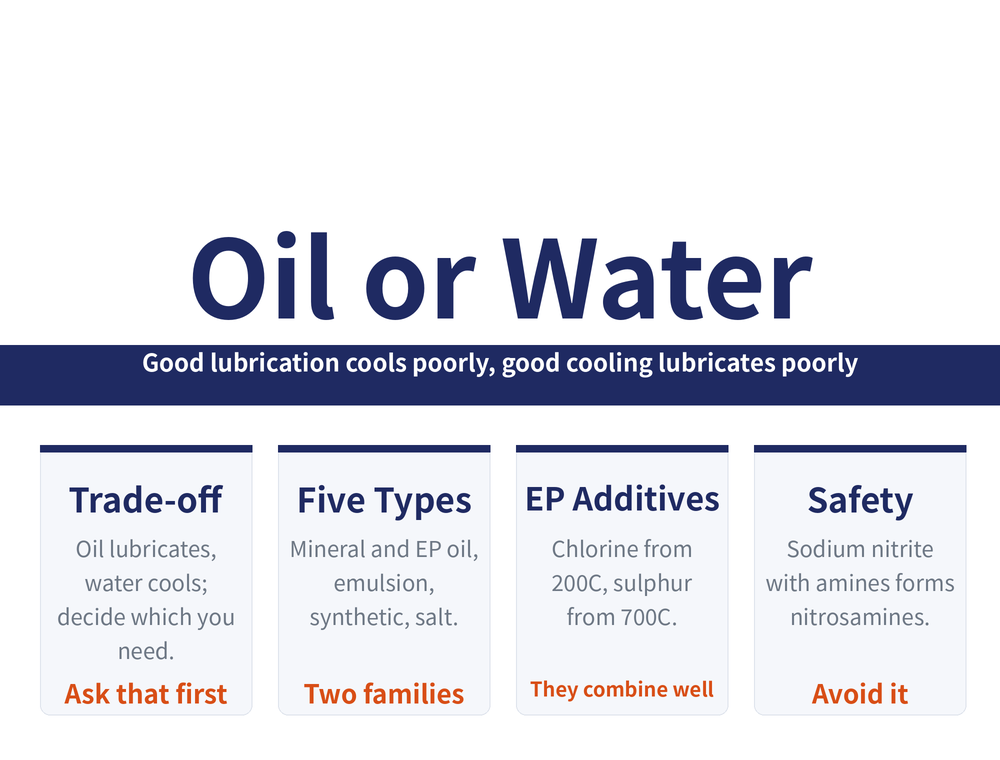
Grinding fluid is not a box to tick—oil based lubricates well and cools poorly, water based is the reverse, and picking the wrong one means using a lubricant where you needed a coolant. This lays out the five types and where each fits, explains the temperature window that separates chlorine from sulphur EP additives, and ends with a safety rule worth knowing.
1. The trade-off: lubrication or cooling
| Type | Lubrication | Cooling |
|---|---|---|
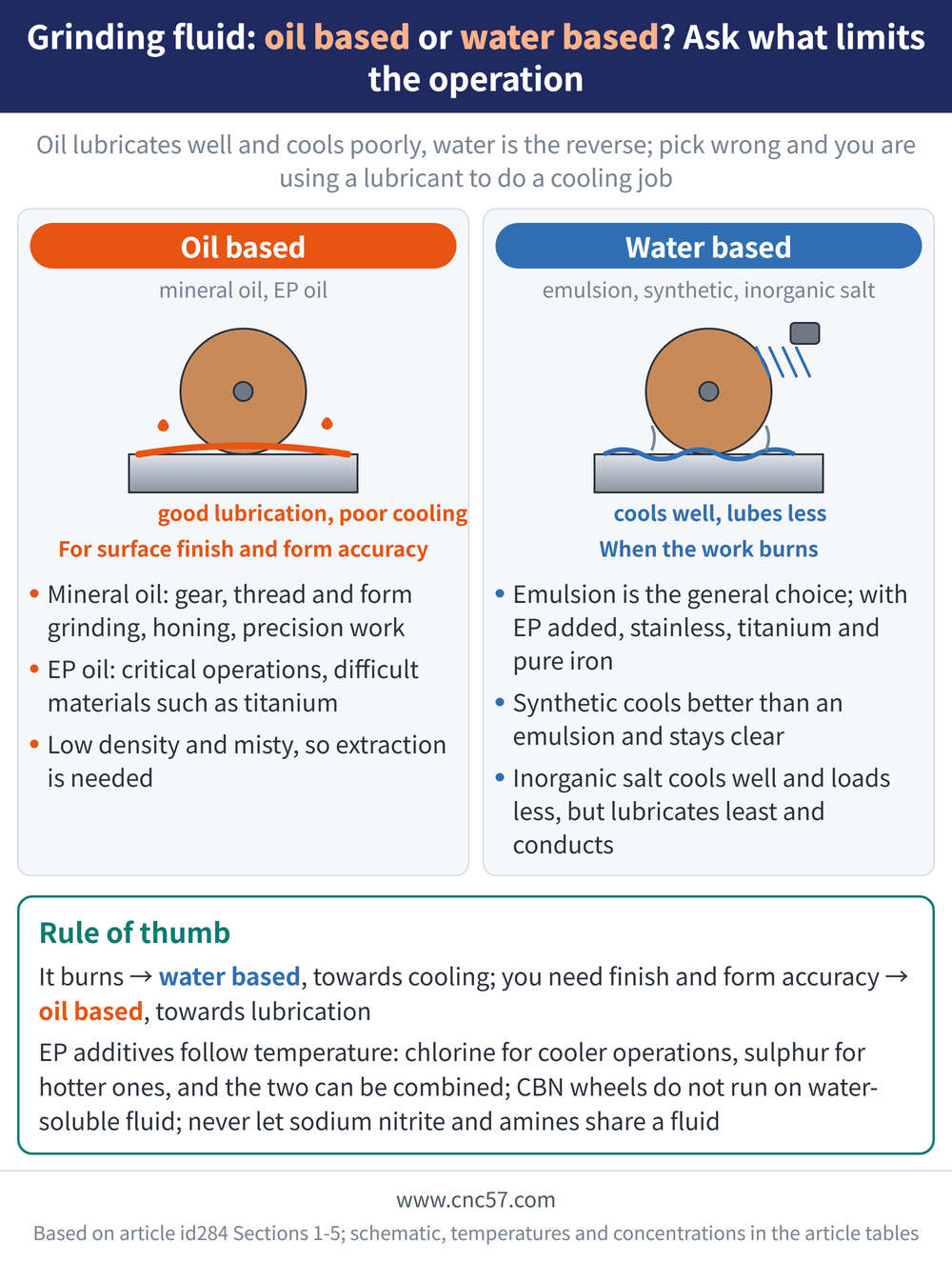
| Oil based | Good | Poor |
| Water based | Weaker | Good |
Water based fluids split further: a synthetic fluid lubricates about as well as an emulsion but cools better; an emulsion sits in the middle; an inorganic salt fluid also cools well but lubricates least. So the first question is not the brand but whether this operation is limited by lubrication or by heat—if it burns, move towards cooling; if you need surface finish and form accuracy, move towards lubrication. On spotting burn, see tracing grinding defects.
2. The five types and where they fit
| Type | Main content | Fits |
|---|---|---|
| Mineral oil (oil based) | Light mineral oil with rust and polar additives | Gear, thread and form grinding, honing, precision work |
| EP oil (oil based) | Light mineral oil with EP additives | Critical operations, difficult materials such as titanium |
| Emulsion (water based) | Water, mineral oil, emulsifier, rust inhibitor | General; with EP added, stainless, titanium and pure iron |
| Synthetic (water based) | Water and surfactant, optionally rust and EP additives | High-efficiency grinding; clear, so the cut stays visible |
| Inorganic salt (water based) | Water and inorganic salts, optionally surfactant | Cools well; ions adsorb, so the wheel loads less |
3. EP additives: chlorine and sulphur differ by temperature
The two additive families start reacting with metal at completely different temperatures, and that is the key to choosing:
| Family | Reaction starts | Fits |
|---|---|---|
| Chlorine | 200–300°C | Cooler operations; lower friction, better lubrication |
| Sulphur | 700–800°C | Hotter operations; the sulphide film survives high heat |
They can be combined—adding both chlorine and sulphur EP additives keeps lubrication effective across a wider temperature range. At equal content, sulphur gives a higher grinding ratio than chlorine, and the gap widens as concentration rises; it also lowers grinding force and improves surface finish.
4. Concentration and handling
| Item | Point |
|---|---|
| Emulsifier content | Above 10%; below the critical rate it will not emulsify at all |
| Inorganic salt dosing | Generally 0.25%–1%, adjusted by material and conditions |
| Wetting agent | Very effective in trace amounts, typically around 0.1% |
| Emulsion stabiliser | Add triethanolamine or it separates into water and oil layers |
⚠ Superabrasive wheels carry one extra rule: hot CBN hydrolyses with water, so do not run it on a water-soluble fluid—details in diamond or CBN wheels.
5. Safety and side effects
🚨 Sodium nitrite: with organic amines it forms nitrosamines, which are seriously harmful. Never use a fluid containing both sodium nitrite and amine compounds. Where sodium nitrite is used alone, keep the concentration low, and avoid it altogether where you can.
| Type | Side effect to watch |
|---|---|
| Inorganic salt fluid | Highly conductive; degrades wiring and motor insulation |
| Inorganic salt fluid | Attacks machine paint; mixed with oil it lubricates worse |
| Oil based fluid | Low density and misty; pollutes, so extraction is needed |
6. Frequently Asked Questions (FAQ)
Q: Oil based or water based?
Ask what limits the operation. Choose oil when you need lubrication—gear, thread and form grinding, honing and precision work. Choose water when heat and burn are the problem; synthetic cools best and inorganic salt keeps the wheel from loading.
Q: Chlorine or sulphur EP additive?
It follows grinding temperature. Chlorine begins working at 200–300°C and suits cooler work; sulphur needs 700–800°C and suits hot work. Combining both covers a wider range, and sulphur gives the higher grinding ratio.
Q: What happens if an emulsion is mixed too weak?
Below the critical emulsification rate it simply will not emulsify, so keep emulsifier content above 10%. An emulsion also needs triethanolamine as a stabiliser, or it separates into water and oil layers in storage.
Q: Are there health risks to watch?
Yes. Sodium nitrite with organic amines forms nitrosamines, which are seriously harmful, so a fluid containing both must be avoided; used alone, keep it dilute and preferably skip it. Oil based fluids mist readily, so fit extraction.
This article is part of Grinding Wheels and Machines: The Complete Guide - Reading the Wheel, Mounting It, Dressing It, and Tracing Defects; that guide shows how the whole topic fits together.
Published: 2026-08-16|Updated: 2026-08-16









