
Stainless Steel Cross-Reference: JIS, DIN, AISI, EN
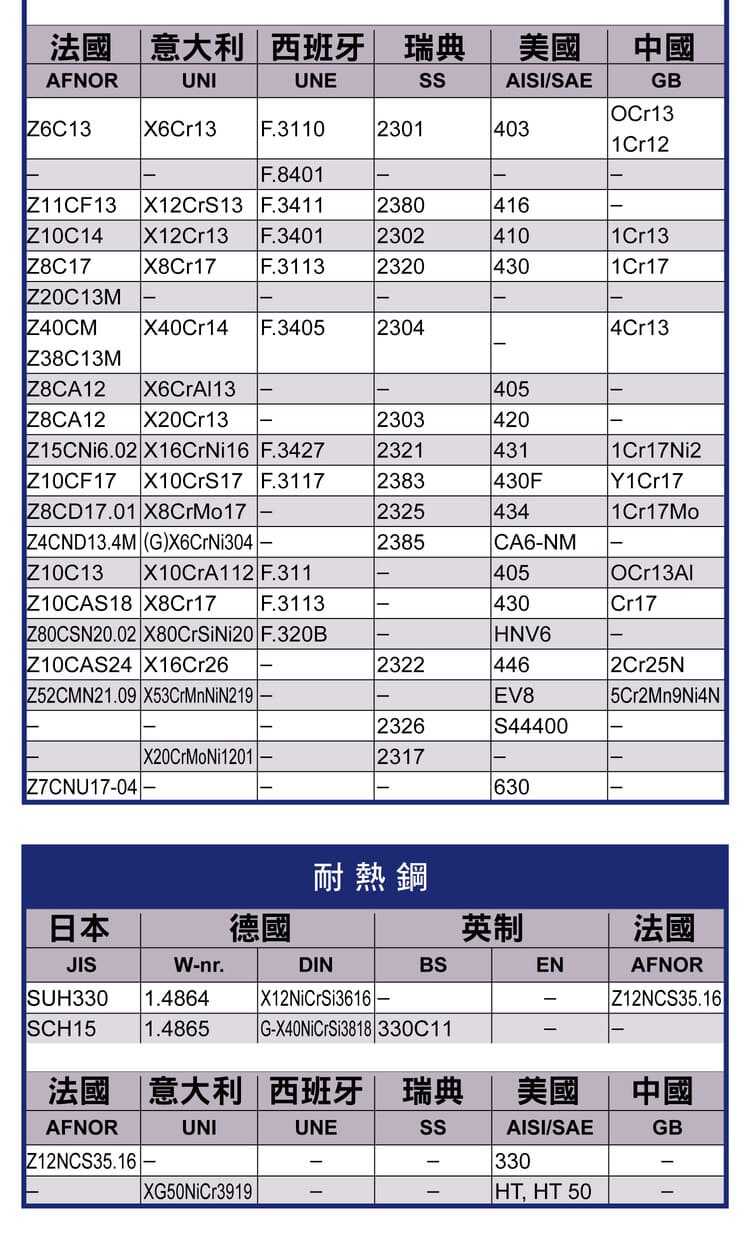
Stainless steel is expressed by different standards worldwide (JIS, DIN, AISI, EN…). This cross-reference maps ferritic, martensitic, austenitic and precipitation-hardening grades across countries, helping engineers compare specs, select materials and find substitutes—reducing purchasing errors and improving machining and design efficiency. For the material-group concept, see ISO Workpiece Material Classification.
Stainless Steel Types
| Item | Description |
|---|---|
| Ferritic (e.g. 430) | magnetic, moderate corrosion resistance, not hardenable; relatively easy to machine. |
| Martensitic (e.g. 410/420) | heat-treatable, high strength; easy annealed, abrasive when hardened. |
| Austenitic (e.g. 304/316) | excellent corrosion resistance and ductility, but work-hardens severely, gummy, low conductivity. |
| Precipitation-hardening (PH, e.g. 17-4PH/630) | high strength with corrosion resistance. |
| Heat-resistant (e.g. 310S, SUH) | high-temperature oxidation resistance. |
International Standard Systems
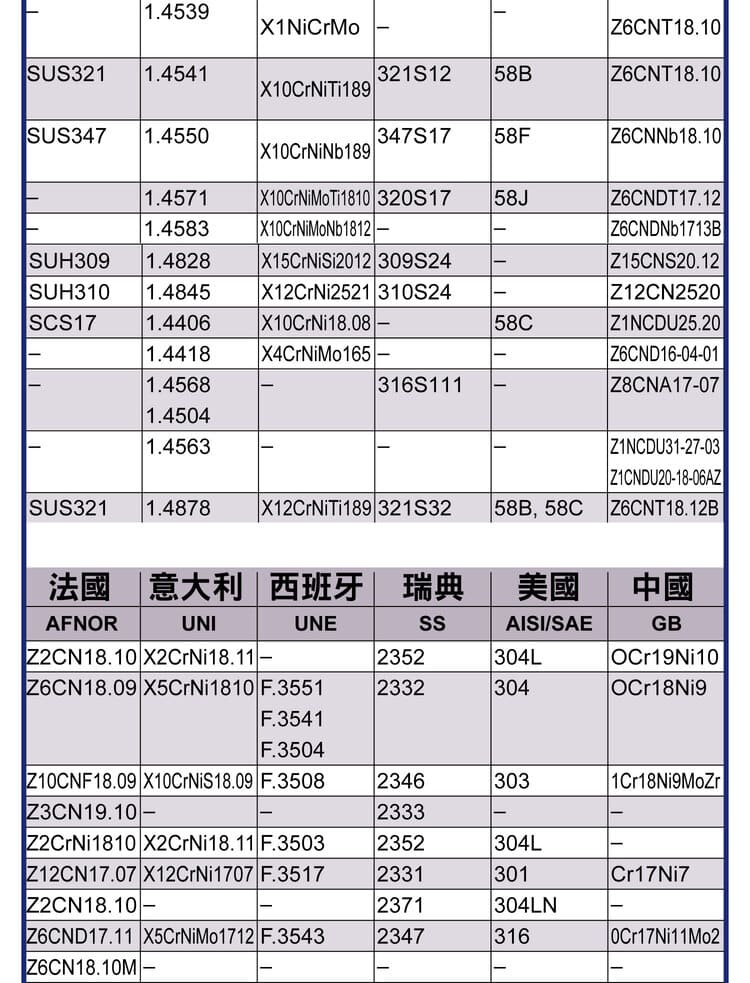
Japan JIS (SUS series), Germany DIN / W-nr., USA AISI / SAE, Europe EN, France AFNOR, China GB. Naming differs by country; chemistry and properties must be cross-checked.
Common Stainless Steel Cross-Reference
| Type | Japan JIS | USA AISI/SAE | Germany W-nr. (EN) | Characteristics | Machining notes |
|---|---|---|---|---|---|
| Austenitic | SUS304 | 304 | 1.4301 | General corrosion resistance, work-hardens | Sharp edge, ample coolant, no dwelling |
| Austenitic | SUS304L | 304L | 1.4307 | Low carbon, intergranular-corrosion resistant | As 304 |
| Austenitic | SUS316 | 316 | 1.4401 | Mo-bearing, better corrosion resistance | Wear-resistant tool, ample coolant |
| Austenitic | SUS316L | 316L | 1.4404 | Low carbon 316 | As 316 |
| Austenitic | SUS321 | 321 | 1.4541 | Ti-stabilized, heat-resistant | As austenitic |
| Austenitic (free-cut) | SUS303 | 303 | 1.4305 | Sulfur-bearing, free-machining | Best machinability |
| Martensitic | SUS410 | 410 | 1.4006 | Heat-treatable, moderate corrosion | Machine annealed; hardened → group H |
| Martensitic | SUS420 | 420 | 1.4021/1.4028 | High hardness (tool/mold grade) | Hardened → group H |
| Martensitic (free-cut) | SUS416 | 416 | 1.4005 | Sulfur-bearing, free-machining | Good machinability |
| Ferritic | SUS430 | 430 | 1.4016 | Magnetic, moderate corrosion, not hardenable | Relatively easy |
| PH | SUS630 | 17-4PH | 1.4542 | High strength with corrosion resistance | Work-hardens, wear-resistant tool |
| Heat-resistant | SUS310S | 310S | 1.4845 | High-temperature oxidation resistance | Low conductivity, hard to machine |
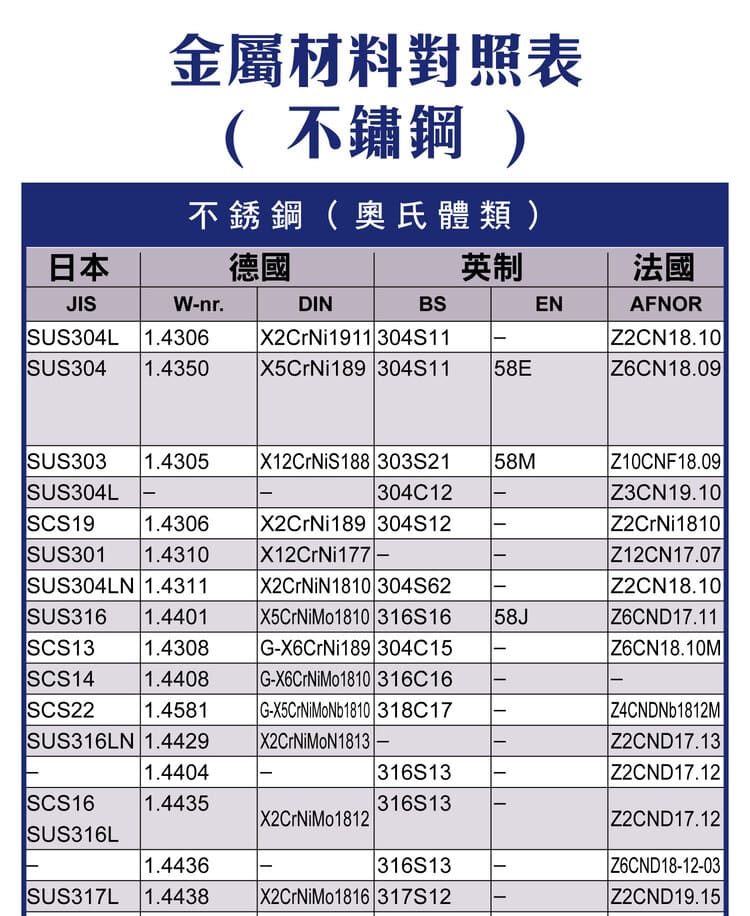
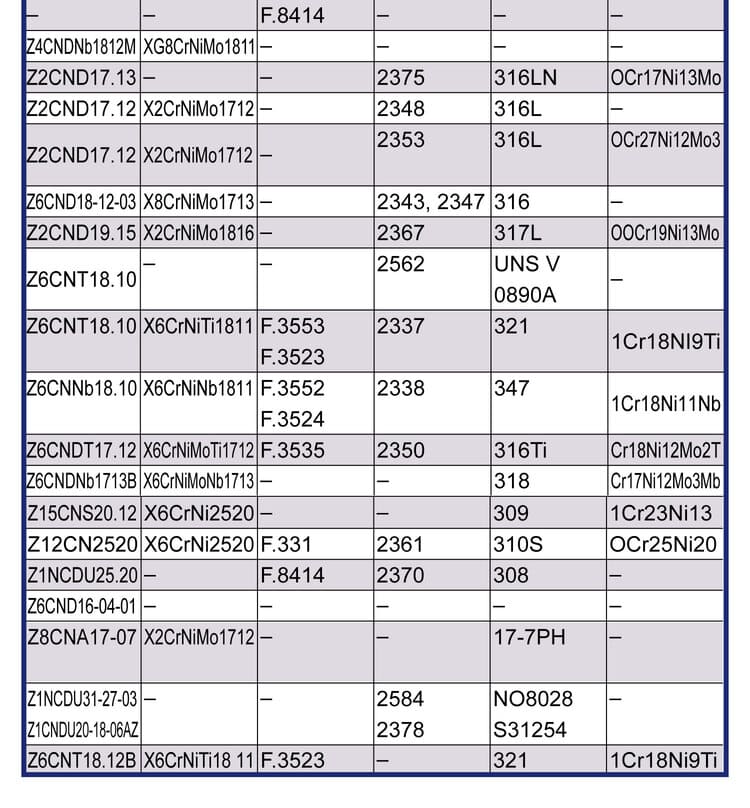
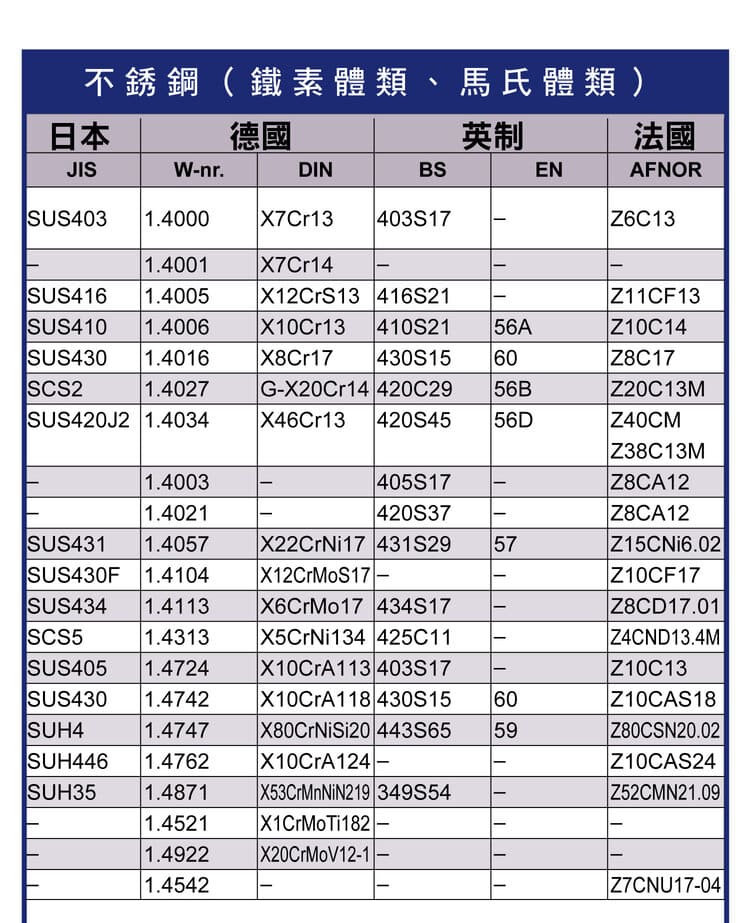
※ The table is an approximate common-grade cross-reference (W-nr. is the commonly used equivalent); the full multi-country mapping (BS/EN/AFNOR/UNI/UNE/SS/GB) is in the original images below. Verify chemistry and properties against national standards before use.
Machining & Selection
| Item | Description |
|---|---|
| Corrosion resistance | 304 / 316 series. |
| High strength | 410 / 420 (martensitic). |
| High temperature | 310S / SUH series. |
| Machinability | free-cutting 303, 416. |
Austenitic (304/316) work-hardens severely—use sharp edges, ample coolant, steady feed and avoid dwelling. For cutting speeds and feeds, see End Mill Cutting Conditions Guide.
Substitution Strategy
When substituting across standards: compare chemistry first, then mechanical properties, then machinability. A common error is matching only by name without confirming composition, or ignoring heat-treatment and hardness differences.
FAQ
Is SUS304 the same as AISI 304?
SUS304 (JIS) corresponds to AISI 304, W-nr. ≈ 1.4301. Compositions are broadly the same, but confirm ranges and properties against national standards.
What's the difference between 304 and 316?
316 adds molybdenum (Mo) for better corrosion resistance (especially chlorides), used in marine/chemical environments; both are austenitic and work-harden when machined.
Why is stainless hard to machine?
Austenitic stainless work-hardens severely, has low conductivity and is gummy. Use sharp edges, ample coolant, steady feed and avoid dwelling on the surface.
Which stainless machines most easily?
Sulfur-bearing free-cutting grades (303, 416) machine best, but corrosion resistance is slightly lower than 304—weigh corrosion needs when choosing.
This article is part of Workpiece Materials: The Complete Guide - Name the Metal First, Then Match the Tool; that guide shows how the whole topic fits together.
Published: 2026-03-25 | Last updated: 2026-08-08









